



New Comprehensive Geologic Map of the Moon Released
USGS Astrogeology training astronauts Meteor Crater
Close Up on Jezero Crater on Mars
Lunar Resources at Astrogeology
Learn about USGS Astrogeology's mission science in planetary critical minerals, energy, and resources
Learn about USGS Astrogeology's mission science in planetary critical minerals, energy, and resources
Astrogeology Science Center
Our mission is to serve the Nation, the international planetary science community, and the public in pursuit of new knowledge of our solar system. The USGS Astrogeology Science Center is a national resource for the integration of planetary geoscience, cartography, and remote sensing.


News
A True Halloween Story Treat: The dirt on Oppy’s demise!
A True Halloween Story Treat: The dirt on Oppy’s demise!
Happy International Moon Day!
Happy International Moon Day!
USGS Director Ned Mamula and Team Visit Flagstaff Science Campus, June 1–3: An Astrogeology Account
USGS Director Ned Mamula and Team Visit Flagstaff Science Campus, June 1–3: An Astrogeology Account
Publications
Phase evolution and elemental partitioning in impact melts from Meteor Crater, Arizona Phase evolution and elemental partitioning in impact melts from Meteor Crater, Arizona
The impact of the Canyon Diablo iron meteorite in Arizona ∼61,000 years ago resulted in partial vaporization of the meteorite and target rocks, producing a vapor plume and melt particles with taenite, olivine and clinopyroxene in glassy matrix. The resulting Meteor Crater is ∼1.2 km in diameter and ∼200 m deep. Although the crater has been the natural laboratory for impact cratering, the
Corundum discovered by SuperCam and the Perseverance rover at Jezero crater, Mars Corundum discovered by SuperCam and the Perseverance rover at Jezero crater, Mars
Mars is primarily composed of mafic mineral assemblages and their alteration products, but small, scattered rocks strewn across the landscape offer clues to greater petrological diversity. While traversing the Jezero crater rim, the Perseverance rover encountered several plagioclase-rich light-toned float rocks. SuperCam identified the distinctive signature of corundum (α-Al2O3) in these...
Subsurface water ice mapping on Mars: A probabilistic approach Subsurface water ice mapping on Mars: A probabilistic approach
Subsurface water ice deposits on Mars are an important resource for potential future human exploration. They are also an indicator of the planet’s past climate. However, the distribution of subsurface water ice in Mars’s midlatitudes is uncertain because spacecraft imagery cannot directly observe subsurface ice in most cases. Various spacecraft remote sensing instruments are sensitive to
Science
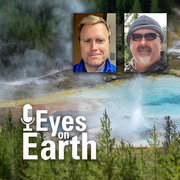
Eyes on Earth Episode 137 – Landsat Takes Yellowstone’s Temperature
How do you keep track of thousands of hot spots in an area the size of Yellowstone National Park? Check out thermal satellite data like Landsat’s!

Python Hyperspectral Analysis Tool (PyHAT)
The Python Hyperspectral Analysis Tool (PyHAT) provides access to data processing, analysis, and machine learning capabilities for spectroscopic applications. It includes a GUI so you can get straight to analyzing data without writing any code. Or, if you are comfortable writing code, PyHAT can be imported just like any other Python package.

Analysis Ready Data
Astrogeology is a world leader in developing and releasing analysis-ready planetary science data sets that are approachable and usable by anyone. We take care of all of the processing and provide data that "just work" so that users can focus on what interests them instead of getting stuck on data processing.