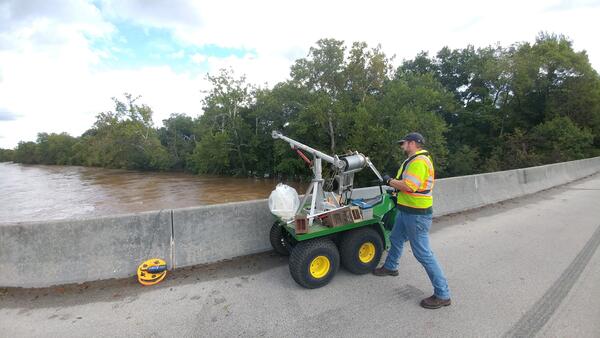
Difficult Run monitoring station in Great Falls, VA
Difficult Run monitoring station in Great Falls, VAThe stream gage at the Difficult Run Near Great Falls, VA monitoring station. This site is a part of the USGS Nontidal Network.
An official website of the United States government
Here's how you know
Official websites use .gov
A .gov website belongs to an official government organization in the United States.
Secure .gov websites use HTTPS
A lock () or https:// means you’ve safely connected to the .gov website. Share sensitive information only on official, secure websites.
Images from USGS Chesapeake Bay reports and field activities are available to visualize and help translate the science. They are available for your use, just please cite the USGS as the source of respective images.
The stream gage at the Difficult Run Near Great Falls, VA monitoring station. This site is a part of the USGS Nontidal Network.
A water quality sampling bottle used to collect samples from S F Quantico Creek Near Independent Hill, VA. This site is part of the USGS nontidal network.
A USGS hydrologist conducts horizontally-integrated synoptic water sampling of the James River at Cartersville as part of the USGS's nontidal network monitoring efforts.
The animation in the figure shows aerial imagery from Anne Arundel County, Maryland, collected by National Agricultural Imagery Program (NAIP), followed by 1-meter Chesapeake Bay Land Cover (13 classes) and Land Use/Land Cover (54 classes) data products.
Abstract:
An illustration of updated short-term nitrogen and phosphorous trends in the Chesapeake Bay
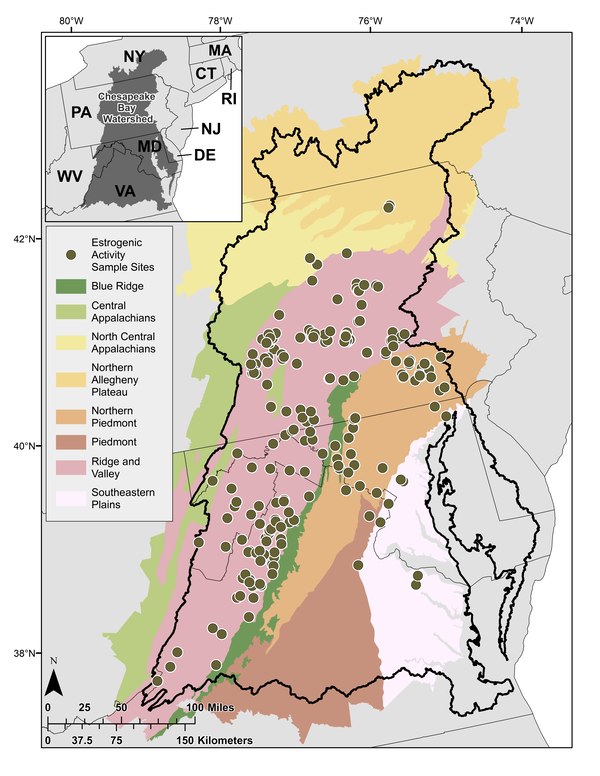
Surface water sampling locations (n = 244) in the Chesapeake Bay Watershed shown with EPA Level 3 Ecoregions.
Summary of long-term (1985-2021) and short-term (2012-2021) trends in nitrogen, phosphorus, and suspended-sediment loads for the River Input Monitoring stations. “Improving” or “Degrading” trends are classified as likelihood estimates greater than or equal to 67 percent, whereas “No trend” estimates are greater than 33 and less than 67 percent.
Impairments in Linganore Creek in Maryland (top) and Little Conestoga Creek in Pennsylvania (bottom) caused by altered geomorphology and high nutrients from sedimentation and agricultural runoff.
Jacob Mavrogeorge surveys in Lewers, Delaware.
Photo credit: Neel Hodgkinson/USGS Contractor
Jacob Mavrogeorge surveys in Lewers, Delaware.
Photo credit: Neel Hodgkinson/USGS Contractor
Collecting water quality samples from the New River Gorge in support of USGS-NPS partnership.
Fall 2022 Photo Contest Winner: Matt Kearns, USGS at Work category
Collecting water quality samples from the New River Gorge in support of USGS-NPS partnership.
Fall 2022 Photo Contest Winner: Matt Kearns, USGS at Work category
Forests in this area of Louisa County, Virginia were recently cleared for timber (brown) and for the development of solar fields (yellow).
New development (red, black, yellow) near the towns of Waldorf and La Plata in Charles County, Maryland from 2014-2018.
Forest harvested for timber (brown) in southwest Cumberland County, Virginia from 2014-2018.
Differential leveling techniques are performed by Alex Wong to determine reference-mark elevations at historic USGS streamgage, 01303000 Mill Neck Creek in Mill Neck, NY.
Summer 2022 Photo Contest Winner: Amy Simonson, Where We Work category
Differential leveling techniques are performed by Alex Wong to determine reference-mark elevations at historic USGS streamgage, 01303000 Mill Neck Creek in Mill Neck, NY.
Summer 2022 Photo Contest Winner: Amy Simonson, Where We Work category
USGS scientist Doug Moyer capturing an elevated stage (storm-impacted) water quality sample at the South Fork Shenandoah River near Lynnwood, VA.
Data for this monitoring site can be found at USGS Water Data for the Nation.
USGS scientist Doug Moyer capturing an elevated stage (storm-impacted) water quality sample at the South Fork Shenandoah River near Lynnwood, VA.
Data for this monitoring site can be found at USGS Water Data for the Nation.
Downstream side of the Conowingo (hydroelectric) Dam on the Susquehanna River in Conowingo, Maryland.
Summer 2022 Photo Contest: Nicholas Giro, Honorable Mention category
Downstream side of the Conowingo (hydroelectric) Dam on the Susquehanna River in Conowingo, Maryland.
Summer 2022 Photo Contest: Nicholas Giro, Honorable Mention category
Matt Burgess from the USGS National Uncrewed Systems Office pilots a drone over research ponds at the Eastern Ecological Science Center as part of a methods development campaign to examine how multiple types of remote sensors may be used to map and identify algae, including those that lead to Harmful Algal Blooms.
Annual and seasonal changes in plasma vitellogenin (Vtg) and hepatic vitellogenin (vtg) gene transcripts in A) female and B) male smallmouth bass. C) Prevalence and severity of testicular oocytes (TO) in male smallmouth bass.
Concentrations of three of the most detected pesticides (simazine, atrazine, and metolachlor) sampled near the confluence of Antietam Creek and the Potomac River in Dargan, Maryland, 2013-2019. Dots represent smallmouth bass sampling dates.
Land use (2016) in the immediate (insert) and upstream catchments around the smallmouth bass, Antietam Creek – Potomac Mainstem collection site near Dargan, Maryland.