Candling of grey catbird egg to determine viability
Candling of grey catbird egg to determine viabilityCandling (the process of using light to help determine the quality of an egg) of a grey catbird egg to determine viability.


Official websites use .gov
A .gov website belongs to an official government organization in the United States.

Secure .gov websites use HTTPS
A lock () or https:// means you’ve safely connected to the .gov website. Share sensitive information only on official, secure websites.

Eastern Ecological Science Center images.

Candling (the process of using light to help determine the quality of an egg) of a grey catbird egg to determine viability.
Candling (the process of using light to help determine the quality of an egg) of a grey catbird egg to determine viability.
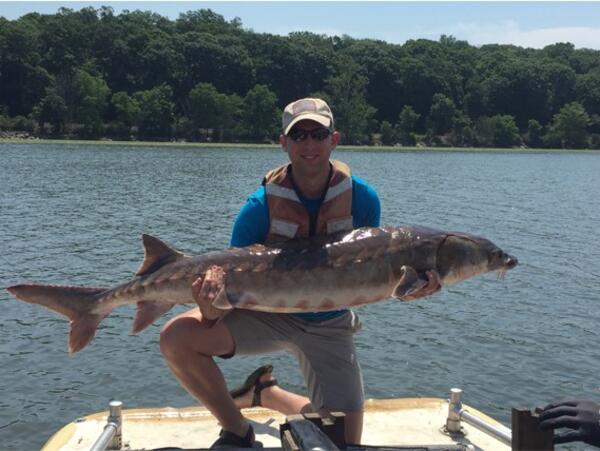
Dr. Dave Kazyak prepares to release an adult Atlantic Sturgeon prior to release as part of a collaborative research effort.
Dr. Dave Kazyak prepares to release an adult Atlantic Sturgeon prior to release as part of a collaborative research effort.
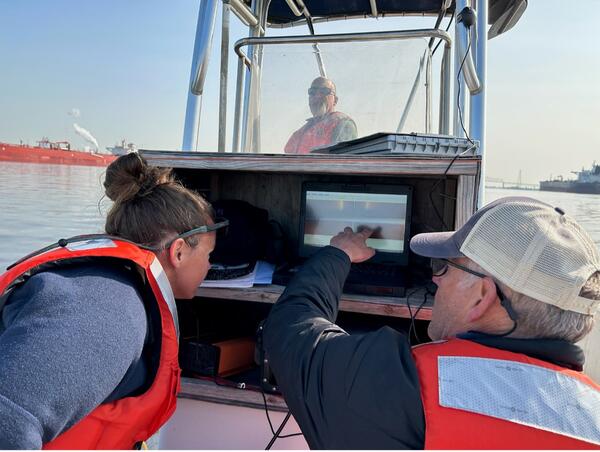
As part of a collaborative study, Dr. Shannon White (USGS EESC) works with partners from the University of Delaware and Delaware State University to count endangered Atlantic sturgeon in the Delaware River using side-scan sonar.
As part of a collaborative study, Dr. Shannon White (USGS EESC) works with partners from the University of Delaware and Delaware State University to count endangered Atlantic sturgeon in the Delaware River using side-scan sonar.

Long-tailed duck diving for underwater hearing testing in an experimental chamber in which the birds’ diving behavior can be studied under various environmental conditions.
Long-tailed duck diving for underwater hearing testing in an experimental chamber in which the birds’ diving behavior can be studied under various environmental conditions.
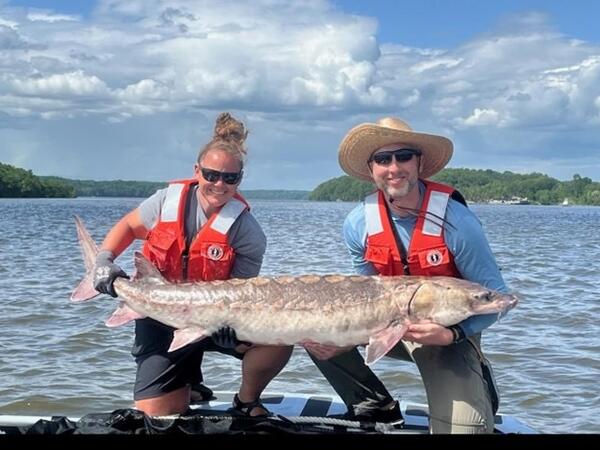
Dr. Shannon Smith and Dr. Dave Kazyak hold a large Atlantic sturgeon prior to release in the Hudson River.
Dr. Shannon Smith and Dr. Dave Kazyak hold a large Atlantic sturgeon prior to release in the Hudson River.
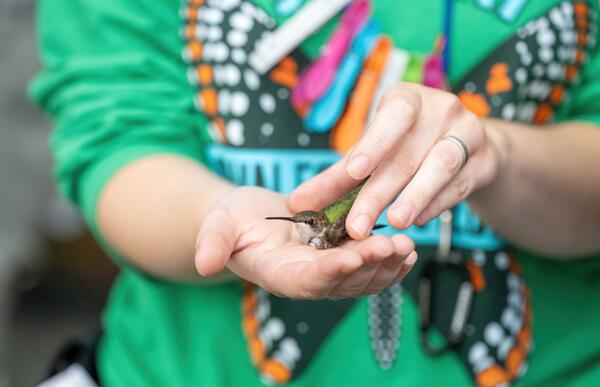
A bird biologist holds a ruby-throated hummingbird in the hand.
A bird biologist holds a ruby-throated hummingbird in the hand.
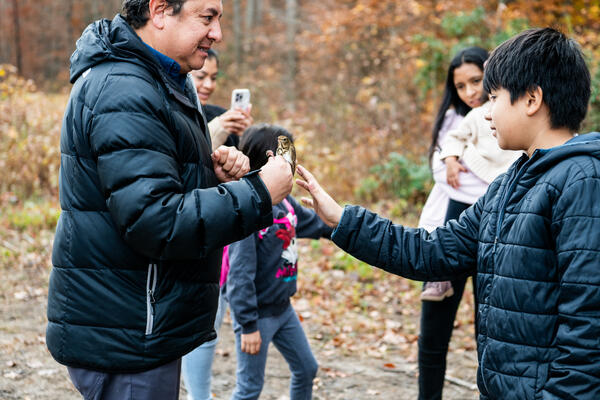
Bird Banding Chief Tony Celis shows a small banded bird to a young member of the Paterson Audubon Society during a visit to the Fall Banding Station.
Bird Banding Chief Tony Celis shows a small banded bird to a young member of the Paterson Audubon Society during a visit to the Fall Banding Station.

Brennan and Emily collect and transfer salmon plasma to assess for PFAS
Brennan and Emily collect and transfer salmon plasma to assess for PFAS

Dr. John Davidson (right) provides instruction on salmon internal anatomy.
Dr. John Davidson (right) provides instruction on salmon internal anatomy.

Brennan and Emily conducting fish habitat surveys in Catoctin Mountain Park.
Brennan and Emily conducting fish habitat surveys in Catoctin Mountain Park.

Brennan and Emily assess habitat in a spillway plunge pool
Brennan and Emily assess habitat in a spillway plunge pool

AFS Hutton Scholars Brennan Landerkin (left) and Emily Hunt (right) observing a tank of Atlantic Salmon (Salmo salar) at the Conservation Fund’s Freshwater Institute.
AFS Hutton Scholars Brennan Landerkin (left) and Emily Hunt (right) observing a tank of Atlantic Salmon (Salmo salar) at the Conservation Fund’s Freshwater Institute.

Picture of supervisory research fish biologist, David Kazyak in the field.
Picture of supervisory research fish biologist, David Kazyak in the field.

The House Finch pictured was quite the surprise at the BBL's Fall Migration Station at Patuxent Research Refuge in 2023. Despite being common feeder birds in Maryland, this is only the second House Finch banded at the Migration Station since the 1990s!
The House Finch pictured was quite the surprise at the BBL's Fall Migration Station at Patuxent Research Refuge in 2023. Despite being common feeder birds in Maryland, this is only the second House Finch banded at the Migration Station since the 1990s!
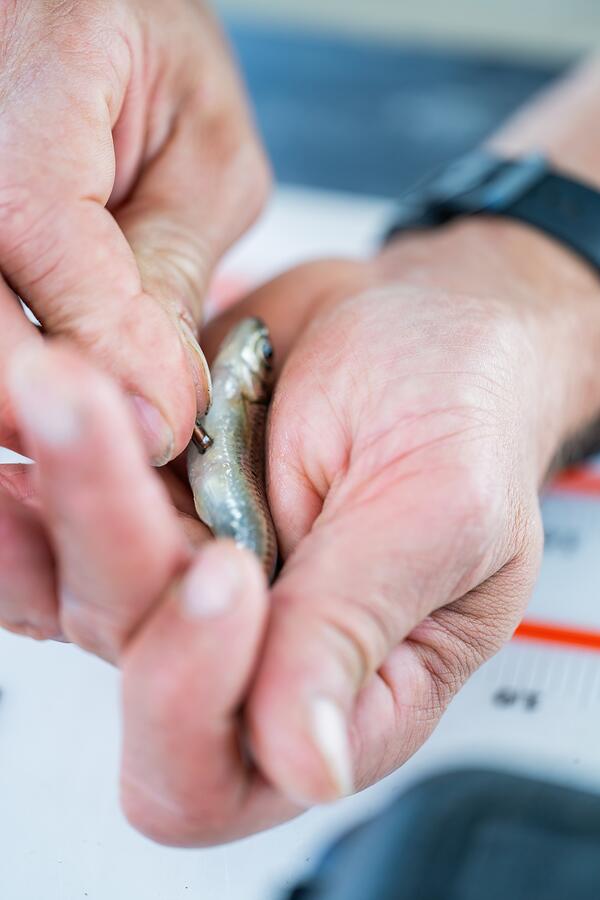
Ted Castro-Santos of the S.O. Conte Research Laboratory implants a small pit tag into a juvenile American shad before release it into the canal at Turners Falls, MA.
Ted Castro-Santos of the S.O. Conte Research Laboratory implants a small pit tag into a juvenile American shad before release it into the canal at Turners Falls, MA.
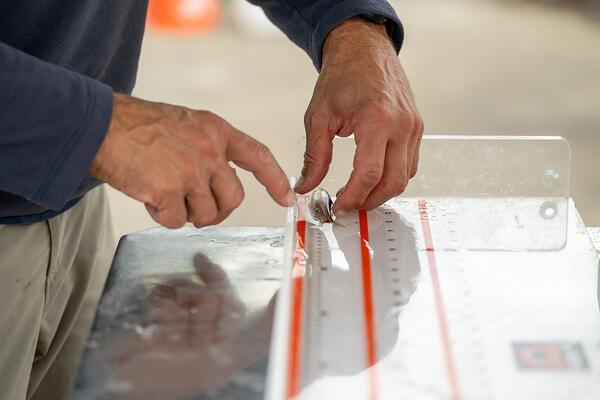
Ted-Castro Santos of the S.O. Conte Research Laboratory measures a juvenile American shad before tagging and releasing it into the Canal at Turners Falls, MA.
Ted-Castro Santos of the S.O. Conte Research Laboratory measures a juvenile American shad before tagging and releasing it into the Canal at Turners Falls, MA.

A biologist gently extends the wing of a Blue-headed Vireo to look for clues on how old the bird is. During fall migration, scientists can generally determine if a bird was hatched during the current year or if the bird is older. They do this by looking at the general wear of the feathers, and if the bird has retained any of their plumage as a nestling.
A biologist gently extends the wing of a Blue-headed Vireo to look for clues on how old the bird is. During fall migration, scientists can generally determine if a bird was hatched during the current year or if the bird is older. They do this by looking at the general wear of the feathers, and if the bird has retained any of their plumage as a nestling.

Field Sparrows, like the one pictured, are one of 15 different sparrow species that have been banded at the BBL's Fall Migration Station.
Field Sparrows, like the one pictured, are one of 15 different sparrow species that have been banded at the BBL's Fall Migration Station.

Fish Biologist Micah Kieffer holds a shortnose sturgeon during a public outreach event at EESC's S.O. Conte Research Lab in Turners Falls, MA.
Fish Biologist Micah Kieffer holds a shortnose sturgeon during a public outreach event at EESC's S.O. Conte Research Lab in Turners Falls, MA.

Ted Castro-Santos, EESC, and Katie Deters, PNNL, release tagged American Shad in the canal at the Conte Lab
Ted Castro-Santos, EESC, and Katie Deters, PNNL, release tagged American Shad in the canal at the Conte Lab

David Walters measuring surface elevation table that is used to assess changes in wetland surface (accretion and/or erosion) at Money Stump in Blackwater National Wildlife Refuge in Cambridge, Maryland.
Winter 2024 Photo Contest: Melinda Martinez, Honorable Mention category
David Walters measuring surface elevation table that is used to assess changes in wetland surface (accretion and/or erosion) at Money Stump in Blackwater National Wildlife Refuge in Cambridge, Maryland.
Winter 2024 Photo Contest: Melinda Martinez, Honorable Mention category