



Ted Castro-Santos, EESC, and Katie Deters, PNNL, release tagged American Shad in the canal at the Conte Lab
Images
Eastern Ecological Science Center images.
Filter Total Items: 5139

American Shad Release at Conte Lab
Ted Castro-Santos, EESC, and Katie Deters, PNNL, release tagged American Shad in the canal at the Conte Lab

EESC Microplate Reader
a view of a laptop computer connected to 2 monitors and a microplate reader. The monitors display data generated from an assay including a standard curve.
a view of a laptop computer connected to 2 monitors and a microplate reader. The monitors display data generated from an assay including a standard curve.

Winter Wren
At the Bird Banding Lab's Fall Migration Station, Winter Wrens are one of the smallest species they band. They have the smallest tail measurement at the station, between 26-36 millimeters!
At the Bird Banding Lab's Fall Migration Station, Winter Wrens are one of the smallest species they band. They have the smallest tail measurement at the station, between 26-36 millimeters!

Biologist Holding Eastern Box Turtle
A female biologist holds an Eastern box turtle in her hand as gets ready to process it as part of a survey.
A female biologist holds an Eastern box turtle in her hand as gets ready to process it as part of a survey.

Processing an Eastern Box Turtle
A female biologist records data taken from an Eastern box turtle survey event
A female biologist records data taken from an Eastern box turtle survey event

Biologist and Eastern Box Turtle
Biologist Sofia Galvan demonstrates how to identify the gender of an Eastern Box Turtle.
Biologist Sofia Galvan demonstrates how to identify the gender of an Eastern Box Turtle.

Measuring an Eastern Box Turtle
A female biologist holds an Eastern box turtle and measures its shell as part of a survey.
A female biologist holds an Eastern box turtle and measures its shell as part of a survey.

Eastern Box Turtle
An Eastern box turtle in the leaves in the woods of Patuxent.
An Eastern box turtle in the leaves in the woods of Patuxent.

Eastern Box Turtle
An Eastern Box turtle with vibrant orange skin is caught as part of the Patuxent Box Turtle Survey.
An Eastern Box turtle with vibrant orange skin is caught as part of the Patuxent Box Turtle Survey.

New shed at the Bird Banding Station
A large shed is part of the new bird banding station. It will serve as a more private place for banding and storage.
A large shed is part of the new bird banding station. It will serve as a more private place for banding and storage.

Northern Parulas
A comparison of two hatch year (born this year) Northern Parulas. The individual on the left is a male, while a female is on the right, note the color differences including the band of chestnut on the males chest.
A comparison of two hatch year (born this year) Northern Parulas. The individual on the left is a male, while a female is on the right, note the color differences including the band of chestnut on the males chest.

Wilson's Warbler
Bird Bander reviewing the "Identification Guide to North American Birds" by Peter Pyle, to see if this Wilson's Warbler's black crown gives any indication of its age.
Bird Bander reviewing the "Identification Guide to North American Birds" by Peter Pyle, to see if this Wilson's Warbler's black crown gives any indication of its age.

Yellow Warbler
The BBL's Fall Migration Station's second banded Yellow Warbler in the last 10 years!
The BBL's Fall Migration Station's second banded Yellow Warbler in the last 10 years!

Yellow-throated Vireo
The Yellow-throated Vireo is an uncommon visitor to the BBL's Fall Migration Station - this is the first one since 2016!
The Yellow-throated Vireo is an uncommon visitor to the BBL's Fall Migration Station - this is the first one since 2016!

Benjamin P Gressler
Ben is a biologist at the Eastern Ecological Science Center in Kearneysville, West Virginia
Ben is a biologist at the Eastern Ecological Science Center in Kearneysville, West Virginia
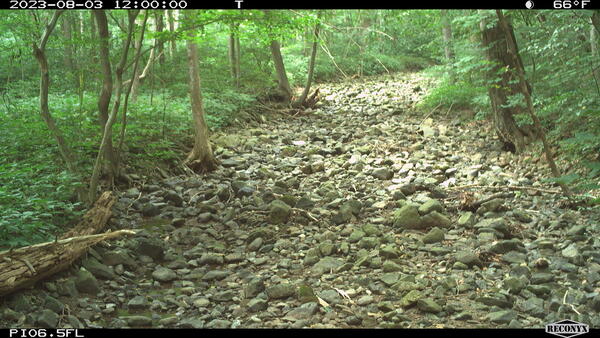
PI_06.5 Dry streambed
A still image taken from a USGS Flow Photo Explorer camera (Pl_06.5) shows drying in a small stream in Shenandoah National Park.
A still image taken from a USGS Flow Photo Explorer camera (Pl_06.5) shows drying in a small stream in Shenandoah National Park.

Larval Two-Lined Salamander
This is a newly hatched two-lined salamander (Eurycea bislineata). Two-lined salamanders are a stream-adapted species, which means that the larvae are fully aquatic and live in streams.
This is a newly hatched two-lined salamander (Eurycea bislineata). Two-lined salamanders are a stream-adapted species, which means that the larvae are fully aquatic and live in streams.

USGS Scientist retrieving seawater from a Niskin bottle
USGS Scientist retrieving seawater from a Niskin bottleUSGS Scientist, Alexis Weinnig, working aboard the NOAA ship Okeanos Explorer to sample seawater with a niskin water bottle mounted on the back of the remotely operated vehicle (ROV). The water from the niskin bottles is filtered for eDNA to detect biological life in the water column.
USGS Scientist retrieving seawater from a Niskin bottle
USGS Scientist retrieving seawater from a Niskin bottleUSGS Scientist, Alexis Weinnig, working aboard the NOAA ship Okeanos Explorer to sample seawater with a niskin water bottle mounted on the back of the remotely operated vehicle (ROV). The water from the niskin bottles is filtered for eDNA to detect biological life in the water column.

Return of remotely operated vehicle after dive in Gulf of America
Return of remotely operated vehicle after dive in Gulf of AmericaThe Mohawk Remotely Operated Vehicle (ROV) returns to the NOAA Ship Pisces after a successful dive to survey benthic habitats in the Gulf of America
Return of remotely operated vehicle after dive in Gulf of America
Return of remotely operated vehicle after dive in Gulf of AmericaThe Mohawk Remotely Operated Vehicle (ROV) returns to the NOAA Ship Pisces after a successful dive to survey benthic habitats in the Gulf of America

Sunset recovery of remotely operated vehicle
After exploring benthic communities in the deep Gulf of America, the remotely operated vehicle Mohawk (UNCW-Undersea Vehicles Program) is lifted back onto the NOAA Ship Pisces
After exploring benthic communities in the deep Gulf of America, the remotely operated vehicle Mohawk (UNCW-Undersea Vehicles Program) is lifted back onto the NOAA Ship Pisces
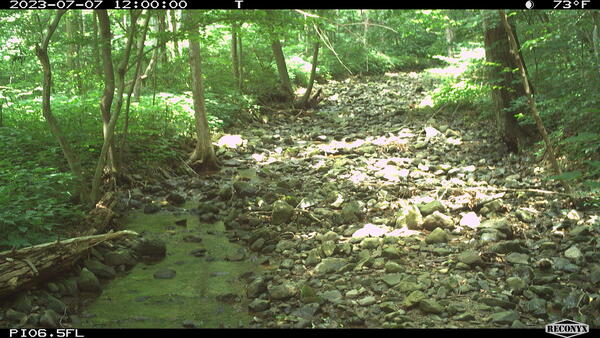
PI_06.5 Isolated pools
A still image taken from a USGS Flow Photo Explorer camera (Pl_06.5) shows isolated pools in a small stream in Shenandoah National Park.
A still image taken from a USGS Flow Photo Explorer camera (Pl_06.5) shows isolated pools in a small stream in Shenandoah National Park.