



Fish and Aquatic Species Conservation
Fish and Aquatic Species Conservation
At the Eastern Ecological Science Center (EESC), we strive to provide world-class science to inform natural resource decisions that preserve and enhance our quality of life.
Filter Total Items: 90

Warm Freshwater Ecosystems
These systems are characterized as 4th order and larger nontidal riverine systems, which includes many of the intermediate and larger size rivers, such as the Penobscot, Connecticut, Hudson, Delaware, and Susquehanna Rivers and their larger tributaries of the northeastern U.S. Fish passage, thermal stress, and ecological flows are likely important issues in these systems. Fish health issues and...

Disease and Environmental Stress
Disease may be caused by infectious agents, nutritional imbalances, physiological or genetically-based abnormalities, and suboptimal environmental conditions, acting either alone or in combination with other factors. In many instances, environmental stressors may merge forces with an infectious agent or some other non-infectious factor to produce or exacerbate a state of disease. By studying...

Freshwater Mussel Physiology
Freshwater mussels are considered ecosystems engineers benefiting the streams and rivers they inhabit through filtration, biodeposition, and nutrient cycling, thereby influencing water quality. However, many of these species are rapidly declining due to shifting environmental conditions and habitat loss. Researchers at Eastern Ecological Science Center are evaluating how different species of...

Fish Passage
A major focus of USGS Eastern Ecological Science Center's S.O. Conte Research Laboratory in Turners Falls, MA is the design and evaluation of state-of the-art upstream and downstream fish passage structures for hydropower facilities of different sizes and locations and for different fish species, including endangered sturgeons and Atlantic salmon. Performance, physiology, behavior and energetics...

Fish Physiology
Physiological demands are especially important to anadromous fish because of their need to move between freshwater and seawater and to make long, often difficult migrations.

Fish Behavior
Recent discoveries of the extent of sturgeon movement in the Gulf of Maine combined with relicensing and water use issues in the Connecticut River demand closer evaluation of shortnose and Atlantic sturgeon migration and behavior patterns.

The West Brook Story
Natural systems, like rivers and streams, are remarkably complex, with many interacting parts. Data visualization tools make understanding and communicating complex ecological processes easier. Effective visualizations help users learn about patterns in data and how models work. Interactive visualizations are particularly useful, as they let users explore data and develop a personal understanding...

Fish Ecology
Our goal is to identify the factors that govern population dynamics.

Fish Biomechanics
Biomechanics is the study of mechanical laws relating to the movement of living organisms.

Stream salamanders in Shenandoah National Park: Movement and survival of stream salamander populations
Research in population biology is concerned with factors affecting the change in a population over time, including births, deaths, immigration and emigration. Despite the potential importance of immigration and emigration, empirical data on movement patterns are lacking in many systems.

Making Decisions for Headwater Stream Conservation at the Watershed Scale
There is growing evidence that headwater stream ecosystems are especially vulnerable to changing climate and land use, but their conservation is challenged by the need to address the threats at a landscape scale, often through coordination with multiple management agencies and landowners.

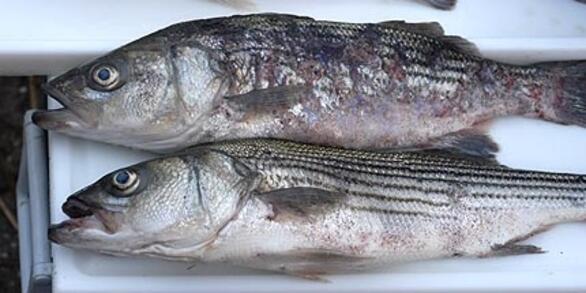
Striped bass with mycobacteriosis
Striped bass ( Morone saxatilis) displaying ulcerative skin lesions and chronic wasting, both typical clinical signs of mycobacteriosis, a bacterial disease that is problematic among many types of fishes around the world.