A Saildrone Explorer being towed on Lake Erie at the beginning of a mission to collect data to improve fishery surveys in July 2023.
Images
Images captured by GLSC scientists while working in and around the Great Lakes.
A Saildrone Explorer being towed on Lake Erie at the beginning of a mission to collect data to improve fishery surveys in July 2023.
Sauble Falls in Sauble Falls Provincial Park, Ontario, Canada. Photo credit: Alden Tilley, USGS.
Little Dunks Bay, Lake Huron, at the tip of the Bruce Peninsula in Ontario, Canada. Photo credit: Alden Tilley, USGS.
A map of Lake Erie that includes the rough dates of operation of autonomous and crewed vehicles by USGS, Saildrone, Monterey Bay Aquarium Research Institute (MBARI), and State and Ontario partners throughout Lake Erie during summer 2023.
A USGS field crew (GLSC; Ann Arbor, Michigan) on an excursion in Metzger Marsh on Lake Erie to monitor invasive Phragmites australis. Photo credit: Kaira Liggett, USGS Contractor.
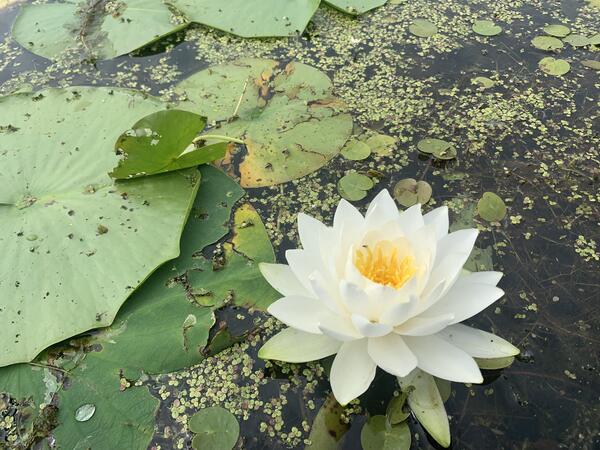
A water lily (Nymphaea) in full bloom surrounded by European frog-bit (Hydrocharis morsus-ranae), and Duckweed (Lemnaceae) in Mezger Marsh, part of the Ottawa National Wildlife Refuge on Lake Erie in Ohio. Photo credit: Kaira Liggett, USGS Contractor.
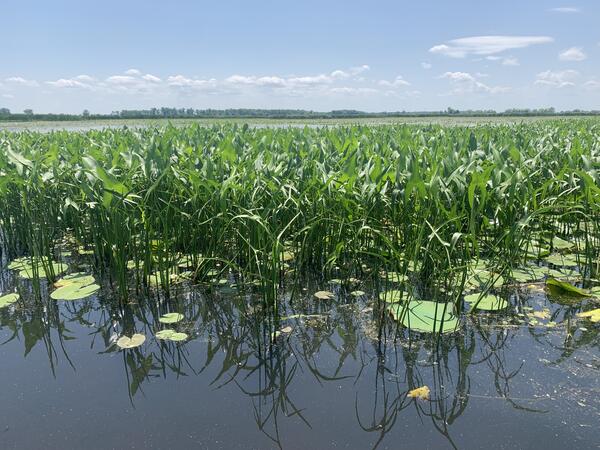
Aquatic vegetation, including arrowhead (Sagittaria), water lily (Nymphaea), lotus (Nelumbo) and European frog-bit (Hydrocharis morsus-ranae), photographed in Metzger Marsh, part of the Ottawa National Wildlife Refuge on Lake Erie in Ohio. Photo credit: Kaira Liggett, USGS Contractor.
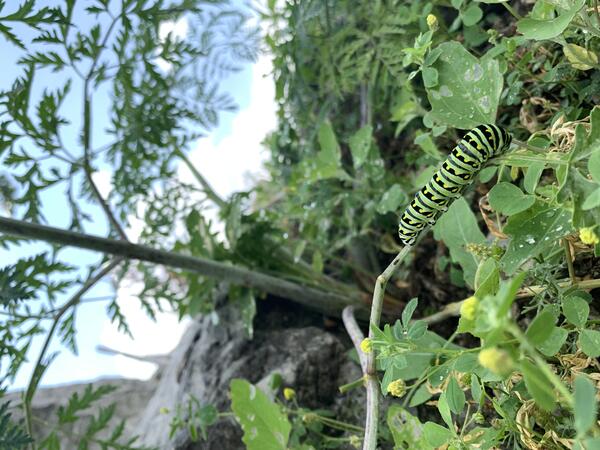
A black swallowtail caterpillar (Papilio polyxenes) feeding on vegetation at the Metzger Marsh boat launch, part of the Ottawa National Wildlife Refuge on Lake Erie in Ohio. Photo credit: Kaira Liggett, USGS Contractor.
USGS lab personnel (GLSC; Chesterton, Indiana) holding benthic sample processing trays; each team member works on a different part of the process. Photo credit: Kasia Przybyla-Kelly, USGS.
The R/V Sculpin II departing the Leland harbor for a day on Lake Michigan tending acoustic telemetry fish-tracking arrays. Photo credit: Greg Kennedy, USGS.
Retrieval of a submerged acoustic telemetry receiver by USGS biological science technicians (GLSC; Ann Arbor, Michigan) from offshore waters of Lake Michigan, using a grapnel drag to hook a 'snag' line attached to the mooring. Photo credit: Greg Kennedy, USGS.
Age-1 coregonine fish caught in a trawl at Jackfish Bay, Lake Superior in June 2023 aboard the R/V Kiyi (GLSC; Ashland, Wisconsin). Photo credit: Lori Evrard, USGS.
A bottom trawl being deployed by USGS biological science technicians (GLSC; Huron, Ohio) aboard the GLSC’s R/V Muskie. Photo credit: Kevin Keretz, USGS.
An evening view of Whitefish Bay shoreline, Lake Superior, Ontario, Canada looking south from Pancake Bay. Photo credit: Lori Evrard, USGS.
A waterfall flowing into Lake Superior along Pictured Rocks National Lakeshore. Photo credit: Alden Tilley, USGS.
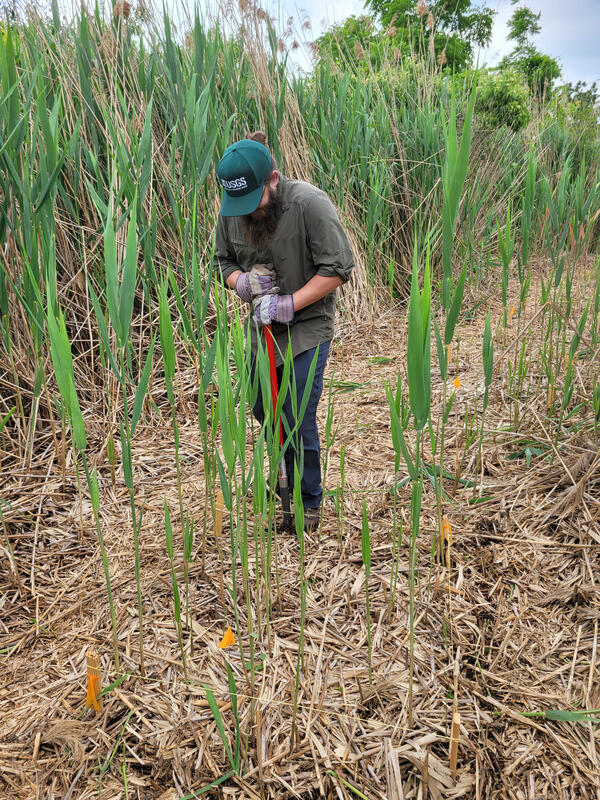
USGS wetland scientist (GLSC; Ann Arbor, Michigan) uses a root spade to severe below-ground connections to an experimental plot as part of a larger invasive Phragmites australis control experiment. Photo credit: Margaret Kimpling, USGS Contractor.
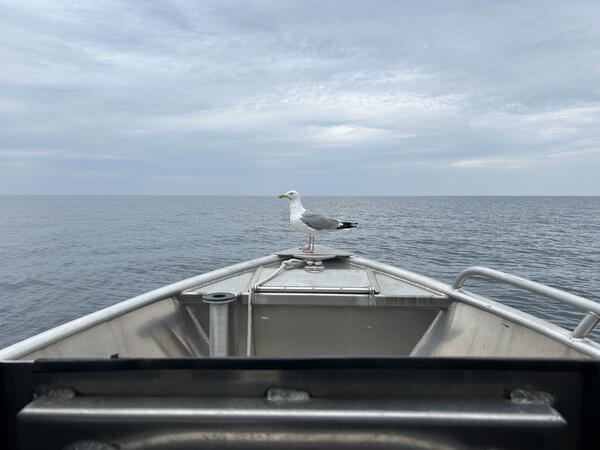
A gull riding the bow of the R/V Desmid in Lake Huron. Photo credit: Nick Yeager, USGS.
USGS divers (GLSC; Ann Arbor, Michigan) take close-up photos and videos of sampling locations before collecting samples, such as this example taken three meters below the surface in Lake Ontario that is full of Cladophora growing on rocks. Photo credit: Megan Lewan, USGS.
A USGS diver (GLSC; Ann Arbor, Michigan) records information on her dive slate before collecting a benthic sample of submerged aquatic vegetation and invasive dreissenid mussels. Photo credit: Megan Lewan, USGS.
Clutches of eggs in a vernal pool on Outer Island of the Apostle Islands National Lakeshore. Photo credit: Nick Yeager, USGS.
The bottom of Lake Huron as seen by USGS divers (GLSC; Chesterton, Indiana) six meters below the surface. Photo credit: Madeleine Giordano, USGS.