



Publications
Scientific reports, journal articles, and information products produced by USGS Pacific Coastal and Marine Science Center scientists.
USGS Pubs Warehouse
USGS Pubs Warehouse

Browse the USGS Publications Warehouse to broaden your search with enhanced filtering.
Sound Waves Newsletter
Sound Waves Newsletter
Browse issues of the Sound Waves newsletter, featuring coastal and marine research news from across the USGS.
Filter Total Items: 1466
Wave dynamics and flooding on low-lying tropical reef-lined coasts Wave dynamics and flooding on low-lying tropical reef-lined coasts
Many tropical islands and coasts are lined with coral reefs. These reefs are host to valuable ecosystems that support abundant marine species and provide resources for fisheries and recreation. As a flood defense, reefs protect coastlines from coastal storm damage and flooding by reducing the majority of incident wave energy. However, during storm and large swell conditions, coastal wave...
Authors
Ap van Dongeran, Curt D. Storlazzi, Ellen Quataert, Stuart Pearson
Rigorously valuing the role of coral reefs in coastal protection: An example from Maui, Hawaii, U.S.A. Rigorously valuing the role of coral reefs in coastal protection: An example from Maui, Hawaii, U.S.A.
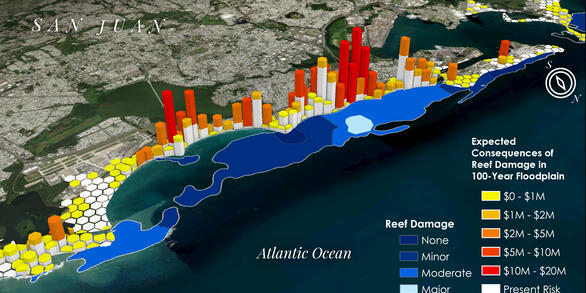
The degradation of coastal habitats, particularly coral reefs, raises risks by exposing communities to flooding hazards. The protective services of these natural defenses are not assessed in the same rigorous, economic terms as artificial defenses such as seawalls, and therefore often not considered in decision-making. Here we present a new methodology that combines economic, ecological...
Authors
Curt D. Storlazzi, Borja G. Reguero, Erik Lowe, James B. Shope, Ann E. Gibbs, Mike Beck, Barry A. Nickel
Description of gravity cores from San Pablo Bay and Carquinez Strait, San Francisco Bay, California Description of gravity cores from San Pablo Bay and Carquinez Strait, San Francisco Bay, California
Seventy-two gravity cores were collected by the U.S. Geological Survey in 1990, 1991, and 2000 from San Pablo Bay and Carquinez Strait, California. The gravity cores collected within San Pablo Bay contain bioturbated laminated silts and sandy clays, whole and broken bivalve shells (mostly mussels), fossil tube structures, and fine-grained plant or wood fragments. Gravity cores from the...
Authors
Donald L. Woodrow, John L. Chin, Florence L. Wong, Theresa A. Fregoso, Bruce E. Jaffe
Reducing risk where tectonic plates collide—U.S. Geological Survey subduction zone science plan Reducing risk where tectonic plates collide—U.S. Geological Survey subduction zone science plan
The U.S. Geological Survey (USGS) serves the Nation by providing reliable scientific information and tools to build resilience in communities exposed to subduction zone earthquakes, tsunamis, landslides, and volcanic eruptions. Improving the application of USGS science to successfully reduce risk from these events relies on whole community efforts, with continuing partnerships among...
Authors
Joan S. Gomberg, K. A. Ludwig, Barbara Bekins, Thomas M. Brocher, John Brock, Daniel S. Brothers, Jason D. Chaytor, Arthur D. Frankel, Eric L. Geist, Matthew M. Haney, Stephen H. Hickman, William S. Leith, Evelyn A. Roeloffs, William H. Schulz, Thomas W. Sisson, Kristi L. Wallace, Janet Watt, Anne M. Wein
Reducing risk where tectonic plates collide Reducing risk where tectonic plates collide
Most of the world’s earthquakes, tsunamis, landslides, and volcanic eruptions are caused by the continuous motions of the many tectonic plates that make up the Earth’s outer shell. The most powerful of these natural hazards occur in subduction zones, where two plates collide and one is thrust beneath another. The U.S. Geological Survey’s (USGS) “Reducing Risk Where Tectonic Plates...
Authors
Joan S. Gomberg, K. A. Ludwig
A new seamless, high-resolution digital elevation model of the San Francisco Bay-Delta Estuary, California A new seamless, high-resolution digital elevation model of the San Francisco Bay-Delta Estuary, California
Climate change, sea-level rise, and human development have contributed to the changing geomorphology of the San Francisco Bay - Delta (Bay-Delta) Estuary system. The need to predict scenarios of change led to the development of a new seamless, high-resolution digital elevation model (DEM) of the Bay – Delta that can be used by modelers attempting to understand potential future changes to...
Authors
Theresa A. Fregoso, Rueen-Fang Wang, Eli Ateljevich, Bruce E. Jaffe
Marine ferromanganese encrustations: Archives of changing oceans Marine ferromanganese encrustations: Archives of changing oceans
Marine iron–manganese oxide coatings occur in many shallow and deep-water areas of the global ocean and can form in three ways: 1) Fe–Mn crusts can precipitate from seawater onto rocks on seamounts; 2) Fe–Mn nodules can form on the sediment surface around a nucleus by diagenetic processes in sediment pore water; 3) encrustations can precipitate from hydrothermal fluids. These oxide...
Authors
Andrea Koschinsky, James R. Hein
Coastal circulation and water-column properties in the National Park of American Samoa, February–July 2015 Coastal circulation and water-column properties in the National Park of American Samoa, February–July 2015
There is little information on the oceanography in the National Park of American Samoa (NPSA). The transport pathways for potentially harmful constituents of land-derived runoff, as well as larvae and other planktonic organisms, are driven by nearshore circulation patterns. To evaluate the processes affecting coral reef ecosystem health, it is first necessary to understand the...
Authors
Curt D. Storlazzi, Olivia Cheriton, Kurt J. Rosenberger, Joshua B. Logan, Timothy B. Clark
Doubling of coastal flooding frequency within decades due to sea-level rise Doubling of coastal flooding frequency within decades due to sea-level rise
Global climate change drives sea-level rise, increasing the frequency of coastal flooding. In most coastal regions, the amount of sea-level rise occurring over years to decades is significantly smaller than normal ocean-level fluctuations caused by tides, waves, and storm surge. However, even gradual sea-level rise can rapidly increase the frequency and severity of coastal flooding. So...
Authors
Sean Vitousek, Patrick L. Barnard, Charles H. Fletcher, Neil Frazer, Li H. Erikson, Curt D. Storlazzi
Can beaches survive climate change? Can beaches survive climate change?
Anthropogenic climate change is driving sea level rise, leading to numerous impacts on the coastal zone, such as increased coastal flooding, beach erosion, cliff failure, saltwater intrusion in aquifers, and groundwater inundation. Many beaches around the world are currently experiencing chronic erosion as a result of gradual, present-day rates of sea level rise (about 3 mm/year) and...
Authors
Sean Vitousek, Patrick L. Barnard, Patrick W. Limber
Formation of Fe-Mn crusts within a continental margin environment Formation of Fe-Mn crusts within a continental margin environment
This study examines Fe-Mn crusts that form on seamounts along the California continental-margin (CCM), within the United States 200 nautical mile exclusive economic zone. The study area extends from approximately 30° to 38° North latitudes and from 117° to 126° West longitudes. The area of study is a tectonically active northeast Pacific plate boundary region and is also part of the...
Authors
Tracey A. Conrad, James R. Hein, Adina Paytan, David A. Clague
Oregon OCS seafloor mapping: Selected lease blocks relevant to renewable energy Oregon OCS seafloor mapping: Selected lease blocks relevant to renewable energy
In 2014 the U.S. Geological Survey (USGS) and the Bureau of Ocean Energy Management (BOEM) entered into Intra-agency agreement M13PG00037 to map an area of the Oregon Outer Continental Shelf (OCS) off of Coos Bay, Oregon, under consideration for development of a floating wind energy farm. The BOEM requires seafloor mapping and site characterization studies in order to evaluate the impact...
Authors
Guy R. Cochrane, Lenaig G. Hemery, Sarah K. Henkel