
The Value of Our Reefs
Cost-benefit study confirms coral reef restoration could be a cost-effective way to save lives and money
Explore the fascinating undersea world of coral reefs. Learn how we map, monitor, and model coral reefs so we can better understand, protect, and preserve our Nation's reefs.
Coral reefs are unique ecosystems of plants, animals, and their associated geological framework. Coral reefs cover less than 0.5 percent of the earth's surface, but are home to an estimated 25 percent of all marine species. Second only to tropical rainforests in size and complexity, some scientists estimate that more than one million species of plants and animals are associated with coral reefs.
Coral reefs are also of great economic importance to those who live on or visit islands in the Pacific and Atlantic Oceans. Reefs shelter and provide nursery grounds for many commercially and culturally important species of fish and invertebrates, they protect the islands' harbors, beaches, and shorelines from erosion and wave damage by storms, and they are vital to the marine tourism industry. These diverse ecosystems provide valuable goods and services worth about $4 billion each year to the U.S.’s coastal communities. Yet, as important as coral reefs are, these ecosystems are being threatened worldwide.
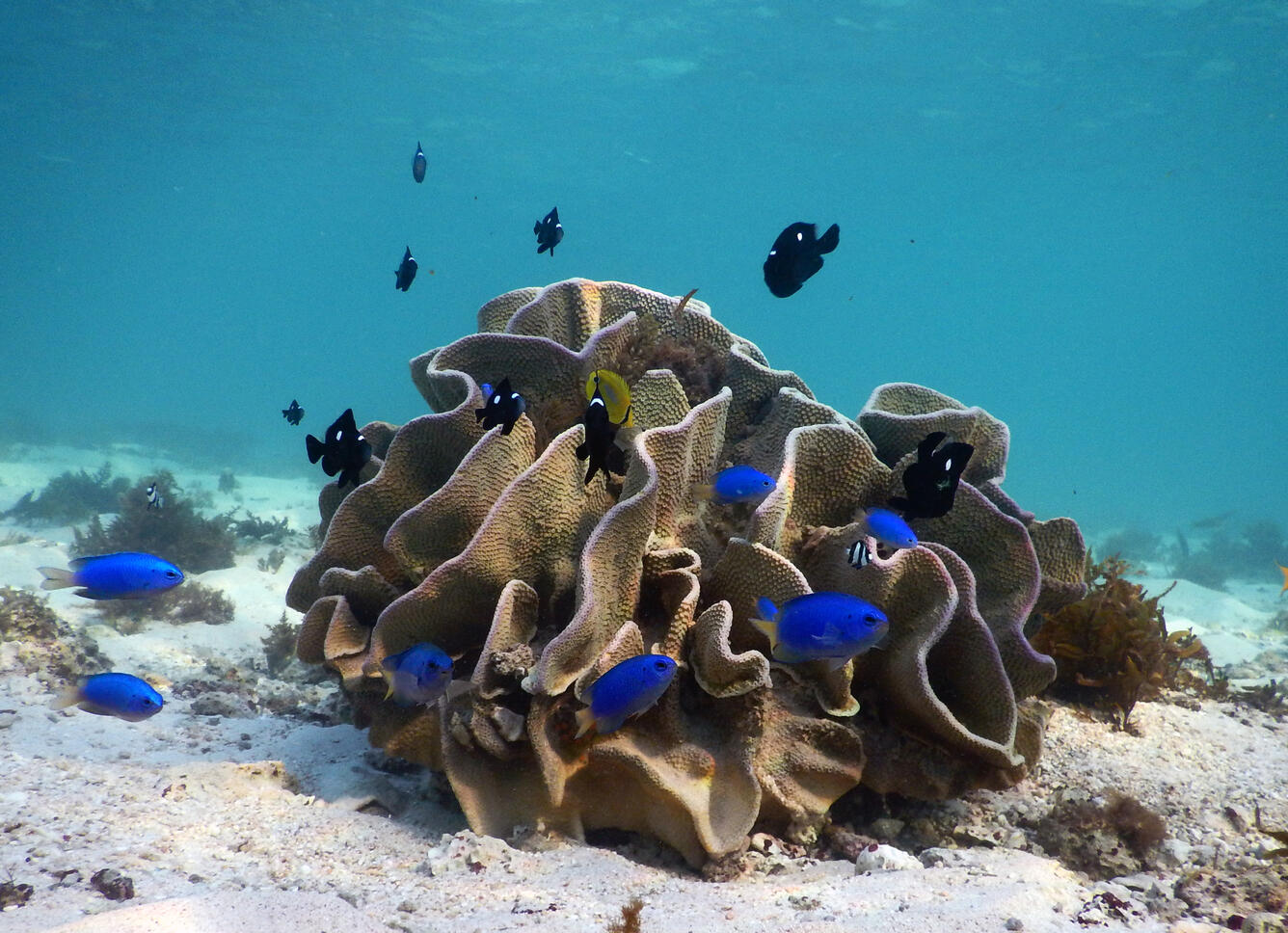
More than 8,500 square miles (22,000 square kilometers) of coral reef habitat is found in U.S. waters. Most of these coral reefs still appear to be relatively healthy, but some areas of dead and dying coral have been found in recent years. The causes of this degradation are poorly known, but are probably in part related to human activities.
The U.S. Geological Survey (USGS), working closely with academic institutions, state, and other Federal agencies, is spearheading an effort to better understand the geologic and oceanographic controls on the structure and processes of our Nation's coral reef ecosystems.
This web site is a gateway to USGS studies of coral reefs. We focus on the geophysical processes that influence the health and sustainability of coral reefs. From this work we are gaining new insight into the structure of coral reefs, providing the basis for future monitoring, and understanding better both the influences of natural processes and impacts of human activities on coral reef health. These efforts will help to preserve and protect the biodiversity, health, and social and economic value of these remarkable habitats.
Read more coral reef facts.
Learn about our current studies by topic:
We are developing new and unique oceanographic and environmental archives from coral skeleton records to better understand the compounding effects of land-use and environmental change on coral reef health.
We are conducting geophysical and geochemical research to address questions about coastal groundwater-to-reef flow and coral reef health, with the goal of informing management decisions related to planning and implementing activities in priority watershed-coral reef systems.
Reef Hydrodynamics and Sediment Processes
We are developing a better understanding how tides, waves, currents, and both land- and reef-derived sediment influence the development of coral reefs and their adjacent shorelines.
Role of Reefs in Coastal Protection
We are combining ocean, engineering, ecologic, social, and economic modeling to provide a high-resolution, rigorous, spatially-explicit valuation of the coastal flood protection benefits provided by coral reefs and the cost effectiveness of reef restoration for enhancing those benefits.
Reef Resource Assessments - Planning for the Future
We are mapping and assessing all of the important geologic and oceanographic factors to identify those coral reefs most at risk and those reefs that are potentially the most resilient and the most likely to recover from natural and human-driven impacts.
Learn about our studies by location:
Guam
Hawaiʻi
Kahoʻolawe
Kauaʻi
Kwajalein Island
Lānaʻi
Maui
Molokaʻi
Oʻahu
Puerto Rico
Roi-Namur Island
Tutuila
Our partners are numerous and include:
- U.S. Coral Reef Task Force (USCRTF)
- Department of the Interior
- Other Federal Partners
- State Partners
- Territorial and Commonwealth Partners
- Guam Division of Aquatic and Wildlife Resources
- Commonwealth of the Northern Mariana Islands Department of Land and Natural Resources
- American Samoa Department of Marine and Wildlife Resources
- Puerto Rico Department of Natural and Environmental Resources
- U.S. Virgin Islands Department of Planning and Natural Resources
- Academia
- University of California Santa Cruz - Institute of Marine Sciences
- University of Western Australia - Oceans Institute
- University of Puerto Rico at Mayaguez - Center for Applied Ocean Science & Engineering
- University of Hawaiʻi - Hawaiʻi Institute of Marine Biology
- Woods Hole Oceanographic Institution - Department of Geology and Geophysics
- Delft University of Technology - Department of Hydraulic Engineering
- Queen's University - Department of Civil Engineering
- University of Cantabria - Department of Sciences and Techniques in Water and Environment
- Non-governmental Organizations
Below are data releases associated with this project.
Jurabi, Exmouth, Western Australia, 2016 Coral Reef Circulation and Sediment Dynamics Experiment Jurabi, Exmouth, Western Australia, 2016 Coral Reef Circulation and Sediment Dynamics Experiment
Database to model three-dimensional flow over coral reef spur-and-groove morphology Database to model three-dimensional flow over coral reef spur-and-groove morphology
Modeled effects of depth and semidiurnal temperature fluctuations on predictions of year that coral reef locations reach annual severe bleaching for various global climate model projections Modeled effects of depth and semidiurnal temperature fluctuations on predictions of year that coral reef locations reach annual severe bleaching for various global climate model projections
Coral reef profiles for wave-runup prediction Coral reef profiles for wave-runup prediction
Model parameter input files to compare wave-averaged versus wave-resolving XBeach coastal flooding models for coral reef-lined coasts Model parameter input files to compare wave-averaged versus wave-resolving XBeach coastal flooding models for coral reef-lined coasts
Dynamically downscaled future wave projections from SWAN model results for the main Hawaiian Islands Dynamically downscaled future wave projections from SWAN model results for the main Hawaiian Islands
Time series data of oceanographic conditions from La Parguera, Puerto Rico, 2017-2018 Coral Reef Circulation and Sediment Dynamics Experiment Time series data of oceanographic conditions from La Parguera, Puerto Rico, 2017-2018 Coral Reef Circulation and Sediment Dynamics Experiment
Physics-based numerical model simulations of wave propagation over and around theoretical atoll and island morphologies for sea-level rise scenarios Physics-based numerical model simulations of wave propagation over and around theoretical atoll and island morphologies for sea-level rise scenarios
Projected flooding extents and depths based on 10-, 50-, 100-, and 500-year wave-energy return periods, with and without coral reefs, for the States of Hawaii and Florida, the Territories of Guam, American Samoa, Puerto Rico, and the U.S. Virgin Islands, Projected flooding extents and depths based on 10-, 50-, 100-, and 500-year wave-energy return periods, with and without coral reefs, for the States of Hawaii and Florida, the Territories of Guam, American Samoa, Puerto Rico, and the U.S. Virgin Islands,
HyCReWW database: A hybrid coral reef wave and water level metamodel HyCReWW database: A hybrid coral reef wave and water level metamodel
Olowalu chronology and geochemistry time-series, West Maui Olowalu chronology and geochemistry time-series, West Maui
Coral growth parameters and seawater chemistry from Kahekili, west Maui, Hawaii Coral growth parameters and seawater chemistry from Kahekili, west Maui, Hawaii
Below are multimedia items associated with this project.
Below is a list of our project publications.
Action plan for restoration of coral reef coastal protection services: Case study example and workbook Action plan for restoration of coral reef coastal protection services: Case study example and workbook
Biology: Integrating core to essential variables (Bio-ICE) task team report for hard corals Biology: Integrating core to essential variables (Bio-ICE) task team report for hard corals
Rigorously valuing the impact of Hurricanes Irma and Maria on coastal hazard risks in Florida and Puerto Rico Rigorously valuing the impact of Hurricanes Irma and Maria on coastal hazard risks in Florida and Puerto Rico
Rigorously valuing the impact of projected coral reef degradation on coastal hazard risk in Florida Rigorously valuing the impact of projected coral reef degradation on coastal hazard risk in Florida
Rigorously valuing the coastal hazard risks reduction provided by potential coral reef restoration in Florida and Puerto Rico Rigorously valuing the coastal hazard risks reduction provided by potential coral reef restoration in Florida and Puerto Rico
Rebounds, regresses, and recovery: A 15-year study of the coral reef community at Pila‘a, Kaua‘i after decades of natural and anthropogenic stress events Rebounds, regresses, and recovery: A 15-year study of the coral reef community at Pila‘a, Kaua‘i after decades of natural and anthropogenic stress events
Bomb-produced radiocarbon across the South Pacific Gyre — A new record from American Samoa with utility for fisheries science Bomb-produced radiocarbon across the South Pacific Gyre — A new record from American Samoa with utility for fisheries science
Land-based sediment sources and transport to southwest Puerto Rico coral reefs after Hurricane Maria, May 2017 to June 2018 Land-based sediment sources and transport to southwest Puerto Rico coral reefs after Hurricane Maria, May 2017 to June 2018
Online-coupling of widely-ranged timescales to model coral reef development Online-coupling of widely-ranged timescales to model coral reef development
Wave-driven flood-forecasting on reef-lined coasts early warning system (WaveFoRCE) Wave-driven flood-forecasting on reef-lined coasts early warning system (WaveFoRCE)
Coral reef restorations can be optimized to reduce coastal flooding hazards Coral reef restorations can be optimized to reduce coastal flooding hazards
The value of US coral reefs for flood risk reduction The value of US coral reefs for flood risk reduction
Below are news stories associated with this project.
USGS Investigations of coral reefs are cooperative efforts, and our scientists are working in partnership and cooperation with the following organizations.
Explore the fascinating undersea world of coral reefs. Learn how we map, monitor, and model coral reefs so we can better understand, protect, and preserve our Nation's reefs.
Coral reefs are unique ecosystems of plants, animals, and their associated geological framework. Coral reefs cover less than 0.5 percent of the earth's surface, but are home to an estimated 25 percent of all marine species. Second only to tropical rainforests in size and complexity, some scientists estimate that more than one million species of plants and animals are associated with coral reefs.
Coral reefs are also of great economic importance to those who live on or visit islands in the Pacific and Atlantic Oceans. Reefs shelter and provide nursery grounds for many commercially and culturally important species of fish and invertebrates, they protect the islands' harbors, beaches, and shorelines from erosion and wave damage by storms, and they are vital to the marine tourism industry. These diverse ecosystems provide valuable goods and services worth about $4 billion each year to the U.S.’s coastal communities. Yet, as important as coral reefs are, these ecosystems are being threatened worldwide.
More than 8,500 square miles (22,000 square kilometers) of coral reef habitat is found in U.S. waters. Most of these coral reefs still appear to be relatively healthy, but some areas of dead and dying coral have been found in recent years. The causes of this degradation are poorly known, but are probably in part related to human activities.
The U.S. Geological Survey (USGS), working closely with academic institutions, state, and other Federal agencies, is spearheading an effort to better understand the geologic and oceanographic controls on the structure and processes of our Nation's coral reef ecosystems.
This web site is a gateway to USGS studies of coral reefs. We focus on the geophysical processes that influence the health and sustainability of coral reefs. From this work we are gaining new insight into the structure of coral reefs, providing the basis for future monitoring, and understanding better both the influences of natural processes and impacts of human activities on coral reef health. These efforts will help to preserve and protect the biodiversity, health, and social and economic value of these remarkable habitats.
Read more coral reef facts.
Learn about our current studies by topic:
We are developing new and unique oceanographic and environmental archives from coral skeleton records to better understand the compounding effects of land-use and environmental change on coral reef health.
We are conducting geophysical and geochemical research to address questions about coastal groundwater-to-reef flow and coral reef health, with the goal of informing management decisions related to planning and implementing activities in priority watershed-coral reef systems.
Reef Hydrodynamics and Sediment Processes
We are developing a better understanding how tides, waves, currents, and both land- and reef-derived sediment influence the development of coral reefs and their adjacent shorelines.
Role of Reefs in Coastal Protection
We are combining ocean, engineering, ecologic, social, and economic modeling to provide a high-resolution, rigorous, spatially-explicit valuation of the coastal flood protection benefits provided by coral reefs and the cost effectiveness of reef restoration for enhancing those benefits.
Reef Resource Assessments - Planning for the Future
We are mapping and assessing all of the important geologic and oceanographic factors to identify those coral reefs most at risk and those reefs that are potentially the most resilient and the most likely to recover from natural and human-driven impacts.
Learn about our studies by location:
Guam
Hawaiʻi
Kahoʻolawe
Kauaʻi
Kwajalein Island
Lānaʻi
Maui
Molokaʻi
Oʻahu
Puerto Rico
Roi-Namur Island
Tutuila
Our partners are numerous and include:
- U.S. Coral Reef Task Force (USCRTF)
- Department of the Interior
- Other Federal Partners
- State Partners
- Territorial and Commonwealth Partners
- Guam Division of Aquatic and Wildlife Resources
- Commonwealth of the Northern Mariana Islands Department of Land and Natural Resources
- American Samoa Department of Marine and Wildlife Resources
- Puerto Rico Department of Natural and Environmental Resources
- U.S. Virgin Islands Department of Planning and Natural Resources
- Academia
- University of California Santa Cruz - Institute of Marine Sciences
- University of Western Australia - Oceans Institute
- University of Puerto Rico at Mayaguez - Center for Applied Ocean Science & Engineering
- University of Hawaiʻi - Hawaiʻi Institute of Marine Biology
- Woods Hole Oceanographic Institution - Department of Geology and Geophysics
- Delft University of Technology - Department of Hydraulic Engineering
- Queen's University - Department of Civil Engineering
- University of Cantabria - Department of Sciences and Techniques in Water and Environment
- Non-governmental Organizations
Below are data releases associated with this project.
Jurabi, Exmouth, Western Australia, 2016 Coral Reef Circulation and Sediment Dynamics Experiment Jurabi, Exmouth, Western Australia, 2016 Coral Reef Circulation and Sediment Dynamics Experiment
Database to model three-dimensional flow over coral reef spur-and-groove morphology Database to model three-dimensional flow over coral reef spur-and-groove morphology
Modeled effects of depth and semidiurnal temperature fluctuations on predictions of year that coral reef locations reach annual severe bleaching for various global climate model projections Modeled effects of depth and semidiurnal temperature fluctuations on predictions of year that coral reef locations reach annual severe bleaching for various global climate model projections
Coral reef profiles for wave-runup prediction Coral reef profiles for wave-runup prediction
Model parameter input files to compare wave-averaged versus wave-resolving XBeach coastal flooding models for coral reef-lined coasts Model parameter input files to compare wave-averaged versus wave-resolving XBeach coastal flooding models for coral reef-lined coasts
Dynamically downscaled future wave projections from SWAN model results for the main Hawaiian Islands Dynamically downscaled future wave projections from SWAN model results for the main Hawaiian Islands
Time series data of oceanographic conditions from La Parguera, Puerto Rico, 2017-2018 Coral Reef Circulation and Sediment Dynamics Experiment Time series data of oceanographic conditions from La Parguera, Puerto Rico, 2017-2018 Coral Reef Circulation and Sediment Dynamics Experiment
Physics-based numerical model simulations of wave propagation over and around theoretical atoll and island morphologies for sea-level rise scenarios Physics-based numerical model simulations of wave propagation over and around theoretical atoll and island morphologies for sea-level rise scenarios
Projected flooding extents and depths based on 10-, 50-, 100-, and 500-year wave-energy return periods, with and without coral reefs, for the States of Hawaii and Florida, the Territories of Guam, American Samoa, Puerto Rico, and the U.S. Virgin Islands, Projected flooding extents and depths based on 10-, 50-, 100-, and 500-year wave-energy return periods, with and without coral reefs, for the States of Hawaii and Florida, the Territories of Guam, American Samoa, Puerto Rico, and the U.S. Virgin Islands,
HyCReWW database: A hybrid coral reef wave and water level metamodel HyCReWW database: A hybrid coral reef wave and water level metamodel
Olowalu chronology and geochemistry time-series, West Maui Olowalu chronology and geochemistry time-series, West Maui
Coral growth parameters and seawater chemistry from Kahekili, west Maui, Hawaii Coral growth parameters and seawater chemistry from Kahekili, west Maui, Hawaii
Below are multimedia items associated with this project.
Below is a list of our project publications.
Action plan for restoration of coral reef coastal protection services: Case study example and workbook Action plan for restoration of coral reef coastal protection services: Case study example and workbook
Biology: Integrating core to essential variables (Bio-ICE) task team report for hard corals Biology: Integrating core to essential variables (Bio-ICE) task team report for hard corals
Rigorously valuing the impact of Hurricanes Irma and Maria on coastal hazard risks in Florida and Puerto Rico Rigorously valuing the impact of Hurricanes Irma and Maria on coastal hazard risks in Florida and Puerto Rico
Rigorously valuing the impact of projected coral reef degradation on coastal hazard risk in Florida Rigorously valuing the impact of projected coral reef degradation on coastal hazard risk in Florida
Rigorously valuing the coastal hazard risks reduction provided by potential coral reef restoration in Florida and Puerto Rico Rigorously valuing the coastal hazard risks reduction provided by potential coral reef restoration in Florida and Puerto Rico
Rebounds, regresses, and recovery: A 15-year study of the coral reef community at Pila‘a, Kaua‘i after decades of natural and anthropogenic stress events Rebounds, regresses, and recovery: A 15-year study of the coral reef community at Pila‘a, Kaua‘i after decades of natural and anthropogenic stress events
Bomb-produced radiocarbon across the South Pacific Gyre — A new record from American Samoa with utility for fisheries science Bomb-produced radiocarbon across the South Pacific Gyre — A new record from American Samoa with utility for fisheries science
Land-based sediment sources and transport to southwest Puerto Rico coral reefs after Hurricane Maria, May 2017 to June 2018 Land-based sediment sources and transport to southwest Puerto Rico coral reefs after Hurricane Maria, May 2017 to June 2018
Online-coupling of widely-ranged timescales to model coral reef development Online-coupling of widely-ranged timescales to model coral reef development
Wave-driven flood-forecasting on reef-lined coasts early warning system (WaveFoRCE) Wave-driven flood-forecasting on reef-lined coasts early warning system (WaveFoRCE)
Coral reef restorations can be optimized to reduce coastal flooding hazards Coral reef restorations can be optimized to reduce coastal flooding hazards
The value of US coral reefs for flood risk reduction The value of US coral reefs for flood risk reduction
Below are news stories associated with this project.
USGS Investigations of coral reefs are cooperative efforts, and our scientists are working in partnership and cooperation with the following organizations.