U.S. flag

An official website of the United States government

Water Availability and Use

We research water availability so that the public knows how much water is available now and into the future. Our research focuses on determining the quantity, quality, and timing of water. In addition to conducting extensive monitoring, we develop detailed models to aid in addressing these complex topics.

Filter Total Items: 68

Updated classifications of flow permanence on streams in the Colville National Forest

The Issue: Streamflow permanence refers to the probability that a stream will lose surface flow (become a dry channel), as well as the timing, duration, and frequency of drying. Patterns of streamflow permanence drive important decisions regarding forest management and other land uses. The Colville National Forest Land and Resource Management Plan (2019), for example, specifies riparian management...
Updated classifications of flow permanence on streams in the Colville National Forest

Updated classifications of flow permanence on streams in the Colville National Forest

The Issue: Streamflow permanence refers to the probability that a stream will lose surface flow (become a dry channel), as well as the timing, duration, and frequency of drying. Patterns of streamflow permanence drive important decisions regarding forest management and other land uses. The Colville National Forest Land and Resource Management Plan (2019), for example, specifies riparian management...
Learn More

Analysis of USGS Surface Water Monitoring Networks

The issue: National interests in water information are important but challenging to incorporate into planning and operation of a monitoring network driven by local information needs. These interests include an understanding of the spatial variability in water availability across the United States, anthro-physical factors including climate and land use that affect water availability, and federal...
Analysis of USGS Surface Water Monitoring Networks

Analysis of USGS Surface Water Monitoring Networks

The issue: National interests in water information are important but challenging to incorporate into planning and operation of a monitoring network driven by local information needs. These interests include an understanding of the spatial variability in water availability across the United States, anthro-physical factors including climate and land use that affect water availability, and federal...
Learn More

Aquifer Recharge Study and Water-Budget Components of San Juan County, Washington

The Issue: San Juan County encompasses an archipelago within the Salish Sea between the southeastern end of Vancouver Island, British Columbia and Skagit and Whatcom Counties on mainland western Washington. Although the year-round population is generally small (approximately 16,000 in 2010), there is an ever-growing influx of visitors to the scenic islands especially during the summer months. An...
Aquifer Recharge Study and Water-Budget Components of San Juan County, Washington

Aquifer Recharge Study and Water-Budget Components of San Juan County, Washington

The Issue: San Juan County encompasses an archipelago within the Salish Sea between the southeastern end of Vancouver Island, British Columbia and Skagit and Whatcom Counties on mainland western Washington. Although the year-round population is generally small (approximately 16,000 in 2010), there is an ever-growing influx of visitors to the scenic islands especially during the summer months. An...
Learn More

Aquifer Recharge Area Study of Guemes Island
The Issue: Guemes Island is an 8.2-square-mile island in the northern part of Puget Sound in western Washington State. The population of the island is increasing, as is the demand for groundwater, which is the island's sole source of freshwater. Continued growth and development of the island, particularly in nearshore areas, has led to the increasing failure of nearshore wells due to seawater...
Aquifer Recharge Area Study of Guemes Island

Aquifer Recharge Area Study of Guemes Island

The Issue: Guemes Island is an 8.2-square-mile island in the northern part of Puget Sound in western Washington State. The population of the island is increasing, as is the demand for groundwater, which is the island's sole source of freshwater. Continued growth and development of the island, particularly in nearshore areas, has led to the increasing failure of nearshore wells due to seawater...
Learn More

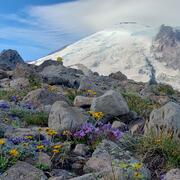
Drought preparedness in Mt. Rainier National Park

Small streams are an important source of water in Mount Rainier National Park. Some streams run year-round, while others go dry during the late summer. The USGS used crowd-sourced data to develop a localized model of Mount Rainier streams. The model provides predictions of whether streams are likely to flow year-round, helping park managers plan for a sustainable water supply.
Drought preparedness in Mt. Rainier National Park

Drought preparedness in Mt. Rainier National Park

Small streams are an important source of water in Mount Rainier National Park. Some streams run year-round, while others go dry during the late summer. The USGS used crowd-sourced data to develop a localized model of Mount Rainier streams. The model provides predictions of whether streams are likely to flow year-round, helping park managers plan for a sustainable water supply.
Learn More

Hydrochemical Analysis of Groundwater in Jewel Cave National Monument

The Issue: The park’s landscape and geomorphology is characterized as a carbonate karst environment, with sinking streams and fast connections between surface water and groundwater, resulting in high vulnerability of contamination to groundwater. Now that subterranean lakes have been discovered in Jewel Cave, understanding the groundwater connection of the lakes therein to the lakes in nearby Wind...
Hydrochemical Analysis of Groundwater in Jewel Cave National Monument

Hydrochemical Analysis of Groundwater in Jewel Cave National Monument

The Issue: The park’s landscape and geomorphology is characterized as a carbonate karst environment, with sinking streams and fast connections between surface water and groundwater, resulting in high vulnerability of contamination to groundwater. Now that subterranean lakes have been discovered in Jewel Cave, understanding the groundwater connection of the lakes therein to the lakes in nearby Wind...
Learn More

Assess the utility of a regional aquifer system groundwater model to inform the USGS National Hydrologic Model

The Issue: In Washington State, groundwater (GW) inflow to streams, or baseflow, is essential for maintaining aquatic habitats, and for out-of-stream uses such as irrigated agriculture during the typically dry summers. However, the National Hydrologic Model (NHM) currently is most suited to predicting total daily streamflow. This project aims to assess the NHM’s performance in simulating baseflow...
Assess the utility of a regional aquifer system groundwater model to inform the USGS National Hydrologic Model

Assess the utility of a regional aquifer system groundwater model to inform the USGS National Hydrologic Model

The Issue: In Washington State, groundwater (GW) inflow to streams, or baseflow, is essential for maintaining aquatic habitats, and for out-of-stream uses such as irrigated agriculture during the typically dry summers. However, the National Hydrologic Model (NHM) currently is most suited to predicting total daily streamflow. This project aims to assess the NHM’s performance in simulating baseflow...
Learn More

Walla Walla River Basin groundwater-flow system, Oregon-Washington

The Issue: Decades of declining groundwater levels in the Walla Walla River Basin (WWRB), which spans Oregon and Washington, are affecting instream flows for threatened and culturally important fish populations and water availability for competing interests across state lines. The public and state resource management agencies have begun implementing efforts to stabilize groundwater levels and...
Walla Walla River Basin groundwater-flow system, Oregon-Washington

Walla Walla River Basin groundwater-flow system, Oregon-Washington

The Issue: Decades of declining groundwater levels in the Walla Walla River Basin (WWRB), which spans Oregon and Washington, are affecting instream flows for threatened and culturally important fish populations and water availability for competing interests across state lines. The public and state resource management agencies have begun implementing efforts to stabilize groundwater levels and...
Learn More

Southeast Sound Groundwater Flow Model

The Issue: Groundwater is an important resource for domestic, commercial, and industrial usage in the Puyallup River and Chambers-Clover Creek Watersheds, and groundwater discharge helps maintain late-summer and early-fall streamflow (baseflow) in many area streams. Consequently, as the population grows, and commercial and industrial activity increase, so does the demand for groundwater. However...
Southeast Sound Groundwater Flow Model

Southeast Sound Groundwater Flow Model

The Issue: Groundwater is an important resource for domestic, commercial, and industrial usage in the Puyallup River and Chambers-Clover Creek Watersheds, and groundwater discharge helps maintain late-summer and early-fall streamflow (baseflow) in many area streams. Consequently, as the population grows, and commercial and industrial activity increase, so does the demand for groundwater. However...
Learn More

Puget Sound Groundwater Low Flows Near Term Action Project

The Issue: Groundwater discharge to streams and rivers in the Puget Sound basin is the primary source of water for sustaining summer low flows. A robust understanding of how anthropogenic and natural stressors affect summer low flows across the entire Puget Sound Regional Aquifer System is lacking, and USGS has tools and data—including current water-use data and subbasin-scale groundwater models...
Puget Sound Groundwater Low Flows Near Term Action Project

Puget Sound Groundwater Low Flows Near Term Action Project

The Issue: Groundwater discharge to streams and rivers in the Puget Sound basin is the primary source of water for sustaining summer low flows. A robust understanding of how anthropogenic and natural stressors affect summer low flows across the entire Puget Sound Regional Aquifer System is lacking, and USGS has tools and data—including current water-use data and subbasin-scale groundwater models...
Learn More

Chambers-Clover Model

The Issue: In 1998, to address diminishing water availability and quality and the loss of critical habitat for fish and wildlife, Washington State enacted the Watershed Management Act. Under this Act, in the process of watershed planning for the Chambers-Clover Creek Watershed in Pierce County, Planning Unit members and partners uncovered gaps in data that would limit the usefulness of their plan...
Chambers-Clover Model

Chambers-Clover Model

The Issue: In 1998, to address diminishing water availability and quality and the loss of critical habitat for fish and wildlife, Washington State enacted the Watershed Management Act. Under this Act, in the process of watershed planning for the Chambers-Clover Creek Watershed in Pierce County, Planning Unit members and partners uncovered gaps in data that would limit the usefulness of their plan...
Learn More

Characterization and Numerical Simulation of the Puyallup River Watershed

Groundwater is an important resource for domestic, commercial, and industrial usage in the Puyallup River Watershed, and groundwater discharge helps maintain late-summer and early-fall streamflow (baseflow) in many area streams. Consequently, as the population grows, and commercial and industrial activity increase, so does the demand for groundwater. However, the quantity of usable groundwater...
Characterization and Numerical Simulation of the Puyallup River Watershed

Characterization and Numerical Simulation of the Puyallup River Watershed

Groundwater is an important resource for domestic, commercial, and industrial usage in the Puyallup River Watershed, and groundwater discharge helps maintain late-summer and early-fall streamflow (baseflow) in many area streams. Consequently, as the population grows, and commercial and industrial activity increase, so does the demand for groundwater. However, the quantity of usable groundwater...
Learn More
Was this page helpful?