U.S. flag

An official website of the United States government

Images

Western Ecological Research Center (WERC) images.

Filter Total Items: 455
person in shilouette walking away from the camera in the shallows along a shoreline
Walking the shallows of Lake Abert, Oregon
many avocets flying with mountains in the background
Avocets flying above Farmington Bay Wildlife Management Area, Utah

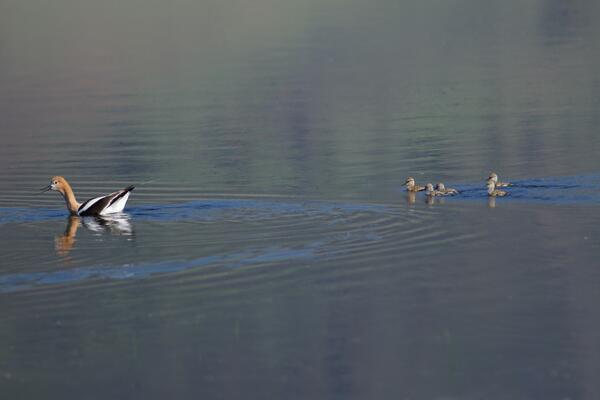
The Saline Lake Ecosystems IWAA Waterbird Movement Project began tagging American Avocets in March 2023 to track their movements across the landscape. Tracking data from these birds will help scientists better understand why these birds choose to use the terminal lake and wetland habitats they do in the Great Basin.

American Avocet birds swimming in a lake. There is an adult followed by five chicks
American Avocet trailed by chicks
a sagebrush landscape with Phlox sp. growing on intact biological soil crusts
Abundant Biocrust and Phlox in Sagebrush Landscape

In this sagebrush community, there are intact biological soil crusts that are composed of cyanobacteria, lichens and mosses. Phlox sp. are growing abundantly on these biocrust communities.

In this sagebrush community, there are intact biological soil crusts that are composed of cyanobacteria, lichens and mosses. Phlox sp. are growing abundantly on these biocrust communities.

Biological soil crusts with lichens, mosses, and cyanobacteria
Biological Soil Crust Community

This is a community of biological soil crusts including scale lichens, crustose lichens, mosses, and cyanobacteria. 

Biological soil crusts are an intimate association of soil particles, cyanobacteria, algae, lichens, bryophytes, and microfungi which live within or directly on top of the uppermost millimeters of soil. (Belnap, 2003)

This is a community of biological soil crusts including scale lichens, crustose lichens, mosses, and cyanobacteria. 

Biological soil crusts are an intimate association of soil particles, cyanobacteria, algae, lichens, bryophytes, and microfungi which live within or directly on top of the uppermost millimeters of soil. (Belnap, 2003)

Hoary bat held in gloved hand with a tiny Motus tag attached to its back
Hoary bat with Motus tag

Hoary bat with a Motus tag. Learn more about our project to track bats and birds through the Motus network here: https://www.usgs.gov/centers/werc/science/birds-bats-and-beyond-network…

Wearing a mask, gloves, and headlamp, Gabe Reyes holds a hoary bat during the process of attaching Motus tags
Gabe Reyes tags a hoary bat with a Motus tag
a silhouette of a goose standing on the shore of a lake at sunrise
Lone goose at sunrise at Summer Lake Wildlife Area
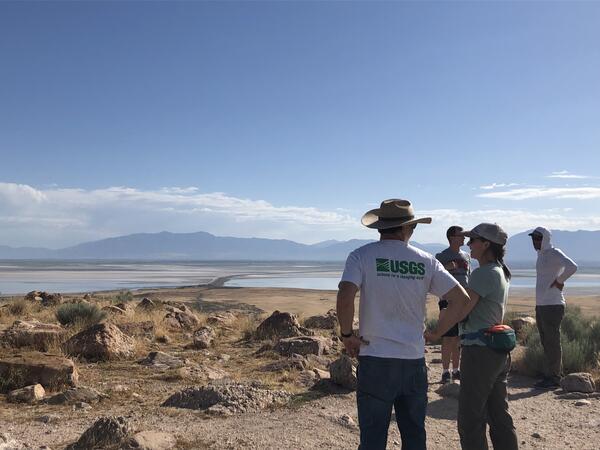
Four scientist looking out over the Great Salt Lake from Antelope Island. There are mountains behind them and clouds
Scientist looking out onto the GSL from Antelope Island

These scientists are working on The Great Salt Lake to determine the amount of water and qualities of it. This will help them in developing better management techniques that will work to support the migratory birds that frequent the area. 

Underwater view of a reef manta ray
Reef manta ray at Palmyra Atoll

Reef manta rays were one of 10 pelagic species tagged in a new effort to understand marine habitat use and the functionality of the large "blue water" marine protected area surrounding Palmyra Atoll and Kingman Reef in the central eastern Pacific Ocean.

Learn more:

Reef manta rays were one of 10 pelagic species tagged in a new effort to understand marine habitat use and the functionality of the large "blue water" marine protected area surrounding Palmyra Atoll and Kingman Reef in the central eastern Pacific Ocean.

Learn more:

a photo of a patch of short moss
Short Moss
Short Moss
Short Moss

A patch of short moss photographed in the Great Basin.

Biological soil crusts are an intimate association of soil particles, cyanobacteria, algae, lichens, bryophytes, and microfungi which live within or directly on top of the uppermost millimeters of soil. (Belnap, 2003)

Reference

A patch of short moss photographed in the Great Basin.

Biological soil crusts are an intimate association of soil particles, cyanobacteria, algae, lichens, bryophytes, and microfungi which live within or directly on top of the uppermost millimeters of soil. (Belnap, 2003)

Reference

A male greater sage-grouse displaying on a lek in the Bodie Hills, California
Greater sage-grouse displaying in Bodie Hills, California
Animation with dots showing cinnamon teal movements in Western North America
Cinnamon teal locations from GPS-GSM tracked birds

Locations of GPS-GSM tracked cinnamon teal between April 2017 and August 2021. 

Since 2017, USGS scientists have tagged more than 200 cinnamon teal with lightweight, solar-powered GPS-GSM transmitters, which the ducks wear like backpacks. The GPS transmitters produce near real-time data on where the birds go and what kinds of habitats they use.

Locations of GPS-GSM tracked cinnamon teal between April 2017 and August 2021. 

Since 2017, USGS scientists have tagged more than 200 cinnamon teal with lightweight, solar-powered GPS-GSM transmitters, which the ducks wear like backpacks. The GPS transmitters produce near real-time data on where the birds go and what kinds of habitats they use.

Was this page helpful?