U.S. flag

An official website of the United States government

Ecosystems Mission Area

The USGS Ecosystems Mission Area provides science that directly benefits the health, safety, and prosperity of the American people by providing trusted and timely information to help address the Nation’s toughest management and conservation issues impacting public lands and the surrounding communities that benefit from them. 

News

Tackling Invasive Mussels with Science and Strategy

Tackling Invasive Mussels with Science and Strategy

WEBINAR: USGS Invasive Species Science - Innovation for a Healthy Nation

WEBINAR: USGS Invasive Species Science - Innovation for a Healthy Nation

New habitat suitability model to inform decision making and recover rare species in New Mexico

New habitat suitability model to inform decision making and recover rare species in New Mexico

Publications

Background, methods, goals, challenges, opportunities, and information needs Background, methods, goals, challenges, opportunities, and information needs

Understanding how climate change and variability will impact grassland ecosystems is crucial for successful grasslands management in the future. In 2020, the North Central Climate Adaptation Science Center began a project to establish a baseline of information to best serve grassland managers (that is, those individuals who develop grassland management plans, implement those plans on the...

Ten new insights in climate science 2025 Ten new insights in climate science 2025

Interdisciplinary understanding is vital for delivering sound climate policy advice. However, navigating the ever-growing and increasingly diverse scholarly literature on climate change is challenging for any individual researcher. This annual synthesis highlights and explains recent advances across a variety of fields of climate change research. This year, the 10 insights focus on: (1)...
Authors
Daniel Ospina, Paula Mirazo, Richard P. Allan, Smriti Basnett, Ana Bastos, Nishan Bhattarai, Wendy Broadgate, Derik J. Broekhoff, Mercedes Bustamante, Deliang Chen, Yeonju Choi, Peter Cox, Luiz A. Domeignoz-Horta, Krislie Ebi, Pierre Friedlingstein, Thomas L. Frölicher, Sabine Fuss, Helge F. Goessling, Nicolas Gruber, Qingyou He, Sophie R. Hebden, Nadja Hedrich, Adrian Heilemann, Marina Hirota, Øivind Hodnebrog, Gustaf Hugelius, Santiago Izquierdo-Tort, Sirkku Juhola, Fumiko Kasuga, Piyu Ke, Douglas I. Kelley, Şiir Kilkiș, Maximilian Kotz, Nilushi Kumarasinghe, William F. Lamb, Shih-Yu Lee, Junguo Liu, Cara N. Maesano, Maria A. Martin, Guilherme G. Mazzochini, Christopher J. Merchant, Akira S. Mori, Jennifer Morris, Åsa Persson, Hans-Otto Pörtner, Benedict S. Probst, Justine Ramage, Estelle Razanatsoa, Aaron Redman, Johan Rockström, Regina Rodrigues, Sophie Ruehr, Sadie J. Ryan, Carl-Friedrich Schleussner, Peter Schlosser, William A. Scott, Jan C. Semenza, Hansjörg Seybold, Drew T. Shindell, Giles B. Sioen, Kathryn E. Smith, Youba Sokona, Annika H. Stechemesser, Thomas F. Stocker, Sophie H.L. Su, Djiby Thiam, Gregory Trencher, Anna-Maria Virkkala, Lila Warszawski, Sarah R. Weiskopf, Henry Wu, Shupeng Zhu

James Buttle Review: A synthesis of riparian plant water use over two decades in North American drylands James Buttle Review: A synthesis of riparian plant water use over two decades in North American drylands

Assessing riparian ecosystem water use, particularly transpiration from vegetation and evaporation from soils (‘plant water use’, hereafter), is key to developing sound water management approaches. In western North America, a multidecadal drought is reducing water availability and increasing the use of detailed water budgets. Questions related to both removal of vegetation for water...
Authors
Emily C. Palmquist, Pamela Nagler, Kiona Ogle, Claudia DiMartini, Jeffrey R. Kennedy, Joel B. Sankey

Science

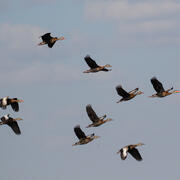
Tackling avian influenza with automated detection for an early warning system

The USGS is collaborating with agricultural and wildlife management partners to address the threat of highly-pathogenic avian influenza (HPAI) to wildlife, domestic poultry, and livestock. Partners include federal (U.S. Fish and Wildlife Service and U.S. Department of Agriculture) and non-federal agencies as well as State government, private organizations, and academic institutions. Our...
Tackling avian influenza with automated detection for an early warning system

Tackling avian influenza with automated detection for an early warning system

The USGS is collaborating with agricultural and wildlife management partners to address the threat of highly-pathogenic avian influenza (HPAI) to wildlife, domestic poultry, and livestock. Partners include federal (U.S. Fish and Wildlife Service and U.S. Department of Agriculture) and non-federal agencies as well as State government, private organizations, and academic institutions. Our...
Learn More

Batrachochytrium salamandrivorans (Bsal)

Batrachochytrium salamandrivorans  ( Bsal ) is an emerging pathogen capable of causing significant morbidity and mortality in salamanders.
Batrachochytrium salamandrivorans (Bsal)

Batrachochytrium salamandrivorans (Bsal)

Batrachochytrium salamandrivorans  ( Bsal ) is an emerging pathogen capable of causing significant morbidity and mortality in salamanders.
Learn More

Batrachochytrium salamandrivorans (Bsal) Surveillance

Scientists of the USGS National Wildlife Health Center (NWHC) in collaboration with partners have developed risk assessments for  Batrachochytrium salamandrivorans  ( Bsal ) in the United States and are sampling high-risk locations for the fungus.
Batrachochytrium salamandrivorans (Bsal) Surveillance

Batrachochytrium salamandrivorans (Bsal) Surveillance

Scientists of the USGS National Wildlife Health Center (NWHC) in collaboration with partners have developed risk assessments for  Batrachochytrium salamandrivorans  ( Bsal ) in the United States and are sampling high-risk locations for the fungus.
Learn More
Was this page helpful?