



Throughout the world, irrigation (water for agriculture) is essential for keeping fruits, vegetables, and grains growing to feed the world's population. In addition, irrigation can alleviate crop stress from droughts, decrease soil erosion, and can reduce water pollution. USGS scientists provide estimates of irrigation water use to help water managers make informed decisions.
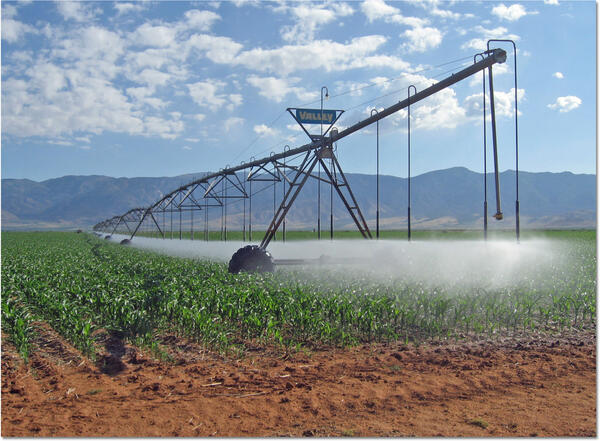
Irrigation water use is essential to the American food chain, both for watering crops directly consumed by people, or growing crops that become food for livestock. Water is also used for non-agricultural irrigation, for example, to irrigate golf courses, parks, plant nurseries, or turf farms. Farmers apply water to support the growth of crops, lawns, and plants. Farmers use irrigation water throughout the growth cycle for many reasons, including:
- Ensuring crops receive a consistent supply of water;
- Protecting vegetation from frost;
- Applying fertilizer and pesticides;
- Controlling the growth of weeds;
- Reducing the risk of crop failure because of droughts or irregular weather;
- Suppressing dust accumulation on crops; and
- Removing unwanted salts from soil.
2020 Water Use
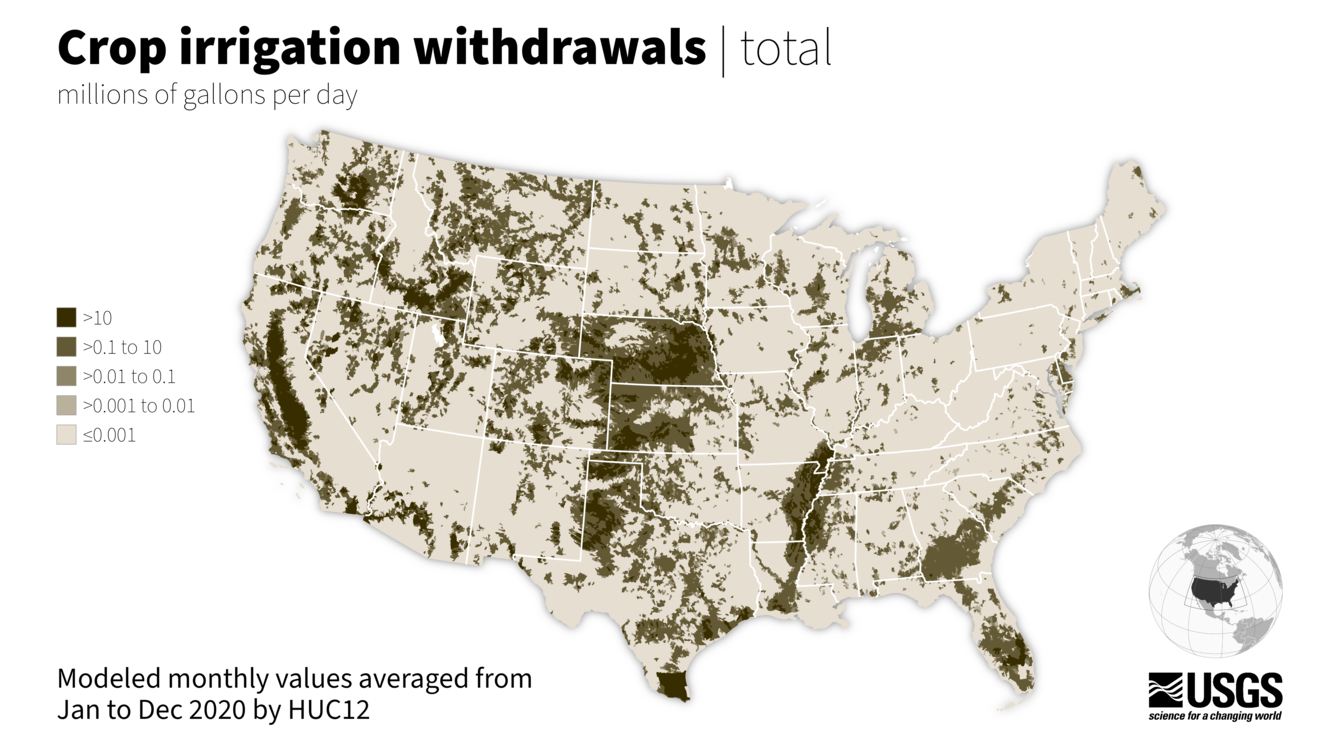
In 2020, about 110,904 million gallons per day (mgd) of water was withdrawn for crop irrigation across the lower 48 United States.
- Approximately 72% of the water withdrawn for irrigation was consumptive use, meaning it did not return to local waterbodies or groundwater. In the case of irrigation, consumptive water is incorporated into plants or lost to evapotranspiration.
- Withdrawals from surface water totaled 40,470 mgd (about 36.5%) and from groundwater 70,434 mgd (about 63.5%).
- The California-Nevada hydrologic region withdrew the most at about 24.6% (27,242 mgd), followed by Columbia-Snake at about 13.9% (15,407 mgd). The Northeast region used the least, with about 123 mgd (about 0.1%).
- Crop irrigation withdrawals are highest in August at 337,259 mgd, followed by July at 305,476 mgd. December has the lowest at 4,924 mgd.
2020 irrigation water use estimates are from Martin et al., 2025 and Haynes et al., 2023 and accessed through the National Water Availability Assessment Data Companion, using the hydrologic region boundaries published here.
The Sources of Irrigation Water
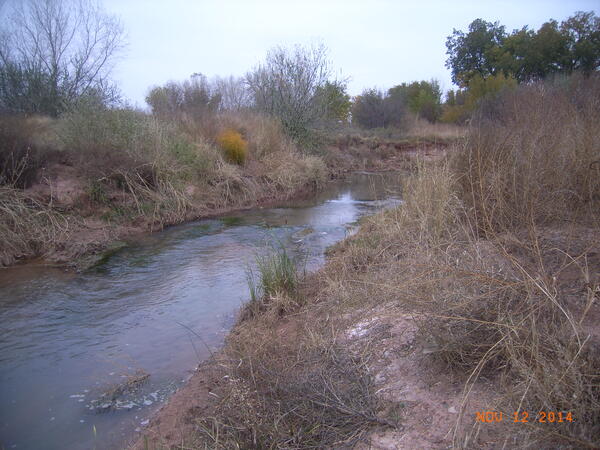
The USGS estimates irrigation withdrawals by source (groundwater, springs, streams, ponds, or reclaimed wastewater) and include the following in their estimate:
- Water that is lost from evaporation, leakage, and seepage before being applied on fields;
- Water that returns to a surface-water body as runoff after it is applied on fields;
- Water that vegetation consumes and releases back into the atmosphere; and
- Water that recharges aquifers as it seeps past the root zone.
In addition to water for agriculture, some historic USGS irrigation estimates included freshwater applied to golf courses, parks, nurseries, turf farms, cemeteries, and other self-supplied landscape-watering. Irrigation water use also includes withdrawals and deliveries from irrigation companies or districts, cooperatives, or governmental entities. Some irrigation systems use reclaimed wastewater from nearby treatment facilities or industries.
Estimating Irrigation Water Use
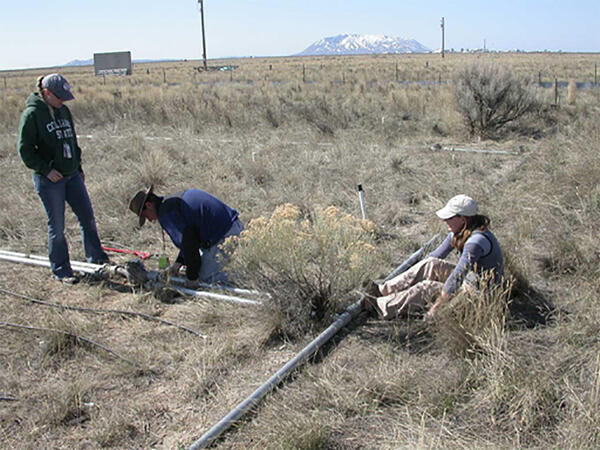
Historically (1950-2015), USGS estimated irrigation withdrawals for the United States using a combination of reported water use and estimation methods. These estimates varied by state and included agricultural and non-agricultural applications for some time periods. Estimation methods also may include adjustments for climate, the efficiency of the irrigation system, the amount of water lost in transport, and other irrigation practices. Consumptive use was also sometimes estimated based on coefficients, irrigation-system efficiencies, theoretical crop requirements from various sources, or satellite-derived evapotranspiration. Read the Accessing Water Use data page for more information on historical water use estimates.
A hydrologic modeling approach was used to estimate agricultural irrigation water use and consumptive use for 2000-2020 (Martin et al., 2025 and Haynes et al., 2023). Using climatic, hydrologic, and land-use data as inputs, the model uses a water balance approach to estimate crop irrigation consumptive use by resolving differences between modeled evapotranspiration values and remotely-sensed evapotranspiration. Crop irrigation withdrawals are determined by dividing the consumptive use estimates by irrigation efficiencies and partitioning into groundwater and surface water. Irrigation efficiencies include losses from irrigation application systems and conveyances.
Continued development is underway to estimate irrigation water use and consumptive use.
Learn more about water use
Water Use in the United States
Accessing Water Use Data
Thermoelectric Power Water Use
Public Supply Water Use
Domestic Self-supply Water Use
Industrial Water Use
Mining Water Use
Livestock Water Use
Aquaculture Water Use
Below are links for other categories of water use.

Water Use in the United States

Accessing Water Use Data

Public Supply Water Use

Domestic Water Use

Thermoelectric Power Water Use

Industrial Water Use

Mining Water Use

Livestock Water Use

Aquaculture Water Use
Throughout the world, irrigation (water for agriculture) is essential for keeping fruits, vegetables, and grains growing to feed the world's population. In addition, irrigation can alleviate crop stress from droughts, decrease soil erosion, and can reduce water pollution. USGS scientists provide estimates of irrigation water use to help water managers make informed decisions.
Irrigation water use is essential to the American food chain, both for watering crops directly consumed by people, or growing crops that become food for livestock. Water is also used for non-agricultural irrigation, for example, to irrigate golf courses, parks, plant nurseries, or turf farms. Farmers apply water to support the growth of crops, lawns, and plants. Farmers use irrigation water throughout the growth cycle for many reasons, including:
- Ensuring crops receive a consistent supply of water;
- Protecting vegetation from frost;
- Applying fertilizer and pesticides;
- Controlling the growth of weeds;
- Reducing the risk of crop failure because of droughts or irregular weather;
- Suppressing dust accumulation on crops; and
- Removing unwanted salts from soil.
2020 Water Use
In 2020, about 110,904 million gallons per day (mgd) of water was withdrawn for crop irrigation across the lower 48 United States.
- Approximately 72% of the water withdrawn for irrigation was consumptive use, meaning it did not return to local waterbodies or groundwater. In the case of irrigation, consumptive water is incorporated into plants or lost to evapotranspiration.
- Withdrawals from surface water totaled 40,470 mgd (about 36.5%) and from groundwater 70,434 mgd (about 63.5%).
- The California-Nevada hydrologic region withdrew the most at about 24.6% (27,242 mgd), followed by Columbia-Snake at about 13.9% (15,407 mgd). The Northeast region used the least, with about 123 mgd (about 0.1%).
- Crop irrigation withdrawals are highest in August at 337,259 mgd, followed by July at 305,476 mgd. December has the lowest at 4,924 mgd.
2020 irrigation water use estimates are from Martin et al., 2025 and Haynes et al., 2023 and accessed through the National Water Availability Assessment Data Companion, using the hydrologic region boundaries published here.
The Sources of Irrigation Water
The USGS estimates irrigation withdrawals by source (groundwater, springs, streams, ponds, or reclaimed wastewater) and include the following in their estimate:
- Water that is lost from evaporation, leakage, and seepage before being applied on fields;
- Water that returns to a surface-water body as runoff after it is applied on fields;
- Water that vegetation consumes and releases back into the atmosphere; and
- Water that recharges aquifers as it seeps past the root zone.
In addition to water for agriculture, some historic USGS irrigation estimates included freshwater applied to golf courses, parks, nurseries, turf farms, cemeteries, and other self-supplied landscape-watering. Irrigation water use also includes withdrawals and deliveries from irrigation companies or districts, cooperatives, or governmental entities. Some irrigation systems use reclaimed wastewater from nearby treatment facilities or industries.
Estimating Irrigation Water Use
Historically (1950-2015), USGS estimated irrigation withdrawals for the United States using a combination of reported water use and estimation methods. These estimates varied by state and included agricultural and non-agricultural applications for some time periods. Estimation methods also may include adjustments for climate, the efficiency of the irrigation system, the amount of water lost in transport, and other irrigation practices. Consumptive use was also sometimes estimated based on coefficients, irrigation-system efficiencies, theoretical crop requirements from various sources, or satellite-derived evapotranspiration. Read the Accessing Water Use data page for more information on historical water use estimates.
A hydrologic modeling approach was used to estimate agricultural irrigation water use and consumptive use for 2000-2020 (Martin et al., 2025 and Haynes et al., 2023). Using climatic, hydrologic, and land-use data as inputs, the model uses a water balance approach to estimate crop irrigation consumptive use by resolving differences between modeled evapotranspiration values and remotely-sensed evapotranspiration. Crop irrigation withdrawals are determined by dividing the consumptive use estimates by irrigation efficiencies and partitioning into groundwater and surface water. Irrigation efficiencies include losses from irrigation application systems and conveyances.
Continued development is underway to estimate irrigation water use and consumptive use.
Learn more about water use
Water Use in the United States
Accessing Water Use Data
Thermoelectric Power Water Use
Public Supply Water Use
Domestic Self-supply Water Use
Industrial Water Use
Mining Water Use
Livestock Water Use
Aquaculture Water Use
Below are links for other categories of water use.
Water Use in the United States
Accessing Water Use Data
Public Supply Water Use
Domestic Water Use
Thermoelectric Power Water Use
Industrial Water Use
Mining Water Use
Livestock Water Use