
U.S. flag

An official website of the United States government

Lakes and Reservoirs

Filter Total Items: 59

Health-Based Screening Levels for Evaluating Water-Quality Data

This searchable online database provides Health-Based Screening Levels (HBSLs) for hundreds of chemicals, including pesticides and degradates. HBSLs are non-enforceable benchmark concentrations of contaminants in water. These screening levels supplement federal drinking-water standards and guidelines.
Health-Based Screening Levels for Evaluating Water-Quality Data

Health-Based Screening Levels for Evaluating Water-Quality Data

This searchable online database provides Health-Based Screening Levels (HBSLs) for hundreds of chemicals, including pesticides and degradates. HBSLs are non-enforceable benchmark concentrations of contaminants in water. These screening levels supplement federal drinking-water standards and guidelines.
Learn More

Water-Quality Trends From Lake Cores

Sediment cores let us look back in time at the contaminant history of a watershed. Learn about what lake and reservoir sediment cores tell us about trends in metals, organochlorine pesticides, polycyclic aromatic hydrocarbons, and other sediment-related contaminants.
Water-Quality Trends From Lake Cores

Water-Quality Trends From Lake Cores

Sediment cores let us look back in time at the contaminant history of a watershed. Learn about what lake and reservoir sediment cores tell us about trends in metals, organochlorine pesticides, polycyclic aromatic hydrocarbons, and other sediment-related contaminants.
Learn More

National Water-Quality Assessment (NAWQA): 1991-2012

In 1991, Congress established the National Water-Quality Assessment (NAWQA) Project to address where, when, why, and how the Nation's water quality has changed, or is likely to change in the future, in response to human activities and natural factors. This page discusses the first two decadal cycles of NAWQA research from 1991 through 2012.
National Water-Quality Assessment (NAWQA): 1991-2012

National Water-Quality Assessment (NAWQA): 1991-2012

In 1991, Congress established the National Water-Quality Assessment (NAWQA) Project to address where, when, why, and how the Nation's water quality has changed, or is likely to change in the future, in response to human activities and natural factors. This page discusses the first two decadal cycles of NAWQA research from 1991 through 2012.
Learn More

Urban Waters Federal Partnership—Middle Rio Grande (Albuquerque, N. Mex.)

The Valle de Oro National Wildlife Refuge, just 7 miles south of downtown Albuquerque on the Rio Grande, will reconnect people, especially young people, with nature in this highly populated area. The USGS is gathering data that will help gauge the success of habitat restoration efforts.
Urban Waters Federal Partnership—Middle Rio Grande (Albuquerque, N. Mex.)

Urban Waters Federal Partnership—Middle Rio Grande (Albuquerque, N. Mex.)

The Valle de Oro National Wildlife Refuge, just 7 miles south of downtown Albuquerque on the Rio Grande, will reconnect people, especially young people, with nature in this highly populated area. The USGS is gathering data that will help gauge the success of habitat restoration efforts.
Learn More

Urban Waters Federal Partnership—Little Calumet River (Northwest Indiana)

The USGS works with a wide range of cooperators to investigate many aspects of water quality. The newly integrated USGS Ohio-Kentucky-Indiana Water Science Center is assisting in furthering urban water-quality research in Northwest Indiana.
Urban Waters Federal Partnership—Little Calumet River (Northwest Indiana)

Urban Waters Federal Partnership—Little Calumet River (Northwest Indiana)

The USGS works with a wide range of cooperators to investigate many aspects of water quality. The newly integrated USGS Ohio-Kentucky-Indiana Water Science Center is assisting in furthering urban water-quality research in Northwest Indiana.
Learn More

Thermal Imaging Cameras for Studying Groundwater/Surface-Water Exchange

USGS scientists are using high-resolution handheld and airborne thermal imaging cameras in groundwater/surface-water exchange studies and other investigations where surface temperature contrasts indicate various hydrological processes. These cameras are used to quickly locate and characterize thermal (temperature) anomalies along streams, lakes, wetlands, estuaries, and across the landscape...
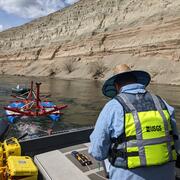
Thermal Imaging Cameras for Studying Groundwater/Surface-Water Exchange

Thermal Imaging Cameras for Studying Groundwater/Surface-Water Exchange

USGS scientists are using high-resolution handheld and airborne thermal imaging cameras in groundwater/surface-water exchange studies and other investigations where surface temperature contrasts indicate various hydrological processes. These cameras are used to quickly locate and characterize thermal (temperature) anomalies along streams, lakes, wetlands, estuaries, and across the landscape...
Learn More

Geophysics for USGS Groundwater/Surface Water Exchange Studies

Locating and quantifying exchanges of groundwater and surface water, along with characterizing geologic structure, is essential to water-resource managers and hydrologists for the development of effective water-resource policy, protection, and management. The USGS conducts applied research to evaluate the use of new or emerging hydrogeophysical tools and methods to improve our understanding of...
Geophysics for USGS Groundwater/Surface Water Exchange Studies

Geophysics for USGS Groundwater/Surface Water Exchange Studies

Locating and quantifying exchanges of groundwater and surface water, along with characterizing geologic structure, is essential to water-resource managers and hydrologists for the development of effective water-resource policy, protection, and management. The USGS conducts applied research to evaluate the use of new or emerging hydrogeophysical tools and methods to improve our understanding of...
Learn More

Sequential, Time-Integrated Collector of Precipitation, Ground Water, and Surface Water for Analysis of Isotopes; US Patent 7,687,028

Patent for a sequential, time-integrated collector having an electronic controller that actuates either of two electrically-actuated valves, each connected to a water reservoir. (Full details provided by the U.S. Patent and Trademark Office website.)
Sequential, Time-Integrated Collector of Precipitation, Ground Water, and Surface Water for Analysis of Isotopes; US Patent 7,687,028

Sequential, Time-Integrated Collector of Precipitation, Ground Water, and Surface Water for Analysis of Isotopes; US Patent 7,687,028

Patent for a sequential, time-integrated collector having an electronic controller that actuates either of two electrically-actuated valves, each connected to a water reservoir. (Full details provided by the U.S. Patent and Trademark Office website.)
Learn More

Water-Quality Trends

Is water quality getting better or worse? Answering this deceptively simple question has been a fundamental objective of the USGS National Water-Quality Assessment Project’s research. Learn about trends in contaminants in the nation’s streams and rivers, trends in contaminants that collect in the bed sediment of streams and lakes, and changes in the quality of the nation’s groundwater.
Water-Quality Trends

Water-Quality Trends

Is water quality getting better or worse? Answering this deceptively simple question has been a fundamental objective of the USGS National Water-Quality Assessment Project’s research. Learn about trends in contaminants in the nation’s streams and rivers, trends in contaminants that collect in the bed sediment of streams and lakes, and changes in the quality of the nation’s groundwater.
Learn More

Sediment-Associated Contaminants

Stream, river, and lake bed sediment are reservoirs for many contaminants. These contaminants include some “legacy” contaminants, like DDT, PCBs, and chlordane, and chemicals currently in use, like the insecticide bifenthrin and many flame retardants. Learn about techniques used to study sediment-associated contaminants and their importance to aquatic biota.
Sediment-Associated Contaminants

Sediment-Associated Contaminants

Stream, river, and lake bed sediment are reservoirs for many contaminants. These contaminants include some “legacy” contaminants, like DDT, PCBs, and chlordane, and chemicals currently in use, like the insecticide bifenthrin and many flame retardants. Learn about techniques used to study sediment-associated contaminants and their importance to aquatic biota.
Learn More

Aqueous Crystal Growth and Dissolution Kinetics of Earth Surface Materials

Although calcium carbonate reaction kinetics has important application in several areas of Earth Science, the mechanism of natural organic matter mediation of carbonate minerals growth and dissolution rates remains largely unknown. This project uses multiple approaches to study calcium carbonate formation and dissolution rates in surface water and groundwater systems.
Aqueous Crystal Growth and Dissolution Kinetics of Earth Surface Materials

Aqueous Crystal Growth and Dissolution Kinetics of Earth Surface Materials

Although calcium carbonate reaction kinetics has important application in several areas of Earth Science, the mechanism of natural organic matter mediation of carbonate minerals growth and dissolution rates remains largely unknown. This project uses multiple approaches to study calcium carbonate formation and dissolution rates in surface water and groundwater systems.
Learn More
Was this page helpful?