



Dynamics of Rabies Transmission in Vampire Bats (Desmodus rotundus) and Potential for Control Through Vaccination
Research in Response to Florida’s Emerging Stony Coral (scleractinia) Diseases
Understanding and Containing Chronic Wasting Disease
CWD is expanding geographically and increasing in prevalence.
CWD is expanding geographically and increasing in prevalence.
Wildlife Health Information Sharing Partnership – event reporting system (WHISPers)
National Wildlife Health Center
Welcome to the National Wildlife Health Center! Our mission is to advance wildlife health science for the benefit of animals, humans, and the environment.
Explore SCIENCE to learn more about wildlife diseases, ongoing projects, the Honolulu Field Station, and our services.
Explore WEB TOOLS to access WHISPers, wildlife health bulletins, our field manual, and more.


Honolulu Field Station
Honolulu Field Station

The NWHC HFS provides support to the natural resource communities of Hawaii and the Pacific Basin in the investigation of wildlife diseases.
News
Presumptive Candida Stomatitis in a Broad-Tailed Hummingbird (Selasphorus platycercus)
Presumptive Candida Stomatitis in a Broad-Tailed Hummingbird (Selasphorus platycercus)
A Tale of Two Islands and the Future of an Ocean Sentinel Seabird
A Tale of Two Islands and the Future of an Ocean Sentinel Seabird
EcoNews - Vol. 7 | Issue 2
EcoNews - Vol. 7 | Issue 2
Publications
Digging into soil: Effects of soil texture on RT-QuIC performance for environmental prion surveillance. Digging into soil: Effects of soil texture on RT-QuIC performance for environmental prion surveillance.
Chronic wasting disease (CWD) is a fatal neurodegenerative disease caused by infectious prions affecting wild and captive cervids. Transmission occurs directly between hosts or indirectly through contact with prion-contaminated environments. Soils, particularly those rich in clay, are hypothesized to enhance prion stability, retention, and bioavailability. Accurate detection of prions is...
Debunking the myth of the quintessential resource manager: Precision in actionable science Debunking the myth of the quintessential resource manager: Precision in actionable science
“Actionable science” is a widely held standard for identifying the merits of natural resources research. Yet, science is often framed as actionable to a vaguely identified quintessential “manager” without defining either the intended manager or use. Generic descriptions lack precision for identifying end users or their needs, limiting methodological rigor in research design and leading...
By
Ecosystems Mission Area, Water Resources Mission Area, Climate Adaptation Science Centers, Cooperative Research Units, Forest and Rangeland Ecosystem Science Center, Fort Collins Science Center, National Wildlife Health Center, Oklahoma-Texas Water Science Center, Southwest Biological Science Center, St. Petersburg Coastal and Marine Science Center, Office of Science Quality and Integrity
Annotated bibliography of scientific research on new world screwworm (Cochliomyia hominivorax) myiasis in wildlife Annotated bibliography of scientific research on new world screwworm (Cochliomyia hominivorax) myiasis in wildlife
The New World screwworm (Cochliomyia hominivorax; NWS) is a parasitic blowfly that lays its eggs in open wounds of live, warm-blooded animals including livestock, wildlife, and potentially humans. The larvae consume living animal tissue, and if untreated, the infestation can lead to death. Although NWS was eradicated in the United States in 1966, it has been moving northward from its...
Science

Advancing the Use of RT-QuIC for Applications in CWD Management
Chronic wasting disease (CWD) is an emerging infectious disease that is fatal to free-ranging and captive animals in Cervidae, the deer family. The development of the real-time quaking-induced conversion (RT-QuIC) assay has the potential to transform laboratory research of prions and provide new opportunities for improved surveillance and management.

White-nose Syndrome Vaccine Updates
Since its emergence in 2006, white-nose syndrome (WNS) continues to spread in North America and has substantially impacted hibernating bat populations, contributing to declines of over 90% in northern long-eared ( Myotis septentrionalis), little brown ( Myotis lucifugus), and tri-colored bat ( Perimyotis subflavus) populations. We are developing tools and management strategies to protect bat...
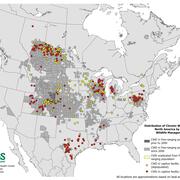
Expanding Distribution of Chronic Wasting Disease
Chronic wasting disease (CWD) has been detected in 37 US states and five Canadian provinces in free-ranging cervids and/or captive cervid facilities.