U.S. flag

An official website of the United States government

All Multimedia

Access all multimedia to include images, video, audio, webcams, before-after imagery, and more. Filter and explore with filtering options to refine search. 

Filter Total Items: 24923
Simplified Geologic Map of Yellowstone National Park

Simplified Geologic Map of Yellowstone, modified from USGS I-711 by Marli Miller, University of Oregon. All rock material resulting from the major caldera-forming eruptions are labelled at Qt, where the dashed caldera boundary highlights the scale of these events. Older volcanic, sedimentary and metamorphic rocks are found outside of this boundary.

Simplified Geologic Map of Yellowstone, modified from USGS I-711 by Marli Miller, University of Oregon. All rock material resulting from the major caldera-forming eruptions are labelled at Qt, where the dashed caldera boundary highlights the scale of these events. Older volcanic, sedimentary and metamorphic rocks are found outside of this boundary.

Illustration of the seafloor that shows depth, and where data was collected.
Trinidad submarine canyon bathymetry

Colored, shaded-relief bathymetry of Trinidad Submarine Canyon northwest of Humboldt Bay in northern California. Area is in the vicinity of a potential offshore renewable energy development. See larger map for location.

Colored, shaded-relief bathymetry of Trinidad Submarine Canyon northwest of Humboldt Bay in northern California. Area is in the vicinity of a potential offshore renewable energy development. See larger map for location.

image related to volcanoes. See description
Extraordinary tenure ends for leader of USGS Hawaiian Volcano Observatory
Man holds up a USGS hat with a lizard sitting on top
Orange-throated Whiptail lizard gets a ride

James Molden shows off an Orange-throated Whiptail (Aspidoscelis hyperythra) while conducting the monthly pitfall trap monitoring at Cabrillo National Monument. The traps were put in place over 20 years ago by researcher Robert Fisher. USGS is looking at the effects of fragmentation on the isolated amphibian and reptile community at the monument.

James Molden shows off an Orange-throated Whiptail (Aspidoscelis hyperythra) while conducting the monthly pitfall trap monitoring at Cabrillo National Monument. The traps were put in place over 20 years ago by researcher Robert Fisher. USGS is looking at the effects of fragmentation on the isolated amphibian and reptile community at the monument.

Photographs of a common eider liver and pancreas.
Photographs from a Common Eider (Somateria mollissima)

Photographs from a Common Eider (Somateria mollissima) from Massachusetts, USA. (A) There are scattered, small, pale foci in the liver. (B) Petechial and ecchymotic hemorrhages are present in the pancreas.

Photographs from a Common Eider (Somateria mollissima) from Massachusetts, USA. (A) There are scattered, small, pale foci in the liver. (B) Petechial and ecchymotic hemorrhages are present in the pancreas.

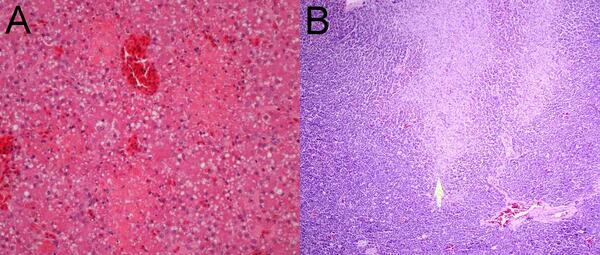
Photomicrographs from a Common Eider showing necrosis.
Photomicrographs from a Common Eider (Somateria mollissima)

Photomicrographs from a Common Eider (Somateria mollissima) from Massachusetts, USA. (A) Multiple pale foci of acute hepatic necrosis. (B) Multiple foci of acute pancreatic necrosis (arrow).

Photomicrographs from a Common Eider (Somateria mollissima) from Massachusetts, USA. (A) Multiple pale foci of acute hepatic necrosis. (B) Multiple foci of acute pancreatic necrosis (arrow).

Walruses resting on an ice floe

A group of Pacific walruses during summer in the Chukchi Sea

cantilever staff plate
Cantilever Staff Plate at Muddy Creek

Cantilever staff plate at Muddy Creek near Hampton streamgage

An image depiction how remote sensing is used to sense soil erosion
How Remote Sensing Was Used To Detect Soil Erosion

Information from satellite imagery helped to differentiate areas vulnerable to soil erosion from off-highway vehicle use. For this study we developed a “P-factor” by scaling ground measurements of soil compaction to vehicle disturbances mapped from aerial imagery.

Information from satellite imagery helped to differentiate areas vulnerable to soil erosion from off-highway vehicle use. For this study we developed a “P-factor” by scaling ground measurements of soil compaction to vehicle disturbances mapped from aerial imagery.

Graphic of invasives increases after wind turbine construction
Invasives Increases After Wind Turbine Construction

Invasives index values before and after turbine construction compared to surrounding control areas (top). Green indicates turbines with higher index values in the period after construction, and yellow indicates no change or lower invasive index values after construction.

Invasives index values before and after turbine construction compared to surrounding control areas (top). Green indicates turbines with higher index values in the period after construction, and yellow indicates no change or lower invasive index values after construction.

A diagram of sampling approach for remote measurement of invasives around wind turbines.
Wind Turbine Sampling Approach

Sampling approach for remote measurements of invasives around wind turbines. 

Jim Lacasse with the graphic for the USGS EROS podcast Eyes on Earth
Eyes on Earth - Satellite Constellations
Eyes on Earth Episode 26 – Satellite Constellations
Jim Lacasse with the graphic for the USGS EROS podcast Eyes on Earth
Eyes on Earth - Satellite Constellations
Eyes on Earth Episode 26 – Satellite Constellations

Between them, Landsats 7 and 8 image the entire land surface of Earth every eight days. The USGS orbiters are just two of many Earth observing satellites flying at the same altitude and collecting data at the same time of day.

Between them, Landsats 7 and 8 image the entire land surface of Earth every eight days. The USGS orbiters are just two of many Earth observing satellites flying at the same altitude and collecting data at the same time of day.

Woman wearing a USGS cap and face covering holds up a coiled snake
Melanie Madden displays a gophersnake

Researcher Melanie Madden holds up a gophersnake (Pituophis catenifer).

Woman wearing USGS cap and a face covering holds up lizard that appears to smile
Melanie Madden displays Blainville's Horned Lizard

Researcher Melanie Madden holds up a Blainville's Horned Lizard (Phrynosoma blainvillii).

Person wearing a USGS hat and a face covering stands in a vegetated area next to a creek and takes a photo
Taking habitat photos for Arroyo Toad surveys

James Molden takes habitat photos for Arroyo Toad surveys in Santa Ysabel Creek.

The Colorado River near Grand Junction, Colorado. 

The Colorado River near Grand Junction, Colorado. The entire Colorado River Basin provides water for more than 40 million people in seven states and nearly 5.5 million acres of farmland across the western U.S. and Mexico. 

The Colorado River near Grand Junction, Colorado. The entire Colorado River Basin provides water for more than 40 million people in seven states and nearly 5.5 million acres of farmland across the western U.S. and Mexico. 

Cody Lanpher making a high flow measurement during a snow melt event on the Gallatin River near Gallatin Gateway, MT.
USGS employee making a high flow measurement during a snow melt event

Cody Lanpher making a high flow measurement during a snow melt event on the Gallatin River near Gallatin Gateway, MT.

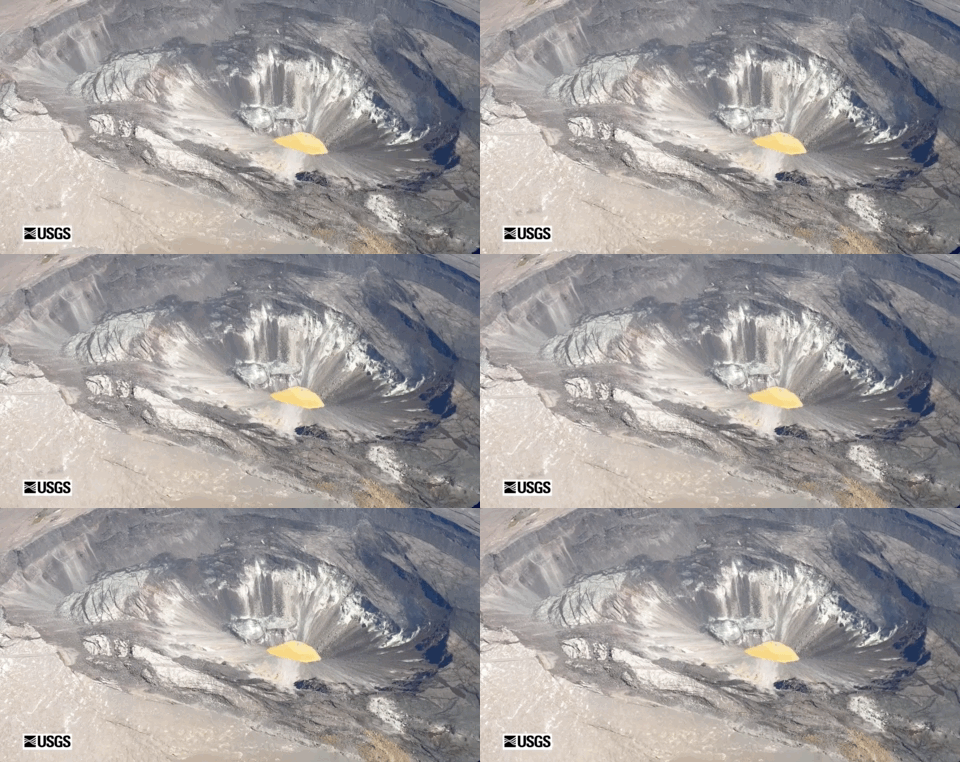
Video of Kīlauea summit from May 29 overflight

This wide-angle video was captured during a helicopter overflight on May 29, and skirts the southern border of Halema‘uma‘u crater. The water lake, filling the bottom of the crater, was tan and brown today, and showed no significant changes. USGS video by M. Patrick.

This wide-angle video was captured during a helicopter overflight on May 29, and skirts the southern border of Halema‘uma‘u crater. The water lake, filling the bottom of the crater, was tan and brown today, and showed no significant changes. USGS video by M. Patrick.

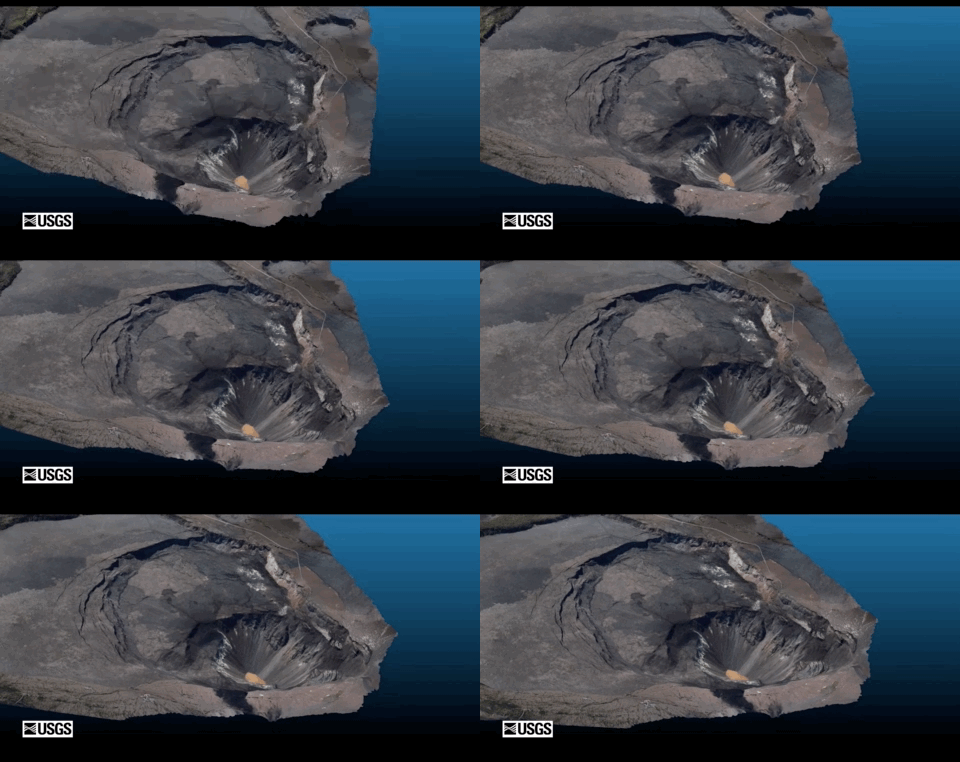
Virtual flyover of Kīlauea summit

A helicopter overflight provided aerial photographs of Kīlauea caldera on May 29, and these photos were used to construct a 3D model. The water lake is visible as the tan area in the deepest portion of Halema‘uma‘u crater. For scale, the water lake is 270 m (885 ft) long and approximately 600 m (1970 ft) below the western caldera rim. USGS photos by K. Mulliken.

A helicopter overflight provided aerial photographs of Kīlauea caldera on May 29, and these photos were used to construct a 3D model. The water lake is visible as the tan area in the deepest portion of Halema‘uma‘u crater. For scale, the water lake is 270 m (885 ft) long and approximately 600 m (1970 ft) below the western caldera rim. USGS photos by K. Mulliken.

Was this page helpful?