U.S. flag

An official website of the United States government

Images

Explore our planet through photography and imagery, including climate change and water all the way back to the 1800s when the USGS was surveying the country by horse and buggy.

Filter Total Items: 21394
USGS scientists map river bathymetry around bridge piers in the Copper River Delta, Alaska
Mapping river bathymetry in the Copper River Delta, Alaska

USGS scientists Robin Beebee (left) and Jeff Conaway use a boat-mounted multibeam echosounder to map river bathymetry around bridge piers in the Copper River Delta of Alaska. The bathymetric mapping is part of a streambed scour study conducted in cooperation with the Alaska Department of Transportation and Public Facilities.

USGS scientists Robin Beebee (left) and Jeff Conaway use a boat-mounted multibeam echosounder to map river bathymetry around bridge piers in the Copper River Delta of Alaska. The bathymetric mapping is part of a streambed scour study conducted in cooperation with the Alaska Department of Transportation and Public Facilities.
Photograph of tubing inserted into a fumarole
Tubing inserted into a fumarole

Tubing inserted into a fumarole at the Sulphur Banks in Hawai‘i Volcanoes National Park allows HVO gas scientists to sample gas. The gas travels through the tube into gas sampling bottles for later analyses. USGS photo by M. Warren.

Tubing inserted into a fumarole at the Sulphur Banks in Hawai‘i Volcanoes National Park allows HVO gas scientists to sample gas. The gas travels through the tube into gas sampling bottles for later analyses. USGS photo by M. Warren.

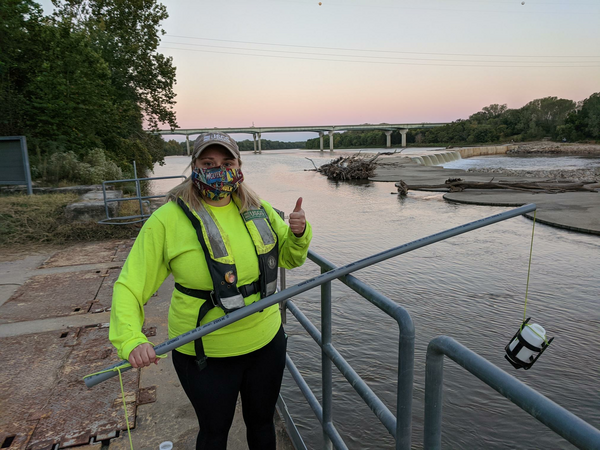
USGS scientist Chantelle Davis prepares to collect a red-dye sample
USGS scientist prepares to collect a red-dye sample in Olathe, Kansas

USGS scientist Chantelle Davis prepares to collect a red-dye sample, at sunrise, for the Time of Travel study in Olathe, Kansas. 

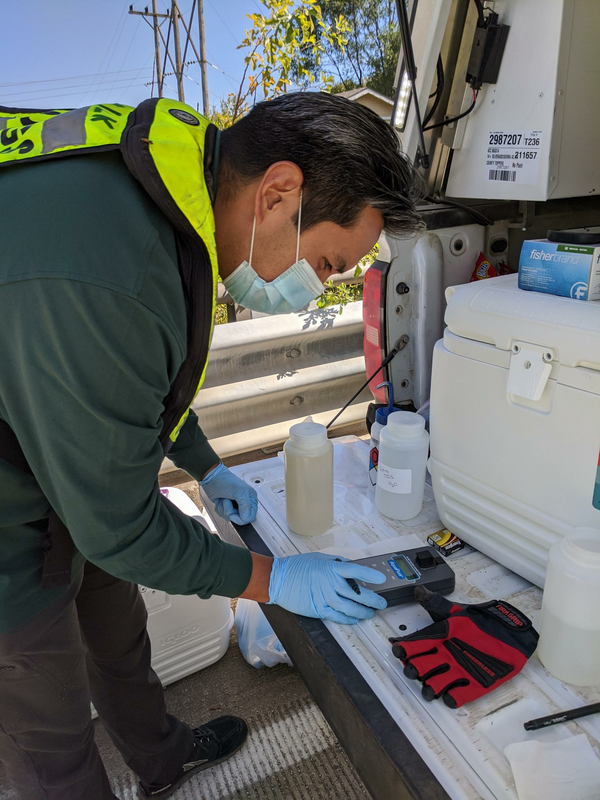
USGS scientist gets a field fluorometer reading from a recently collected red-dye study sample from the Kansas River in DeSoto.
Getting a field fluorometer reading from a red-dye study sample

USGS scientist Ian Gambill gets a field fluorometer reading from a recently collected red-dye study sample from the Kansas River in DeSoto, Kansas.

Iron Spring outflow at Fountain Creek near Manitou Springs, CO
Iron Spring outflow at Fountain Creek near Manitou Springs, Colorado

Springs discharging from the artesian aquifer are commonly supersaturated with minerals. In this photo at Iron Spring a small mound of iron hydroxides is forming below where the spring outflows to Fountain Creek.

Springs discharging from the artesian aquifer are commonly supersaturated with minerals. In this photo at Iron Spring a small mound of iron hydroxides is forming below where the spring outflows to Fountain Creek.

A man wearing safety gear and a warm hat sits in a pontoon boat in very calm water setting up equipment, bridge in background.
Portable single-beam echo sounder set-up

Marine engineering technician Pete Dal Ferro sets up a newly acquired, portable, single-beam echo sounder on the San Lorenzo River in Santa Cruz, California. The new device, called CEESCOPE, collects bathymetric (depth) data and also records features of the subsurface.

Marine engineering technician Pete Dal Ferro sets up a newly acquired, portable, single-beam echo sounder on the San Lorenzo River in Santa Cruz, California. The new device, called CEESCOPE, collects bathymetric (depth) data and also records features of the subsurface.

A small inflatable boat sits on a towing platform with big wheels, on sand in front of an elevated amusement park ride.
Ready for nearshore survey

The USGS Pacific Coastal and Marine Science Center's new inflatable boat equipped with a portable, single beam, shallow-water echo sounder used for nearshore surveys. USGS scientists collect such data seasonally, to study sediment input and movement in and around Monterey Bay area beaches.

The USGS Pacific Coastal and Marine Science Center's new inflatable boat equipped with a portable, single beam, shallow-water echo sounder used for nearshore surveys. USGS scientists collect such data seasonally, to study sediment input and movement in and around Monterey Bay area beaches.

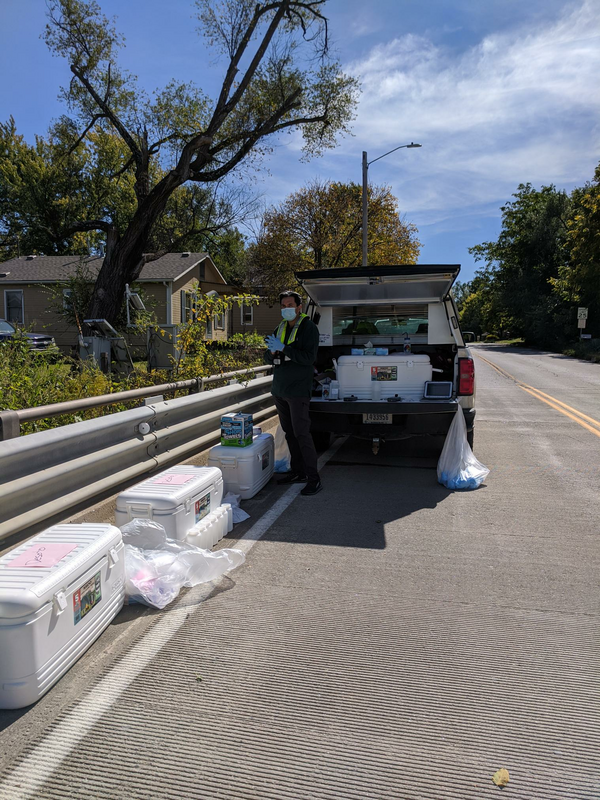
USGS scientist watches over the many samples collected during the red-dye study trial run in Desoto, Kansas.
Samples collected during the red-dye study trial run in Desoto, Kansas

USGS scientist watches over the many samples collected during the red-dye study trial run in Desoto, Kansas while he awaits the next sample.

Panoramic view of Pocket Basin, Yellowstone National Park

Panoramic photo of Pocket Basin, a hydrothermal explosion crater in Yellowstone National Park's Lower Geyser Basin, taken from the northeast rim looking southwest into the crater. Pocket Basin is a U-shaped crater that is dissected on the SW edge by the Firehole River, visible on the far-right of the photo.

Panoramic photo of Pocket Basin, a hydrothermal explosion crater in Yellowstone National Park's Lower Geyser Basin, taken from the northeast rim looking southwest into the crater. Pocket Basin is a U-shaped crater that is dissected on the SW edge by the Firehole River, visible on the far-right of the photo.

Photo of river in steep-sided canyon. A cableway is set up over the river. Scientific instruments are mounted on the cableway ov
USGS Testing ground-penetrating radar (GPR) on a cableway

In September 2020 USGS tested ground-penetrating radar (GPR) mounted on a cableway over the Gunnison River in Colorado. USGS has been testing use of the GPR to map river bathymetry (profiles of water depth along the river), measurements often made by personnel in the water or on boats.

In September 2020 USGS tested ground-penetrating radar (GPR) mounted on a cableway over the Gunnison River in Colorado. USGS has been testing use of the GPR to map river bathymetry (profiles of water depth along the river), measurements often made by personnel in the water or on boats.

Photograph of material floating on volcanic crater lake
Floating material on Kīlauea's summit water lake on September 23, 2020

Small patches of light-colored floating material were seen drifting on the surface of Kīlauea's summit water lake on September 23, 2020. The composition of this material is unknown, but future water sampling missions may provide insight. USGS photo by M. Patrick.

Small patches of light-colored floating material were seen drifting on the surface of Kīlauea's summit water lake on September 23, 2020. The composition of this material is unknown, but future water sampling missions may provide insight. USGS photo by M. Patrick.

Great Salt Lake from Elephant Head
GSL Elephant Head
GSL Elephant Head
GSL Elephant Head

Technicians set up equipment to monitor atmospheric deposition on Elephant Head on a bluebird day, looking north across the Great Salt Lake.

Technicians set up equipment to monitor atmospheric deposition on Elephant Head on a bluebird day, looking north across the Great Salt Lake.

Expansive view of Great Salt Lake from Elephant Head.
GSL Elephant Head 2
GSL Elephant Head 2
GSL Elephant Head 2

Spectacular view of Great Salt Lake on relatively clear day. Lake is lost in the distance as it meets the blue of the sky at the horizon. USGS research scientists in foreground setting up atmospheric deposition collection frame on Elephant Head.

Spectacular view of Great Salt Lake on relatively clear day. Lake is lost in the distance as it meets the blue of the sky at the horizon. USGS research scientists in foreground setting up atmospheric deposition collection frame on Elephant Head.

Photograph of gravimeter in caldera
Kīlauea summit gravity survey - September 23, 2020

A gravimeter makes a measurement at a benchmark situated among lava flows erupted in 1919. The strength of gravity varies with both elevation and the amount of mass beneath the instrument. Changes in mass can indicate changes in the amount of magma entering Kīlauea's magma reservoirs. USGS photo by A. Flinders.

A gravimeter makes a measurement at a benchmark situated among lava flows erupted in 1919. The strength of gravity varies with both elevation and the amount of mass beneath the instrument. Changes in mass can indicate changes in the amount of magma entering Kīlauea's magma reservoirs. USGS photo by A. Flinders.

Photograph of scientists surveying caldera
Kīlauea summit gravity survey - September 23, 2020

On September 23, 2020, Hawaiian Volcano Observatory geophysicists and a geologist conducted a gravity survey of Kīlauea summit, as part of HVO's regular monitoring program. In this photo, scientists are carrying survey equipment westward along the remnants of the Halema‘uma‘u Trail on the down-dropped block of Kīlauea caldera.

On September 23, 2020, Hawaiian Volcano Observatory geophysicists and a geologist conducted a gravity survey of Kīlauea summit, as part of HVO's regular monitoring program. In this photo, scientists are carrying survey equipment westward along the remnants of the Halema‘uma‘u Trail on the down-dropped block of Kīlauea caldera.

Photograph of scientists surveying caldera
Kīlauea summit gravity survey - September 23, 2020

During a gravity survey, HVO scientists measure the relative strength of gravity (gravimeter, bottom left corner of photo) between benchmarks. High-precision vertical positions from kinematic Global Positioning System (GPS, tripod and antenna middle of photo) help correct the gravity measurement for the effects of elevation changes.

During a gravity survey, HVO scientists measure the relative strength of gravity (gravimeter, bottom left corner of photo) between benchmarks. High-precision vertical positions from kinematic Global Positioning System (GPS, tripod and antenna middle of photo) help correct the gravity measurement for the effects of elevation changes.

Photograph of scientist surveying gravity in caldera
Kīlauea summit gravity survey - September 23, 2020

An HVO geophysicist takes a gravity measurement at a benchmark near a continuous gravimeter (inside hutch). The continuous gravimeter takes gravity measurements once per second and relays the data via radio back to HVO. During the gravity survey on September 23, 2020, HVO scientists took measurements at multiple locations on the floor of Kīlauea caldera.

An HVO geophysicist takes a gravity measurement at a benchmark near a continuous gravimeter (inside hutch). The continuous gravimeter takes gravity measurements once per second and relays the data via radio back to HVO. During the gravity survey on September 23, 2020, HVO scientists took measurements at multiple locations on the floor of Kīlauea caldera.

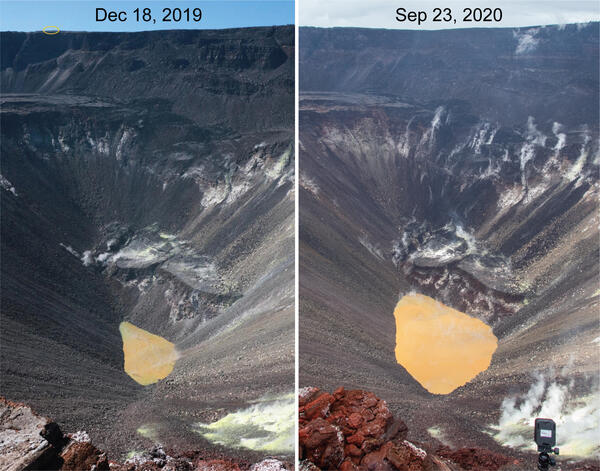
Color photographs of volcanic crater lake
Kīlauea's summit water lake comparison - September 23, 2020

HVO geologists made observations of Kīlauea's summit water lake from the east rim of Halema‘uma‘u. This view point is on the large downdropped block that subsided during the 2018 collapse events. From this spot, a view of the entire lake is possible, providing a new perspective on the growth of the lake.

HVO geologists made observations of Kīlauea's summit water lake from the east rim of Halema‘uma‘u. This view point is on the large downdropped block that subsided during the 2018 collapse events. From this spot, a view of the entire lake is possible, providing a new perspective on the growth of the lake.

Photograph of volcanic crater lake
Kīlauea's water lake from the east side - September 23, 2020

This view shows Kīlauea's water lake from the east side of the crater. On September 23, 2020, the western portion of the lake (top of image) was the most varied in color, with patches of greenish and brown water. The majority of the lake surface, however, was the typical tan hue. USGS photo by M. Patrick.

This view shows Kīlauea's water lake from the east side of the crater. On September 23, 2020, the western portion of the lake (top of image) was the most varied in color, with patches of greenish and brown water. The majority of the lake surface, however, was the typical tan hue. USGS photo by M. Patrick.

Color photograph of road and crater lake
Kīlauea’s summit water lake and Crater Rim Drive - September 23, 2020

Portions of Crater Rim Drive, within Hawai‘i Volcanoes National Park, appear cracked, offset, and down-dropped in this photo, taken during an overflight of Kīlauea’s summit on September 23, 2020. To the north, Kīlauea’s summit water lake, within Halema‘uma‘u, is visible. USGS photo by K. Mulliken.

Portions of Crater Rim Drive, within Hawai‘i Volcanoes National Park, appear cracked, offset, and down-dropped in this photo, taken during an overflight of Kīlauea’s summit on September 23, 2020. To the north, Kīlauea’s summit water lake, within Halema‘uma‘u, is visible. USGS photo by K. Mulliken.

Was this page helpful?