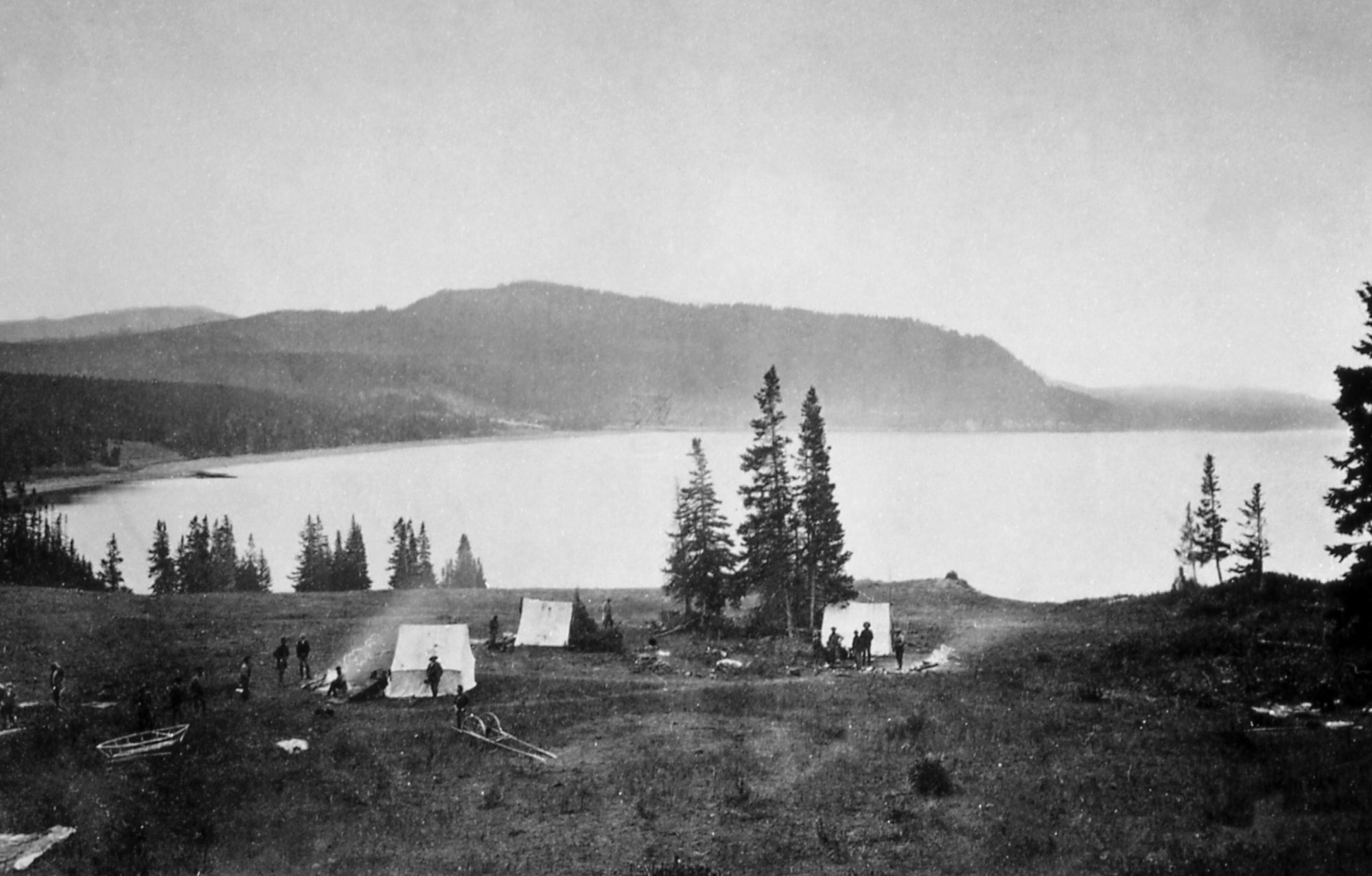
Thurston Lake and Mount Konocti, Clear Lake Volcanic Field
Thurston Lake and Mount Konocti, Clear Lake Volcanic FieldThurston Lake and Mount Konocti, Clear Lake Volcanic Field, California.
An official website of the United States government
Here's how you know
Official websites use .gov
A .gov website belongs to an official government organization in the United States.
Secure .gov websites use HTTPS
A lock () or https:// means you’ve safely connected to the .gov website. Share sensitive information only on official, secure websites.
Volcano Hazard Program images.
Thurston Lake and Mount Konocti, Clear Lake Volcanic Field, California.
Beryl Spring's strongly boiling blue pool is about 8 m (25 ft) wide and contains high-chloride liquid water with a near-neutral pH. Immediately behind the pool is a loud, hissing fumarole producing a white cloud of steam. USGS Photo by Pat Shanks, 2002.
Imperial Geyser looking south. This hot spring pool is about 30 m (about 100 ft) across and contains alkaline-Cl waters with a steam vent in the pool and mudpots outside the pool area (in the upper right part of this photo). USGS Photo by Pat Shanks, 2019.
Volcano Awareness Month programs offered in January 2020 are depicted by these images. Clockwise from top left: ground cracks opened at HVO's former location atop Kīlauea in 2018; fissure erupting on Mauna Loa in March 1984; crater lake within Halema‘uma‘u at Kīlauea's summit; and visitors hiking a Kahuku trail in Hawai‘i Volcanoes National Park (NPS).
2020 Volcano Awareness Month Schedule Overview. Details are posted on the USGS-Hawaiian Volcano Observatory's website at https://volcanoes.usgs.gov/observatories/hvo/.
USGS Hawaiian Volcano Observatory geophysicist Jefferson Chang during his presentation at the 2019 National Diversity in STEM Conference in Honolulu. Chang and Kevan Kamibayashi (left) were two of four HVO scientists who spoke about their work monitoring Hawaiian volcanoes at the SACNAS conference.
Still image from January 2, 2020, YVO video update.
Jefferson Chang (far left) was one of four USGS Hawaiian Volcano Observatory scientists who spoke about monitoring Hawaiian volcanoes and mentored students at the 2019 National Diversity in STEM Conference in Honolulu.
Map of seismicity (yellow circles) in the Yellowstone region during 2019. Gray lines are roads, red line shows the caldera boundary, Yellowstone National Park is outlined by black dashed line, and gray dashed lines denote state boundaries.
The December 18 overflight provided updated aerial photographs of Kīlauea summit, covering the caldera floor and showing the current size of the water pond in Halema‘uma‘u crater. The label "downdropped block" shows the large portion of the caldera floor that subsided, along with the Halema‘uma‘u region, during the 2018 eruption.
The December 18 overflight provided updated thermal images of Kīlauea summit, covering the caldera floor and showing the warm surface of the water pond in Halema‘uma‘u crater. A band of warm temperatures persists along the new cliff formed during the 2018 subsidence.
Photos taken two weeks apart show the rise of water in Halema‘uma‘u. A white arrow denotes a large rock along the edge of the lake for comparing water levels in the two images. The water continues to rise at a rate of approximately 15 cm (6 in) per day. USGS photos by M. Patrick.
The 1880-1881 eruption of Mauna Loa produced lava flows that came within 1.7 km (1.1 mi) of the Hilo Bay shoreline. This painting by Charles Furneaux, "Night View 1880–1881, Eruption from Hilo Bay," illustrates the first two flows as they would have been in November 1880. In reality, however, both flows would not have been visible from this vantage.
An HVO geologist uses a high-precision Global Positioning System (GPS) unit to collect latitude, longitude, and altitude data on a down-dropped portion of Kīlauea's caldera.
Clear Lake Volcanic Field, California. Tuff deposit outcrop.
After collecting a sample from the well using the narrow sampler shown, HVO staff transfer the water sample into a container. The water is collected periodically for chemical analyses so that changes in the water composition can be tracked. For more information about the Keller Well, please see HVO's Dec.
The communications hub at Pu‘u ‘Ō‘ō is precariously perched on the north rim, which is actively collapsing. This hub, and the PN cam behind the hub (to the left of image) will ultimately fall into the crater as the north rim continues to collapse.
On Tuesday, December 10 HVO staff visited Keller Well, a deep borehole at the summit of Kīlauea, to take quarterly measurements and samples. This photo shows an extra long measuring tape, which has a sensor attached to the end, being lowered into the well to measure the distance to the top of the water table.
The "Short-term Sulfur Dioxide Advisory Level Information" table (http://www.hiso2index.info/assets/FinalSO2Exposurelevels.pdf) uses a six-tiered color-coded system to depict sulfur dioxide (SO2) concentrations and provide guidance for different groups of people exposed to SO2
Angel Terrace, Mammoth Hot Springs, Yellowstone National Park. Travertine deposits are abundant in the area. Photo by JoAnn Holloway, 2003.
Water collected from the lake at the bottom of Halema‘uma‘u is prepared for laboratory analyses at the USGS California Volcano Observatory. Results thus far reveal chemistry indicative of complex reactions between the water, magmatic gases, and Kīlauea's basaltic rocks.