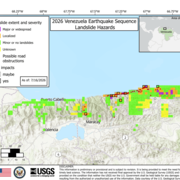
Helping Prepare the Nation Against Landslide Threats
Over the last three years, the USGS has awarded millions of dollars to local governments to support landslide risk-reduction efforts
USGS Launches Updated Aviation-Focused Volcano Notices
Earthquakes Pose Risk to Global Mineral Supplies
USGS scientists study how seismicity could impact mineral commodity supplies like copper and rhenium.
Monitoring Kīlauea Volcano's Current Eruption
Eruptions within Hawaiʻi Volcanoes National Park have been intermittent since December 23, 2024.
Alarming Future for California's Coastline
Computer modeling and new research predict significant erosion by 2100.
Postfire Debris-Flow Hazard Assessments Help Manage Further Loss
This interactive dashboard shows the likelihood and potential severity for debris-flows.
Understanding Earth's Electrical Conductivity Helps Protect from Space Weather
The study can also help support mineral and geothermal resource assessment.
Natural Hazards Mission Area
Every year in the United States, natural hazards threaten lives and livelihoods and result in billions of dollars in damage. We work with many partners to monitor, assess, and conduct targeted research on a wide range of natural hazards so that policymakers and the public have the understanding they need to enhance preparedness, response, and resilience.
Office of Risk and Resilience

Working to ensure that relevant and actionable USGS hazards and risk information is developed and delivered in user-friendly ways to support risk-reduction efforts at a national scale.
Subduction Zone Science

The most powerful earthquakes, tsunamis, landslides, and volcanic eruptions occur in subduction zones, where two plates collide and one is thrust beneath another.
Get Notified
You can subscribe to USGS Hazards Data Alerts, Forecasts and other Earth Monitoring Information
News
253-year coral record reveals Maui reef’s long history of land-use impacts
Deep-sea sulfide minerals can spontaneously heat and combust when exposed to air
A Case Study for Radon as a Tracer of Seabed Minerals
Publications
Estimating aftershock risk for entry into earthquake-damaged buildings Estimating aftershock risk for entry into earthquake-damaged buildings
Fully contained laboratory earthquakes: The effect of asperity aspect ratio and free surfaces Fully contained laboratory earthquakes: The effect of asperity aspect ratio and free surfaces
CRESCENT earthquake dynamic rupture, earthquake cycle, and tsunami code verification platform CRESCENT earthquake dynamic rupture, earthquake cycle, and tsunami code verification platform
Science
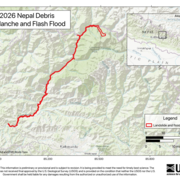
2026 Nepal Debris Avalanche and Flash Flood

Rainfall and Landslides in Northern California