
Karen Thorne, Ph.D. (Former Employee)
Science and Products
Filter Total Items: 28
Assessing Genomic Diversity and Clonality in Tape Seagrass in Guam and Surrounding Pacific Islands to Inform Climate Resilient Restoration
Project Overview Seagrass meadows support island communities by sustaining fisheries and protecting shorelines. However, some species, such as tape grass, may lack the genetic variation needed to survive and adapt to warmer, saltier ocean waters. Researchers supported by this Pacific Islands CASC project will sequence the tape grass genome and assess genetic variation across Micronesia...
Habitat Vulnerability to Climate Change: Identifying Climate Change Induced Mass Mortality Events Across Large Landscapes of the United States
USGS researchers will characterize extreme climatic events across U.S. following a review of case studies of mass mortality events associated with climate extremes including drought, precipitation, freeze, heat waves, and storm events.
Coastal Wetland Vulnerability to Climate Change and Sea-Level Rise: Understanding Ecological Thresholds and Ecosystem Transformations
Eighteen USGS coastal scientists from all four coasts of the conterminous United States are working together to advance the understanding of climate change and sea-level rise impacts to coastal wetlands.
By
California Water Science Center, Chesapeake Bay Activities, Eastern Ecological Science Center, Florence Bascom Geoscience Center, Great Lakes Science Center, Pacific Coastal and Marine Science Center, St. Petersburg Coastal and Marine Science Center, Western Ecological Research Center (WERC), Western Geographic Science Center, Wetland and Aquatic Research Center , Woods Hole Coastal and Marine Science Center
Spread of invasive vegetation under climate change in the national parks of the Klamath Region
Project Overview: The Klamath Region of Oregon and California is a global hotspot of biodiversity, but invasive species, climate change, and severe fires threaten native biodiversity, even within national parks. Scientists supported by this Southwest CASC project will create early-warning maps of where invasive plants are most likely to spread, helping national park managers target their
Enhancing Community and Wildlife Resilience to Sea‐Level Rise and Infrastructure Development in the San Pablo Baylands
Project Overview: The San Pablo Baylands support critical wildlife habitat and major transportation infrastructure, but the combined effects of sea-level rise and planned highway redesigns on habitat and public access remain uncertain. Scientists supported by this Southwest CASC project will work with federal, state, and regional managers to fill key data gaps and model how sea-level...
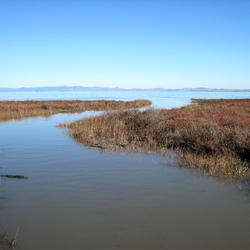
Modeling vulnerability for San Francisco Bay estuary tidal marshes
Karen Thorne researches the effects of inundation and ecological processes within the San Francisco Bay-Delta estuary.
Developing a Pacific Mangrove Monitoring Network (PACMAN) in Response to Sea Level Rise
Continued sea-level rise from a changing climate is expected to result in the loss of many coastal mangrove trees, which, will strongly affect human populations on isolated Western Pacific islands as they rely heavily on mangrove forests for food (fish, shrimp, and crabs), building materials, and firewood. Mangroves also protect local communities from tsunamis and cyclones and are...
Wetland Carbon Working Group: Improving Methodologies and Estimates of Carbon and Greenhouse Gas Flux in Wetlands
WARC researchers are working to quantify the impacts of future climate and land use/land cover change on greenhouse gas emissions and reductions.
Sea-level Rise Vulnerability of Mangrove Forests in Micronesia and the Pacific
The USGS and partners are studying how mangrove forests in the Federated States of Micronesia may respond to sea-level rise over the coming century. Their projections will help Micronesian communities plan for the future.
The Response of Coastal Wetlands to Sea-level Rise: Understanding how Macroscale Drivers Influence Local Processes and Feedbacks
The purpose of this work is to advance our understanding of how coastal wetland responses to sea-level rise (SLR) within the conterminous United States are likely to vary as a function of local, regional, and macroscale drivers, including climate. Based on our interactions with managers and decision makers, as well as our knowledge of the current state of the science, we propose to: (a) conduct a...
The response of coastal wetlands to sea-level rise: Understanding how macroscale drivers influence local processes and feedbacks
The purpose of this work is to advance our understanding of how coastal wetland responses to SLR within the conterminous United States are likely to vary as a function of local, regional, and macroscale drivers, including climate. Based on our interactions with managers and decision makers, as well as our knowledge of the current state of the science, we propose to (a) conduct a national synoptic...
Science to Inform the Management of Mangrove Ecosystems Undergoing Sea Level Rise at Ding Darling National Wildlife Refuge, Sanibel Island, Florida
Mangroves are forested tidal wetlands that occur in tropical, sub-tropical, and warm temperate coastal regions around the world. Mangroves occupy a significant area of coastlines globally and provide important ecosystem services to humans and wildlife. These services include aesthetic value, storm protection, food provisioning, recreation, critical wildlife habitat, and biological carbon
Filter Total Items: 40
No Result Found
Filter Total Items: 83
Waterfowl use of wetland habitats informs wetland restoration designs for multi‐species benefits Waterfowl use of wetland habitats informs wetland restoration designs for multi‐species benefits
Extensive global estuarine wetland losses have prompted intensive focus on restoration of these habitats. In California, substantial tracts of freshwater, brackish and tidal wetlands have been lost. Given the anthropogenic footprint of development and urbanization in this region, wetland restoration must rely on conversion of existing habitat types rather than adding new wetlands. These...
Authors
Michael L. Casazza, Fiona McDuie, Scott Jones, Austen Lorenz, Cory T. Overton, Julie L. Yee, Cliff L. Feldheim, Joshua T. Ackerman, Karen M. Thorne
Short-term impact of sediment addition on plants and invertebrates in a southern California salt marsh Short-term impact of sediment addition on plants and invertebrates in a southern California salt marsh
The implementation and monitoring of management strategies is integral to protect coastal marshes from increased inundation and submergence under sea-level rise. Sediment addition is one such strategy in which sediment is added to marshes to raise relative elevations, decrease tidal inundation, and enhance ecosystem processes. This study looked at the plant and invertebrate community...
Authors
Kaelin J McAtee, Karen M. Thorne, Christine R Whitcraft
Salinity and inundation effects on productivity of brackish tidal marsh plants in the San Francisco Bay-Delta Estuary Salinity and inundation effects on productivity of brackish tidal marsh plants in the San Francisco Bay-Delta Estuary
Plant productivity is central to numerous ecosystem functions in tidal wetlands. We examined how productivity of brackish marsh plants in northern California responded to abiotic stress gradients of inundation and salinity using two experimental approaches. In a greenhouse study with varying salinity, shoot production and biomass of Juncus balticus, Schoenoplectus acutus and S...
Authors
Christopher N. Janousek, Bruce D. Dugger, Brandon M Drucker, Karen M. Thorne
Testing the interactive effects of flooding and salinity on tidal marsh plant productivity Testing the interactive effects of flooding and salinity on tidal marsh plant productivity
Tidal wetlands support plant communities that facilitate carbon storage, accrete soil, and provide habitat for terrestrial and aquatic species. Climate change is likely to alter estuaries through sea-level rise and changing precipitation patterns, although the ecological responses are uncertain. We were interested in plant responses to physiological stress induced by elevated water...
Authors
Kevin J. Buffington, Arianna C Goodman, Chase M. Freeman, Karen M. Thorne
Spatiotemporal patterns of mineral and organic matter deposition across two San Francisco Bay-Delta tidal marshes Spatiotemporal patterns of mineral and organic matter deposition across two San Francisco Bay-Delta tidal marshes
Sediment deposition in tidal wetlands is a critical process that determines whether vertical growth will keep pace with sea-level rise. However, more information is needed on how sediment deposition varies spatially and temporally across wetlands, including the effects of elevation, tidal inundation, vegetation, and weather. We investigated variation in sediment deposition due to season...
Authors
Kevin J. Buffington, Christopher N. Janousek, Karen M. Thorne, Bruce D. Dugger
Effects of elevated sea levels and waves on southern California estuaries during the 2015–2016 El Niño Effects of elevated sea levels and waves on southern California estuaries during the 2015–2016 El Niño
The 2015–2016 El Niño provided insight into how low-inflow estuaries might respond to future climate regimes, including high sea levels and more intense waves. High waves and water levels coupled with low rainfall along the Southern California coastline provided the opportunity to examine how extreme ocean forcing impacts estuaries independently from fluvial events. From November 2015 to...
Authors
Madeleine Harvey, Sarah N Giddings, Eric D. Stein, Jeffrey A Crooks, Christine R Whitcraft, Timu W. Gallien, John L. Largier, Liesl Tiefenthaler, Hallee Meltzer, Geno Pawlak, Karen M. Thorne, Karina Johnston, Richard F. Ambrose, Stephen C Schroeter, Henry M. Page, Hany Elwany
Habitat of the endangered salt marsh harvest mouse (Reithrodontomys raviventris) in San Francisco Bay Habitat of the endangered salt marsh harvest mouse (Reithrodontomys raviventris) in San Francisco Bay
Understanding habitat associations is vital for conservation of at‐risk marsh‐endemic wildlife species, particularly those under threat from sea level rise. We modeled environmental and habitat associations of the marsh‐endemic, Federally endangered salt marsh harvest mouse (Reithrodontomys raviventris, RERA) and co‐occurrence with eight associated small mammal species from annual trap...
Authors
Bruce G. Marcot, Isa Woo, Karen M. Thorne, Chase M. Freeman, Glenn R. Guntenspergen
Understanding tidal marsh trajectories: Evaluation of multiple indicators of marsh persistence Understanding tidal marsh trajectories: Evaluation of multiple indicators of marsh persistence
Robust assessments of ecosystem stability are critical for informing conservation and management decisions. Tidal marsh ecosystems provide vital services, yet are globally threatened by anthropogenic alterations to physical and biological processes. A variety of monitoring and modeling approaches have been undertaken to determine which tidal marshes are likely to persist into the future...
Authors
Kerstin Wasson, Neil K. Ganju, Zafer Defne, Charlie Endris, Tracy Elsey-Quirk, Karen M. Thorne, Chase M. Freeman, Glenn R. Guntenspergen, Daniel J. Nowacki, Kenneth B. Raposa
Thin-layer sediment addition to an existing salt marsh to combat sea-level rise and improve endangered species habitat in California, USA Thin-layer sediment addition to an existing salt marsh to combat sea-level rise and improve endangered species habitat in California, USA
Current tidal marsh elevations and their accretion rates are important predictors of vulnerability to sea-level rise. When tidal marshes are at risk, adaptation measures, such as sediment addition to increase elevations, can be implemented to prevent degradation and loss. In 2016, wildlife managers prescribed a thin-layer sediment addition of locally sourced dredged material from Anaheim...
Authors
Karen M. Thorne, Chase M. Freeman, Jordan A. Rosencranz, Neil K. Ganju, Glenn R. Guntenspergen
Flooding regimes increase avian predation on wildlife prey in tidal marsh ecosystems Flooding regimes increase avian predation on wildlife prey in tidal marsh ecosystems
Within isolated and fragmented populations, species interactions such as predation can cause shifts in community structure and demographics in tidal marsh ecosystems. It is critical to incorporate species interactions into our understanding when evaluating the effects of sea‐level rise and storm surges on tidal marshes. In this study, we hypothesize that avian predators will increase...
Authors
Karen M. Thorne, Kyle A. Spragens, Kevin J. Buffington, Jordan A. Rosencranz, John Takekawa
Rising tides: Assessing habitat vulnerability for an endangered salt marsh-dependent species with sea-level rise Rising tides: Assessing habitat vulnerability for an endangered salt marsh-dependent species with sea-level rise
Salt marsh-dependent species are vulnerable to impacts of sea-level rise (SLR). Site-specific differences in ecogeomorphic processes result in different SLR vulnerabilities. SLR impacts to Ridgway’s rail (Rallus obsoletus) of Southern California (SC) and San Francisco Bay (SF), U.S.A. could foreshadow SLR effects on other coastal endemic species. Salt marsh vulnerabilities to SLR were...
Authors
Jordan A. Rosencranz, Karen M. Thorne, Kevin J. Buffington, Cory T. Overton, John Takekawa, Michael L. Casazza, Jennifer McBroom, Julian K. Wood, Nadav Nur, Richard L. Zembal, Glen M. MacDonald, Richard F. Ambrose
El Niño increases high‐tide flooding in tidal wetlands along the U.S. Pacific coast. El Niño increases high‐tide flooding in tidal wetlands along the U.S. Pacific coast.
Periodic oscillations between El Niño and La Niña conditions in the Pacific Basin affect oceanographic and meteorological phenomena globally, with impacts on the abundance and distribution of marine species. However, El Niño effects on estuarine hydrology and tidal wetland processes have seldom been examined rigorously. We used detailed wetland elevation and local inundation data from 10...
Authors
Arianna Goodman, Karen M. Thorne, Kevin J. Buffington, Chase M. Freeman, Christopher N. Janousek
Science and Products
Filter Total Items: 28
Assessing Genomic Diversity and Clonality in Tape Seagrass in Guam and Surrounding Pacific Islands to Inform Climate Resilient Restoration
Project Overview Seagrass meadows support island communities by sustaining fisheries and protecting shorelines. However, some species, such as tape grass, may lack the genetic variation needed to survive and adapt to warmer, saltier ocean waters. Researchers supported by this Pacific Islands CASC project will sequence the tape grass genome and assess genetic variation across Micronesia...
Habitat Vulnerability to Climate Change: Identifying Climate Change Induced Mass Mortality Events Across Large Landscapes of the United States
USGS researchers will characterize extreme climatic events across U.S. following a review of case studies of mass mortality events associated with climate extremes including drought, precipitation, freeze, heat waves, and storm events.
Coastal Wetland Vulnerability to Climate Change and Sea-Level Rise: Understanding Ecological Thresholds and Ecosystem Transformations
Eighteen USGS coastal scientists from all four coasts of the conterminous United States are working together to advance the understanding of climate change and sea-level rise impacts to coastal wetlands.
By
California Water Science Center, Chesapeake Bay Activities, Eastern Ecological Science Center, Florence Bascom Geoscience Center, Great Lakes Science Center, Pacific Coastal and Marine Science Center, St. Petersburg Coastal and Marine Science Center, Western Ecological Research Center (WERC), Western Geographic Science Center, Wetland and Aquatic Research Center , Woods Hole Coastal and Marine Science Center
Spread of invasive vegetation under climate change in the national parks of the Klamath Region
Project Overview: The Klamath Region of Oregon and California is a global hotspot of biodiversity, but invasive species, climate change, and severe fires threaten native biodiversity, even within national parks. Scientists supported by this Southwest CASC project will create early-warning maps of where invasive plants are most likely to spread, helping national park managers target their
Enhancing Community and Wildlife Resilience to Sea‐Level Rise and Infrastructure Development in the San Pablo Baylands
Project Overview: The San Pablo Baylands support critical wildlife habitat and major transportation infrastructure, but the combined effects of sea-level rise and planned highway redesigns on habitat and public access remain uncertain. Scientists supported by this Southwest CASC project will work with federal, state, and regional managers to fill key data gaps and model how sea-level...
Modeling vulnerability for San Francisco Bay estuary tidal marshes
Karen Thorne researches the effects of inundation and ecological processes within the San Francisco Bay-Delta estuary.
Developing a Pacific Mangrove Monitoring Network (PACMAN) in Response to Sea Level Rise
Continued sea-level rise from a changing climate is expected to result in the loss of many coastal mangrove trees, which, will strongly affect human populations on isolated Western Pacific islands as they rely heavily on mangrove forests for food (fish, shrimp, and crabs), building materials, and firewood. Mangroves also protect local communities from tsunamis and cyclones and are...
Wetland Carbon Working Group: Improving Methodologies and Estimates of Carbon and Greenhouse Gas Flux in Wetlands
WARC researchers are working to quantify the impacts of future climate and land use/land cover change on greenhouse gas emissions and reductions.
Sea-level Rise Vulnerability of Mangrove Forests in Micronesia and the Pacific
The USGS and partners are studying how mangrove forests in the Federated States of Micronesia may respond to sea-level rise over the coming century. Their projections will help Micronesian communities plan for the future.
The Response of Coastal Wetlands to Sea-level Rise: Understanding how Macroscale Drivers Influence Local Processes and Feedbacks
The purpose of this work is to advance our understanding of how coastal wetland responses to sea-level rise (SLR) within the conterminous United States are likely to vary as a function of local, regional, and macroscale drivers, including climate. Based on our interactions with managers and decision makers, as well as our knowledge of the current state of the science, we propose to: (a) conduct a...
The response of coastal wetlands to sea-level rise: Understanding how macroscale drivers influence local processes and feedbacks
The purpose of this work is to advance our understanding of how coastal wetland responses to SLR within the conterminous United States are likely to vary as a function of local, regional, and macroscale drivers, including climate. Based on our interactions with managers and decision makers, as well as our knowledge of the current state of the science, we propose to (a) conduct a national synoptic...
Science to Inform the Management of Mangrove Ecosystems Undergoing Sea Level Rise at Ding Darling National Wildlife Refuge, Sanibel Island, Florida
Mangroves are forested tidal wetlands that occur in tropical, sub-tropical, and warm temperate coastal regions around the world. Mangroves occupy a significant area of coastlines globally and provide important ecosystem services to humans and wildlife. These services include aesthetic value, storm protection, food provisioning, recreation, critical wildlife habitat, and biological carbon
Filter Total Items: 40
No Result Found
Filter Total Items: 83
Waterfowl use of wetland habitats informs wetland restoration designs for multi‐species benefits Waterfowl use of wetland habitats informs wetland restoration designs for multi‐species benefits
Extensive global estuarine wetland losses have prompted intensive focus on restoration of these habitats. In California, substantial tracts of freshwater, brackish and tidal wetlands have been lost. Given the anthropogenic footprint of development and urbanization in this region, wetland restoration must rely on conversion of existing habitat types rather than adding new wetlands. These...
Authors
Michael L. Casazza, Fiona McDuie, Scott Jones, Austen Lorenz, Cory T. Overton, Julie L. Yee, Cliff L. Feldheim, Joshua T. Ackerman, Karen M. Thorne
Short-term impact of sediment addition on plants and invertebrates in a southern California salt marsh Short-term impact of sediment addition on plants and invertebrates in a southern California salt marsh
The implementation and monitoring of management strategies is integral to protect coastal marshes from increased inundation and submergence under sea-level rise. Sediment addition is one such strategy in which sediment is added to marshes to raise relative elevations, decrease tidal inundation, and enhance ecosystem processes. This study looked at the plant and invertebrate community...
Authors
Kaelin J McAtee, Karen M. Thorne, Christine R Whitcraft
Salinity and inundation effects on productivity of brackish tidal marsh plants in the San Francisco Bay-Delta Estuary Salinity and inundation effects on productivity of brackish tidal marsh plants in the San Francisco Bay-Delta Estuary
Plant productivity is central to numerous ecosystem functions in tidal wetlands. We examined how productivity of brackish marsh plants in northern California responded to abiotic stress gradients of inundation and salinity using two experimental approaches. In a greenhouse study with varying salinity, shoot production and biomass of Juncus balticus, Schoenoplectus acutus and S...
Authors
Christopher N. Janousek, Bruce D. Dugger, Brandon M Drucker, Karen M. Thorne
Testing the interactive effects of flooding and salinity on tidal marsh plant productivity Testing the interactive effects of flooding and salinity on tidal marsh plant productivity
Tidal wetlands support plant communities that facilitate carbon storage, accrete soil, and provide habitat for terrestrial and aquatic species. Climate change is likely to alter estuaries through sea-level rise and changing precipitation patterns, although the ecological responses are uncertain. We were interested in plant responses to physiological stress induced by elevated water...
Authors
Kevin J. Buffington, Arianna C Goodman, Chase M. Freeman, Karen M. Thorne
Spatiotemporal patterns of mineral and organic matter deposition across two San Francisco Bay-Delta tidal marshes Spatiotemporal patterns of mineral and organic matter deposition across two San Francisco Bay-Delta tidal marshes
Sediment deposition in tidal wetlands is a critical process that determines whether vertical growth will keep pace with sea-level rise. However, more information is needed on how sediment deposition varies spatially and temporally across wetlands, including the effects of elevation, tidal inundation, vegetation, and weather. We investigated variation in sediment deposition due to season...
Authors
Kevin J. Buffington, Christopher N. Janousek, Karen M. Thorne, Bruce D. Dugger
Effects of elevated sea levels and waves on southern California estuaries during the 2015–2016 El Niño Effects of elevated sea levels and waves on southern California estuaries during the 2015–2016 El Niño
The 2015–2016 El Niño provided insight into how low-inflow estuaries might respond to future climate regimes, including high sea levels and more intense waves. High waves and water levels coupled with low rainfall along the Southern California coastline provided the opportunity to examine how extreme ocean forcing impacts estuaries independently from fluvial events. From November 2015 to...
Authors
Madeleine Harvey, Sarah N Giddings, Eric D. Stein, Jeffrey A Crooks, Christine R Whitcraft, Timu W. Gallien, John L. Largier, Liesl Tiefenthaler, Hallee Meltzer, Geno Pawlak, Karen M. Thorne, Karina Johnston, Richard F. Ambrose, Stephen C Schroeter, Henry M. Page, Hany Elwany
Habitat of the endangered salt marsh harvest mouse (Reithrodontomys raviventris) in San Francisco Bay Habitat of the endangered salt marsh harvest mouse (Reithrodontomys raviventris) in San Francisco Bay
Understanding habitat associations is vital for conservation of at‐risk marsh‐endemic wildlife species, particularly those under threat from sea level rise. We modeled environmental and habitat associations of the marsh‐endemic, Federally endangered salt marsh harvest mouse (Reithrodontomys raviventris, RERA) and co‐occurrence with eight associated small mammal species from annual trap...
Authors
Bruce G. Marcot, Isa Woo, Karen M. Thorne, Chase M. Freeman, Glenn R. Guntenspergen
Understanding tidal marsh trajectories: Evaluation of multiple indicators of marsh persistence Understanding tidal marsh trajectories: Evaluation of multiple indicators of marsh persistence
Robust assessments of ecosystem stability are critical for informing conservation and management decisions. Tidal marsh ecosystems provide vital services, yet are globally threatened by anthropogenic alterations to physical and biological processes. A variety of monitoring and modeling approaches have been undertaken to determine which tidal marshes are likely to persist into the future...
Authors
Kerstin Wasson, Neil K. Ganju, Zafer Defne, Charlie Endris, Tracy Elsey-Quirk, Karen M. Thorne, Chase M. Freeman, Glenn R. Guntenspergen, Daniel J. Nowacki, Kenneth B. Raposa
Thin-layer sediment addition to an existing salt marsh to combat sea-level rise and improve endangered species habitat in California, USA Thin-layer sediment addition to an existing salt marsh to combat sea-level rise and improve endangered species habitat in California, USA
Current tidal marsh elevations and their accretion rates are important predictors of vulnerability to sea-level rise. When tidal marshes are at risk, adaptation measures, such as sediment addition to increase elevations, can be implemented to prevent degradation and loss. In 2016, wildlife managers prescribed a thin-layer sediment addition of locally sourced dredged material from Anaheim...
Authors
Karen M. Thorne, Chase M. Freeman, Jordan A. Rosencranz, Neil K. Ganju, Glenn R. Guntenspergen
Flooding regimes increase avian predation on wildlife prey in tidal marsh ecosystems Flooding regimes increase avian predation on wildlife prey in tidal marsh ecosystems
Within isolated and fragmented populations, species interactions such as predation can cause shifts in community structure and demographics in tidal marsh ecosystems. It is critical to incorporate species interactions into our understanding when evaluating the effects of sea‐level rise and storm surges on tidal marshes. In this study, we hypothesize that avian predators will increase...
Authors
Karen M. Thorne, Kyle A. Spragens, Kevin J. Buffington, Jordan A. Rosencranz, John Takekawa
Rising tides: Assessing habitat vulnerability for an endangered salt marsh-dependent species with sea-level rise Rising tides: Assessing habitat vulnerability for an endangered salt marsh-dependent species with sea-level rise
Salt marsh-dependent species are vulnerable to impacts of sea-level rise (SLR). Site-specific differences in ecogeomorphic processes result in different SLR vulnerabilities. SLR impacts to Ridgway’s rail (Rallus obsoletus) of Southern California (SC) and San Francisco Bay (SF), U.S.A. could foreshadow SLR effects on other coastal endemic species. Salt marsh vulnerabilities to SLR were...
Authors
Jordan A. Rosencranz, Karen M. Thorne, Kevin J. Buffington, Cory T. Overton, John Takekawa, Michael L. Casazza, Jennifer McBroom, Julian K. Wood, Nadav Nur, Richard L. Zembal, Glen M. MacDonald, Richard F. Ambrose
El Niño increases high‐tide flooding in tidal wetlands along the U.S. Pacific coast. El Niño increases high‐tide flooding in tidal wetlands along the U.S. Pacific coast.
Periodic oscillations between El Niño and La Niña conditions in the Pacific Basin affect oceanographic and meteorological phenomena globally, with impacts on the abundance and distribution of marine species. However, El Niño effects on estuarine hydrology and tidal wetland processes have seldom been examined rigorously. We used detailed wetland elevation and local inundation data from 10...
Authors
Arianna Goodman, Karen M. Thorne, Kevin J. Buffington, Chase M. Freeman, Christopher N. Janousek
*Disclaimer: Listing outside positions with professional scientific organizations on this Staff Profile are for informational purposes only and do not constitute an endorsement of those professional scientific organizations or their activities by the USGS, Department of the Interior, or U.S. Government