
U.S. flag

An official website of the United States government

Videos

Videos intro.
Filter Total Items: 26
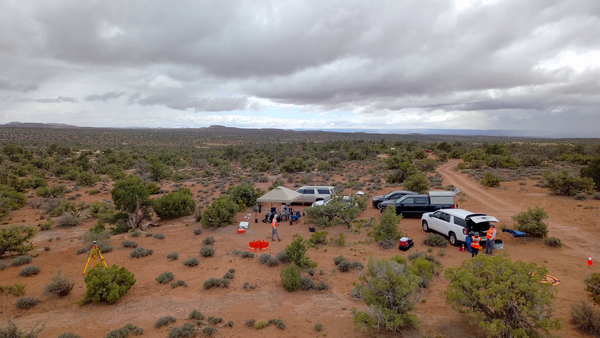
Overhead view taken by drone of a USGS fieldwork site in Moab with multiple cars and a tent shelter Overhead view taken by drone of a USGS fieldwork site in Moab with multiple cars and a tent shelter
B-Roll: Field and drone remote sensing operations near Moab, Utah – May 2025

In May 2025, the U.S. Geological Survey (USGS) National Uncrewed Systems Office (NUSO) collected uncrewed aircraft system (UAS, also known as drone) data to support a collaborative field campaign led by Sasha Reed of the Southwest Biological Science Center (SBSC) and Miguel Villarreal of the Western Geographic Science Center (WGSC) near Moab, Utah.
In May 2025, the U.S. Geological Survey (USGS) National Uncrewed Systems Office (NUSO) collected uncrewed aircraft system (UAS, also known as drone) data to support a collaborative field campaign led by Sasha Reed of the Southwest Biological Science Center (SBSC) and Miguel Villarreal of the Western Geographic Science Center (WGSC) near Moab, Utah.

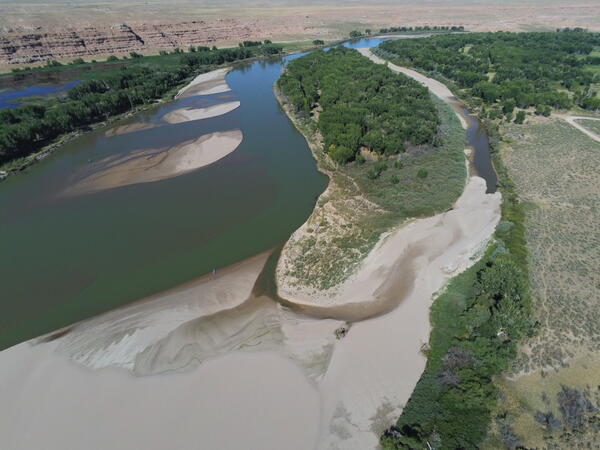
a blue-green river with many sand bars and beaches surrounded by trees and rock formations a blue-green river with many sand bars and beaches surrounded by trees and rock formations
Aerial footage of the Green River in Ouray National Wildlife Refuge

USGS researchers use high-resolution remote sensing data acquired from uncrewed aircraft systems (UAS) to monitor and analyze long-term hydrologic, geomorphic, and ecological dynamics in river systems.

USGS researchers use high-resolution remote sensing data acquired from uncrewed aircraft systems (UAS) to monitor and analyze long-term hydrologic, geomorphic, and ecological dynamics in river systems.

title slide of USGS presentation on satellite observations of lake surface water dynamics title slide of USGS presentation on satellite observations of lake surface water dynamics
Saline Lakes IWAA Fall 2024 Webinar Series: Satellite Observations of Lake Surface Water Dynamics

The sixth and final webinar in the Saline Lakes Ecosystems IWAA Fall 2024 Webinar Series is on satellite observations of lake surface water dynamics. John W. Jones of the USGS Hydrologic Remote Sensing Branch introduces the surface water and wetland remote sensing component of the Integrated Water Availability Assessment.

Saline Lakes Ecosystems IWAA Fall 2024 Webinar Series: Bird Movements

The fourth webinar in the Saline Lakes Ecosystems IWAA Fall 2024 Webinar Series is on movement of bird species associated with Great Basin terminal lake ecosystems. Cory Overton of the Western Ecological Research Center gives an overview of the USGS bird movement monitoring strategy and presents results from the 2024 field season.

screenshot of title slide for saline lakes water-quality monitoring presentation screenshot of title slide for saline lakes water-quality monitoring presentation
Saline Lakes Ecosystems IWAA Fall 2024 Webinar Series: Water-Quality Monitoring of Great Basin Terminal Lake Ecosystems

The third webinar in the Saline Lakes Ecosystems IWAA Fall 2024 Webinar Series is on water-quality monitoring of Great Basin terminal lake ecosystems. Christine Rumsey of the Utah Water Science Center and Casie Smith of the Oregon Water Science Center give an overview of the USGS water-quality monitoring strategy and present results from the 2024 field season.

screenshot of the title slide of a presentation on saline lake ecosystems water budgets screenshot of the title slide of a presentation on saline lake ecosystems water budgets
Saline Lake Ecosystems IWAA Fall 2024 Webinar Series: Physical and Chemical Monitoring in Support of Water Budgets of Select Great Basin Saline Lakes
screenshot of title slide of Saline Lake Ecosystems IWAA project overview presentation screenshot of title slide of Saline Lake Ecosystems IWAA project overview presentation
Saline Lake Ecosystems IWAA Fall 2024 Webinar Series: Project Overview

Allison Shipp, Deputy Regional Director for Science and Research and Saline Lake Ecosystems IWAA Project Manager, kicked off the Fall 2024 webinar series. This presentation gives an overview of the project and introduces topics that will be covered by the USGS research team throughout the webinar series.

UAS operations near Moab, Utah for carbon sequestration research on public lands UAS operations near Moab, Utah for carbon sequestration research on public lands
UAS Operations for Carbon Sequestration Research on Public Lands near Moab, Utah in May 2023

In support of U.S. Geological Survey (USGS) Southwest Biological Science Center research, the USGS National Uncrewed Systems Office (NUSO) conducted uncrewed aircraft systems (UAS) remote sensing flights near Moab, Utah in May 2023 for multi-scale carbon sequestration research on public lands.  


In support of U.S. Geological Survey (USGS) Southwest Biological Science Center research, the USGS National Uncrewed Systems Office (NUSO) conducted uncrewed aircraft systems (UAS) remote sensing flights near Moab, Utah in May 2023 for multi-scale carbon sequestration research on public lands.  


Drone's eye view of a USGS remote pilot during a biocrust mission near Moab, UT Drone's eye view of a USGS remote pilot during a biocrust mission near Moab, UT
Mapping biocrust with UAS technology in Moab, Utah

USGS researchers teamed up for a biological soil crust (biocrust) remote sensing and field data campaign near Moab, Utah in February of 2022.

Logo with title and image of Earth Logo with title and image of Earth
Image of the Week - Lake Powell and the Megadrought

Two decades of drought are contributing to low water levels in reservoirs along the Colorado River, including Lake Powell.

Lake Powell’s highest recorded water level was in 1983. In this 1984 Landsat 5 image, the lake’s elevation was 3,702 feet above sea level.

Two decades of drought are contributing to low water levels in reservoirs along the Colorado River, including Lake Powell.

Lake Powell’s highest recorded water level was in 1983. In this 1984 Landsat 5 image, the lake’s elevation was 3,702 feet above sea level.

Backpack next to rock outcrop Backpack next to rock outcrop
Utah’s ancient mega-landslides

During the late Oligocene to early Miocene, the Marysvale volcanic field of southwestern Utah experienced three consecutive, catastrophic, mega-scale collapse events: the Sevier, Markagunt, and Black Mountains gravity slides, which we refer to collectively as the Marysvale gravity slide complex (MGSC).

During the late Oligocene to early Miocene, the Marysvale volcanic field of southwestern Utah experienced three consecutive, catastrophic, mega-scale collapse events: the Sevier, Markagunt, and Black Mountains gravity slides, which we refer to collectively as the Marysvale gravity slide complex (MGSC).

Historic Lows at Lake Powell - video thumbnail Historic Lows at Lake Powell - video thumbnail
Image of the Week - Historic Lows at Lake Powell

Lake Powell on the border of Utah and Arizona supplies water to millions across the southwestern United States.

Lake Powell - Topobathymetric Digital Elevation Model

This video is a three-dimensional (3D) view of Lake Powell topobathymetric digital elevation model, which consists of topography (land elevation) and bathymetry (water depth). The 3D topobathymetric model was developed by the U.S.

This video is a three-dimensional (3D) view of Lake Powell topobathymetric digital elevation model, which consists of topography (land elevation) and bathymetry (water depth). The 3D topobathymetric model was developed by the U.S.

Land Treatment Exploration Tool: A Quick Introduction

This is a quick introduction video to the Land Treatment Exploration Tool. This short video includes a summary of the tool with screen clips of the fact sheet, web tool, and an example Site Characterization Report.

This is a quick introduction video to the Land Treatment Exploration Tool. This short video includes a summary of the tool with screen clips of the fact sheet, web tool, and an example Site Characterization Report.

Land Treatment Exploration Tool— Step 4: Prop. Treatment Area & Report

This video describes Step 4 and the developing report of the Land Treatment Exploration Tool. In Step 4 the used selects layers to generate spatial overlap statistics with their planned treatment boundary. Summary tables are generated and displayed in the Report tab, where a user can create a PDF Site Characterization Report for their planned treatment boundary.

This video describes Step 4 and the developing report of the Land Treatment Exploration Tool. In Step 4 the used selects layers to generate spatial overlap statistics with their planned treatment boundary. Summary tables are generated and displayed in the Report tab, where a user can create a PDF Site Characterization Report for their planned treatment boundary.

Land Treatment Exploration Tool — Step 5: Select Search Parameters

This video describes Step 5 of the Land Treatment Exploration Tool. In Step 5 the user determines a distance or boundary to search for legacy Land Treatment Digital Library records. The user also indicates if the returned LTDL treatments are statistically evaluated against the planned treatment boundary using a Bray-Curtis Dissimilarity calculation.

This video describes Step 5 of the Land Treatment Exploration Tool. In Step 5 the user determines a distance or boundary to search for legacy Land Treatment Digital Library records. The user also indicates if the returned LTDL treatments are statistically evaluated against the planned treatment boundary using a Bray-Curtis Dissimilarity calculation.

Land Treatment Exploration Tool — Step 6: Compare the LTDL Treatments

This video describes Step 6 of the Land Treatment Exploration Tool. In Step 6 the user filters through the returned list of legacy LTDL treatments to identify records that contain useful information or context for the current planned treatment boundary. Selected treatments are added to the developing report and subsequent exported Site Characterization PDFs.

This video describes Step 6 of the Land Treatment Exploration Tool. In Step 6 the user filters through the returned list of legacy LTDL treatments to identify records that contain useful information or context for the current planned treatment boundary. Selected treatments are added to the developing report and subsequent exported Site Characterization PDFs.

Man sitting in front of a map Man sitting in front of a map
Yellowstone Volcano Observatory Monthly Update: April 1, 2020

Mike Poland, Scientist-in-Charge of the Yellowstone Volcano Observatory, gives an overview of activity at Yellowstone during March 2020.


Powell150 1869-2019: John Wesley Powell's Legacy of USGS Exploration

In 2019, the USGS Youth & Education in Science (YES) team marked the 150th anniversary of the first John Wesley Powell expedition down ~1000 miles of the Green & Colorado rivers with a national-scale educational project known as "Powell150." Educational resources about the science along the rivers and a social media campaign around the theme of exploration w

In 2019, the USGS Youth & Education in Science (YES) team marked the 150th anniversary of the first John Wesley Powell expedition down ~1000 miles of the Green & Colorado rivers with a national-scale educational project known as "Powell150." Educational resources about the science along the rivers and a social media campaign around the theme of exploration w

Virtual tour of Glen Canyon between Bullfrog Bay and the Rincon

This animation takes the viewer down the Glen Canyon from Bullfrog Bay to the Rincon, in the Glen Canyon National Recreation Area. New high resolution multibeam bathymetry collected by the USGS in 2018 shows the submerged portions of Glen Canyon. 
 

This animation takes the viewer down the Glen Canyon from Bullfrog Bay to the Rincon, in the Glen Canyon National Recreation Area. New high resolution multibeam bathymetry collected by the USGS in 2018 shows the submerged portions of Glen Canyon. 
 

A Record of Change: Science and Elder Observations on the Navajo N.

A Record of Change—Science and Elder Observations on the Navajo Nation is a 25-minute documentary about collaborative studies using conventional physical sciences, combined with tribal elder observations to show that local knowledge and conventional science partnerships can effectively document ecosystem change and determine the resulting challenges to livelihoods.&

A Record of Change—Science and Elder Observations on the Navajo Nation is a 25-minute documentary about collaborative studies using conventional physical sciences, combined with tribal elder observations to show that local knowledge and conventional science partnerships can effectively document ecosystem change and determine the resulting challenges to livelihoods.&

Was this page helpful?