U.S. flag

An official website of the United States government

Images

Images intro.
Filter Total Items: 695
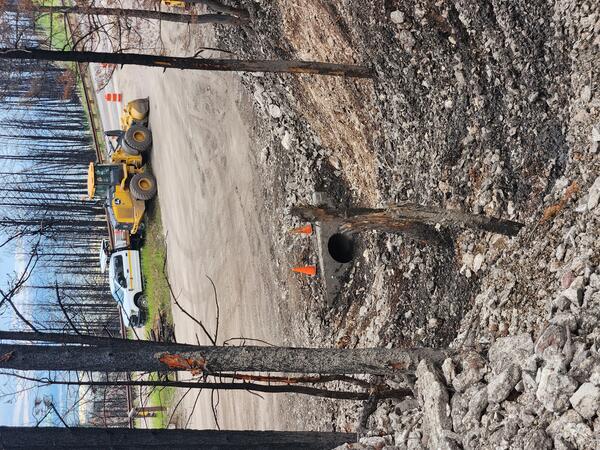
heavy equipment parked on road near watershed outlet
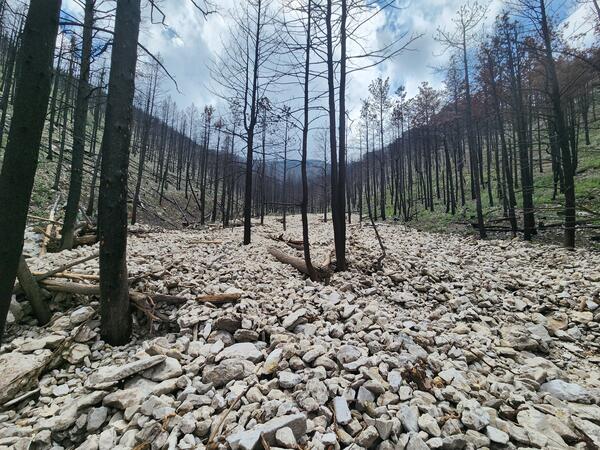
2024 Elk Fire debris flow

Burned watershed in the 2024 Elk Fire burn area where a debris flow was triggered during a July 2025 thunderstorm. This downstream view shows the watershed outlet near the Crystal Springs Rest Area and U.S. Highway 14. Heavy equipment used to clear the debris remains on site 8 days after the event.

Burned watershed in the 2024 Elk Fire burn area where a debris flow was triggered during a July 2025 thunderstorm. This downstream view shows the watershed outlet near the Crystal Springs Rest Area and U.S. Highway 14. Heavy equipment used to clear the debris remains on site 8 days after the event.

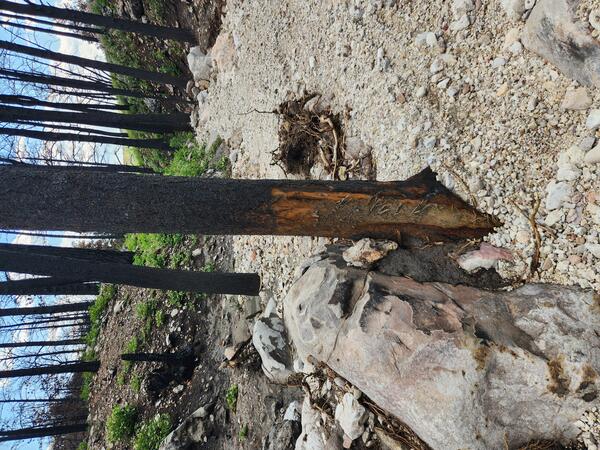
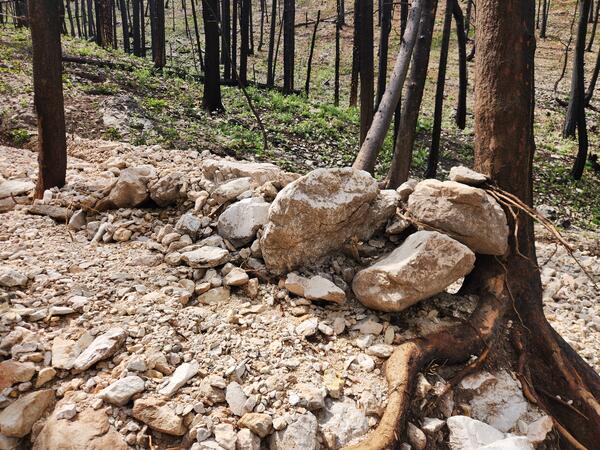
linear deposit of rocks and boulder resting against a tree
Postfire debris-flow levee in the 2024 Elk fire burn area

Postfire debris-flow levee in the 2024 Elk fire burn area near Dayton, Wyoming. This levee, located near the channel margin contains poorly sorted sediment ranging from fine mud-to boulder-sized. A small amount of woody material is also present in the levee. The levee was formed by a debris flow in the watershed, triggered by a 2025 summer thunderstorm.

Postfire debris-flow levee in the 2024 Elk fire burn area near Dayton, Wyoming. This levee, located near the channel margin contains poorly sorted sediment ranging from fine mud-to boulder-sized. A small amount of woody material is also present in the levee. The levee was formed by a debris flow in the watershed, triggered by a 2025 summer thunderstorm.

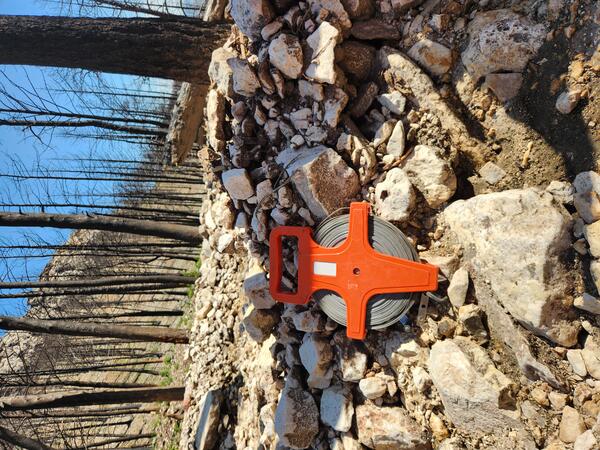
tape measure sit on top of a deposit of rocks and mud
Debris-flow deposit in the 2024 Elk Fire burn area

Close-up view of a debris-flow deposit in the 2024 Elk Fire burn area near Dayton, Wyoming. A debris flow triggered by a 2025 summer thunderstorm deposited poorly sorted material ranging from mud to boulder size. Mud coatings are observed on some larger rocks, and finer material fills spaces between the cobbles and boulders.

Close-up view of a debris-flow deposit in the 2024 Elk Fire burn area near Dayton, Wyoming. A debris flow triggered by a 2025 summer thunderstorm deposited poorly sorted material ranging from mud to boulder size. Mud coatings are observed on some larger rocks, and finer material fills spaces between the cobbles and boulders.

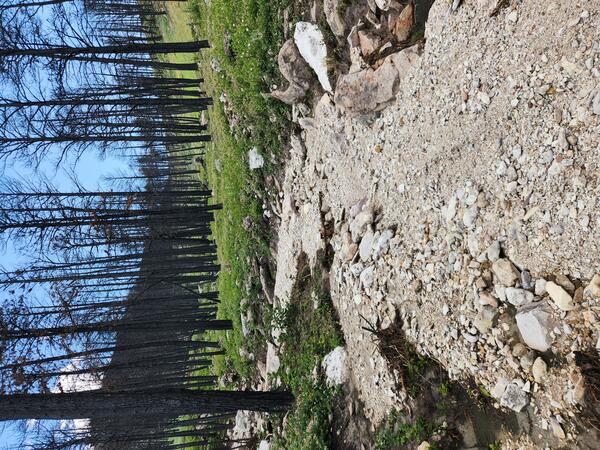
Down stream view of a channel with bedrock visible in the foreground and burned trees on the surrounding hillslopes
Channel in a burned watershed within the 2024 Elk Fire burn area

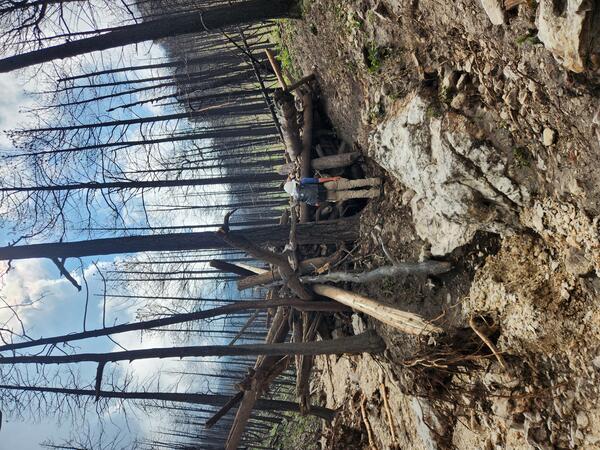
Channel in a burned watershed within the 2024 Elk Fire burn area near Dayton, Wyoming where a debris flow initiated during a July 2025 thunderstorm. Near the headwaters, exposed bedrock is visible in channel, and loose sediment and burned trees cover the hillslope above. Trees near the channel margin show damage from the force of the flow.

Channel in a burned watershed within the 2024 Elk Fire burn area near Dayton, Wyoming where a debris flow initiated during a July 2025 thunderstorm. Near the headwaters, exposed bedrock is visible in channel, and loose sediment and burned trees cover the hillslope above. Trees near the channel margin show damage from the force of the flow.

fist-sized rock samples gray in color with red circles noting large white mineral grains
Samples of Lava Creek Tuff (Yellowstone caldera) with quartz and sanidine crystals indicated

Samples of Lava Creek Tuff, which erupted during the formation of Yellowstone Caldera about 631,000 years ago, with large quartz and sanidine crystals circled in red. Photos by Faith Nolander, July 22, 2025.

Microscope view of beige irregular and broken crystal surrounded by gray material. Chemical composition given for one point.
Microscope view of a sanidine crystal from the Lava Creek Tuff (Yellowstone caldera) with geochemical composition indicated for a point measured by electron microprobe analysis

A close-up (microscope) image of a sanidine crystal from the Lava Creek Tuff, which erupted during the formation of Yellowstone Caldera about 631,000 years ago, marked with a point where electron microprobe analysis was performed. The chemistry of that point is given, where each major element has a corresponding weight percent.

A young man and young woman examine a tan-colored rock outcrop with some grasses and a small tree
Montana State University researchers recording data at an outcrop in Yellowstone National Park

Montana State University researchers recording data at an outcrop in Yellowstone National Park. M.S. student Liv Wheeler (right) overlays the GPS position of the outcrop over a geologic map produced by USGS geologist Robert Christianson, while undergraduate student Liam Arnold (left) notes other data related to the outcrop.
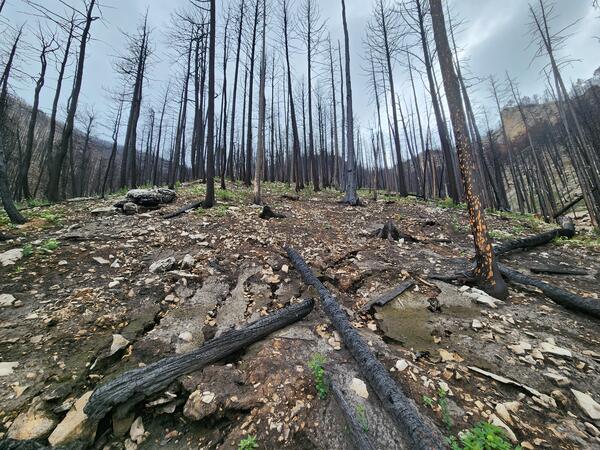
Montana State University researchers recording data at an outcrop in Yellowstone National Park. M.S. student Liv Wheeler (right) overlays the GPS position of the outcrop over a geologic map produced by USGS geologist Robert Christianson, while undergraduate student Liam Arnold (left) notes other data related to the outcrop.
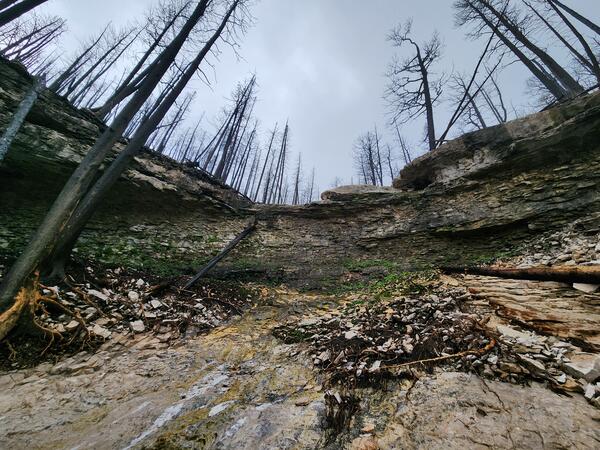
Database entry at top, photo of field book and gray rock in middle, and topographic map with locations noted at bottom
Geodatabase entry for a sample of the Lava Creek Tuff

Geodatabase entry for a sample of the Lava Creek Tuff, which is a result of the eruption that formed Yellowstone Caldera about 631,000 years ago.  Top: A selected point in the ArcGIS geodatabase showing all the data recorded in the field as well as an image of the rock sample. Bottom: Topographic map showing the location of where the data were recorded.

Geodatabase entry for a sample of the Lava Creek Tuff, which is a result of the eruption that formed Yellowstone Caldera about 631,000 years ago.  Top: A selected point in the ArcGIS geodatabase showing all the data recorded in the field as well as an image of the rock sample. Bottom: Topographic map showing the location of where the data were recorded.

Map view and time series plots of deformation in the Yellowstone area
Ground deformation in the Yellowstone area from GPS viewed in a reference frame where North American plate motion has been removed
Seismic wave form registering several small earthquakes
Example of Yellowstone seismic data showing sequence of small earthquakes for which a magnitude could not be determined

Example of a Yellowstone seismic waveform recorded at station YMC (at Maple Creek in the northeast part of Yellowstone National Park) with earthquakes for which a magnitude could not be determined. The magnitude was therefore set at -9.99 in the University of Utah Seismograph Stations catalog.

Map of Yellowstone region with triangles, most of which indicate stations used to calculate AI magnitudes
Map of Yellowstone Seismic Network showing stations used to calculate earthquake magnitudes using various methods

A map of the stations operating in the Yellowstone region between 2012 and 2024 shown as triangles with fill and edge colors indicating whether they are used to calculate magnitudes using traditional approaches, artificial intelligence methods, or both.

burned trees on hillslope above channel
Crystal Springs watershed in the 2024 Elk fire burn area

Crystal springs watershed in the 2024 Elk fire burn area.  The USGS installed a monitoring station here to record postfire hydrologic responses during rainfall events.  This photo was taken before any flooding or debris flows occurred, but the station later recorded a debris flow during a July 2025 thunderstorm.  

Crystal springs watershed in the 2024 Elk fire burn area.  The USGS installed a monitoring station here to record postfire hydrologic responses during rainfall events.  This photo was taken before any flooding or debris flows occurred, but the station later recorded a debris flow during a July 2025 thunderstorm.  

person using a level to measure a rain gage
Rain gage in the 2024 Elk fire burn area

A USGS hydrologist checks a newly installed rain gage in the Elk Fire burn area near Dayton, Wyoming to ensure that it is level. USGS scientists installed several rain gages throughout the Elk Fire burn area. Rain gage data is paired with observations of flooding and debris-flows to test how well the USGS hazard assessment models are working.

A USGS hydrologist checks a newly installed rain gage in the Elk Fire burn area near Dayton, Wyoming to ensure that it is level. USGS scientists installed several rain gages throughout the Elk Fire burn area. Rain gage data is paired with observations of flooding and debris-flows to test how well the USGS hazard assessment models are working.

equipment including rain gage and solar panel on hillslope covered by burned trees
USGS postfire monitoring station in the Elk Fire burn area near Dayton, Wyoming.

USGS postfire monitoring station in the Elk Fire burn area near Dayton, Wyoming. Installed less than a year after the wildfire, the station records hydrologic responses during rainfall on the burned landscape. Located above a channel that was assessed to have a very high likelihood of debris flows, it collects data on soil properties and rainfall.

USGS postfire monitoring station in the Elk Fire burn area near Dayton, Wyoming. Installed less than a year after the wildfire, the station records hydrologic responses during rainfall on the burned landscape. Located above a channel that was assessed to have a very high likelihood of debris flows, it collects data on soil properties and rainfall.

people and equipment on hillslope that is covered with burned trees and loose rocks
USGS scientists install a postfire monitoring station in the Elk Fire burn area near Dayton, Wyoming.

USGS scientists install a postfire monitoring station in the Elk Fire burn area near Dayton, Wyoming. Installed less than a year after the wildfire, the station records hydrologic responses during rainfall on the burned landscape.

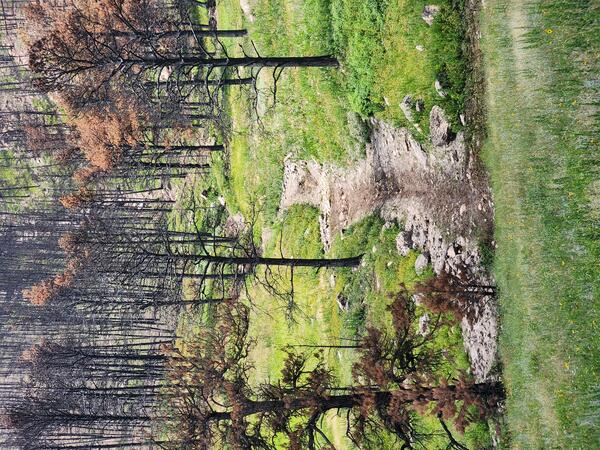
narrow channel surrounded by rocky hillslopes and burned trees
Hillslope within a burned watershed in the 2024 Elk Fire burn

A narrow channel in the High Water Creek watershed within the Elk Fire burn area near Dayton, Wyoming is surrounded by steep, burned hillslopes. The section occurs upslope of where flood and flow deposits were observed. Rocky material and downed trees cover the surrounding hillsides.

A narrow channel in the High Water Creek watershed within the Elk Fire burn area near Dayton, Wyoming is surrounded by steep, burned hillslopes. The section occurs upslope of where flood and flow deposits were observed. Rocky material and downed trees cover the surrounding hillsides.

gray hill slopes in background lack vegetation highway and vegetation in image foreground
Elk Fire burn area
Elk Fire burn area
Elk Fire burn area

View of the Elk Fire burn area from U.S. Highway 15 west of Dayton, Wyoming.  Burned hillslopes lack vegetation and contrast sharply with the unburned terrain on either side of the highway.  

View of the Elk Fire burn area from U.S. Highway 15 west of Dayton, Wyoming.  Burned hillslopes lack vegetation and contrast sharply with the unburned terrain on either side of the highway.  

Mountainside with a tree-covered landslide scar in the background, a treed slope in the foreground, and partly cloudy skies
Gros Ventre landslide area in 2025

Photograph of the Gros Ventre Slide 100 years after it occurred. View is to the south, with the landslide scar visible in the middle of the treed hillslope across the valley. Lower Slide Lake, which formed behind the landslide debris, is visible on the left side of the photograph.  Photo by James Mauch, Wyoming State Geological Survey, June 7, 2025.

Photograph of the Gros Ventre Slide 100 years after it occurred. View is to the south, with the landslide scar visible in the middle of the treed hillslope across the valley. Lower Slide Lake, which formed behind the landslide debris, is visible on the left side of the photograph.  Photo by James Mauch, Wyoming State Geological Survey, June 7, 2025.

shaded relief map with topography indicating landslide scars along mountains that border a river valley
Oblique lidar shaded relief image of the Gros Ventre Slide, Wyoming

Oblique lidar shaded relief map looking east up the Gros Ventre River valley, Wyoming. The Gros Ventre Slide, which occurred on June 23, 1925, is outlined in black, and it moved from the high ridge on the south (right side of image) into the valley below. North-dipping sedimentary rock units are labeled in white, separated by white dashed lines.

Oblique lidar shaded relief map looking east up the Gros Ventre River valley, Wyoming. The Gros Ventre Slide, which occurred on June 23, 1925, is outlined in black, and it moved from the high ridge on the south (right side of image) into the valley below. North-dipping sedimentary rock units are labeled in white, separated by white dashed lines.

map with shaded relief in grayscale, and water (ponds, streams, and springs) in blue
Shaded relief map of Norris Geyser Basin indicating new hydrothermal feature near "Tree Island"

Lidar shaded relief map of the Porcelain Basin and Back Basin areas of Norris Geyser Basin in Yellowstone National Park.  Orange star indicates the location of a new thermal pool that formed sometime during late December 2024 to early February 2025.
animated gif of satellite images showing development of a small hydrothermal pool between October 2024 and February 2025
Animated GIF of the development of a new hydrothermal feature during late 2024 to early 2024, Norris Geyser Basin, Yellowstone National Park

Animated GIF of high-resolution satellite images of the Porcelain Basin area of Norris Geyser Basin, Yellowstone National Park, showing the development of a new thermal pool in the circled area.  There is no indication of the pool in images from October 19 and December 19, 2024.  A small depression is visible in the January 6, 2025, image.  In the Feb

Was this page helpful?