Close-up view of tsunami damage along the waterfront at Kodiak, Alaska.
Images
Browse images from a wide range of science topics covered by USGS. All items in this gallery are considered public domain unless otherwise noted.
Close-up view of tsunami damage along the waterfront at Kodiak, Alaska.
This truck at Lowell Point, 2 miles from Seward, was bent around a tree by the surge-waves generated by the underwater landslides along the Seward waterfront. The truck was about 32 feet above water level at the time of the earthquake. Many landslides generated by the 1964 earthquake originated beneath, or came to rest within, large bodies of water.
An underwater landslide in Blackstone Bay produced a large wave which surged to points 80 feet above sea level. The trees in the photo are about 50 to 75 feet high.
Photograph taken in 1964 of the main part of the Chenega village site in Alaska. Pilings in the ground mark the former locations of homes swept away by tsunami waves. The schoolhouse on high ground was undamaged.
The village of Portage, Alaska at the head of Turnagain Arm of Cook Inlet, is flooded at high tide as a result of 6 feet of tectonic subsidence during the earthquake.
Compare the damage sustained by the Hillside apartment building on left side and the adjacent three-story wood-frame dwelling with tall chimney. In general, wood frame buildings in Anchorage sustained little damage from seismic vibrations.
Close-up of the elementary school which was destroyed by the Government Hill landslide. Subsidence of the graben at the head of the Government Hill landslide in Anchorage tore apart an elementary school and converted the schoolyard into a jumble of fissures, scarps, and tilted and subsided blocks of broken ground.
The waterfront at Seward, looking south, before earthquake-generated underwater landslides, surge-waves, and tsunami waves devastated the water front. Note the small boat harbor, the railroad yards, the large docks, and other waterfront facilities which were removed by the underwater land slides.
The dock area, a tank farm, and railroad facilities at Whittier were severely damaged by surge-waves developed by underwater landslides in Passage Canal. The waves inundated the area of darkened ground, where the snow was soiled or removed by the waves.
Tsunami damage and high-water line at Seward, Alaska
Tsunami damage and high-water line at Seward, AlaskaThe tsunami waves in Seward, Alaska washed the snow from the lower slopes of the hillsides, and the height of the highest wave is marked by the sharp "snow line" on the hillside behind and just above the rooftop in the left center of the photo.
Tsunami damage and high-water line at Seward, Alaska
Tsunami damage and high-water line at Seward, AlaskaThe tsunami waves in Seward, Alaska washed the snow from the lower slopes of the hillsides, and the height of the highest wave is marked by the sharp "snow line" on the hillside behind and just above the rooftop in the left center of the photo.
The Hillside apartment building in Anchorage was severely damaged by the earthquake and has been razed. It was a split-level, five-story building with steel posts and lintels, concrete floor slabs, and unreinforced concrete block walls&nb
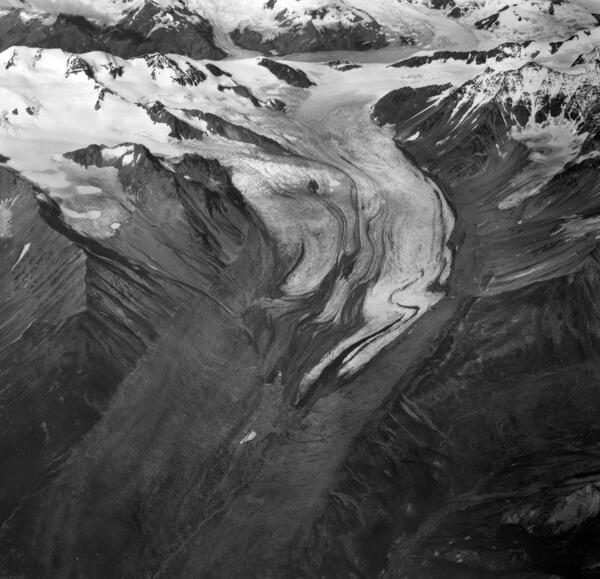
The 1964 earthquake precipitated some large rockslides in the Chugach Mountains. The debris from this one, which fell on Sherman Glacier, covered about 2 square miles. It originated on the highest mountain in the right background.
A series of earthquake-triggered landslides in glacial deposits disrupted almost a mile of The Alaska Railroad mainline at Potter Hill, near Anchorage. Avalanches and especially landslides produced major damage to transportation routes during the 1964 earthquake.
A close-up of one of the scarps bounding the graben of the "L" Street landslide
A close-up of one of the scarps bounding the graben of the "L" Street landslideA close-up of one of the scarps bounding the graben of the "L" Street landslide, showing a house which was undercut by subsidence of the graben. A subsidence trough (or graben) formed at the head of the "L" Street land slide in Anchorage during the 1964 earthquake. The slide block, which is the virtually unbroken ground moved to the left.
A close-up of one of the scarps bounding the graben of the "L" Street landslide
A close-up of one of the scarps bounding the graben of the "L" Street landslideA close-up of one of the scarps bounding the graben of the "L" Street landslide, showing a house which was undercut by subsidence of the graben. A subsidence trough (or graben) formed at the head of the "L" Street land slide in Anchorage during the 1964 earthquake. The slide block, which is the virtually unbroken ground moved to the left.
Scarp at the subsidence trough or graben of the Fourth Avenue landslide, downtown Anchorage. Before the earthquake, the sidewalk in front of the stores on the right, which are in the graben, was at the level of the street on the left, which was not involved in the subsidence.
A close-up of the compressional buckle, the ruptured fuel tank, and the revetment at the foot of the landslide near the Alaska Native Hospital, Anchorage. A rotational-slip landslide with a well-developed compressional buckle at its toe occurred near the Alaska Native Hospital, Anchorage.
The modern wave-cut bedrock surface surrounding Middleton Island
The modern wave-cut bedrock surface surrounding Middleton IslandThe modern wave-cut bedrock surface surrounding Middleton Island (the flat surface between the base of the cliffs and the water) was submerged at a comparable stage of tide before the earthquake.
The modern wave-cut bedrock surface surrounding Middleton Island
The modern wave-cut bedrock surface surrounding Middleton IslandThe modern wave-cut bedrock surface surrounding Middleton Island (the flat surface between the base of the cliffs and the water) was submerged at a comparable stage of tide before the earthquake.
The Turnagain Heights landslide in Anchorage occurred along a steep bluff fronting Knik Arm of Cook Inlet. Its length, which was parallel to the bluff, was about one and half miles; its width was about a quarter to half a mile. This landslide reduced to rubble many of the finer homes of the city of Anchorage.
Close-up of damaged homes at Turnagain Heights landslide, Anchorage from 1964 earthquake.
1964 aerial photograph of St. Mary's Residence and the nearby Four Seasons Apartment Building (#25 on map), Anchorage, Alaska. copyright: Air Photo Tech - NV5 Geospatial
Close-up of the compressional buckle, the ruptured fuel tank, and the revetment at the foot of the landslide near the Alaska Native Hospital in Anchorage.