



Land Management
Land Management
Learn more about FORT research on land management.
Land management research in support of the Department of the Interior
Land management research in support of the Department of the Interior
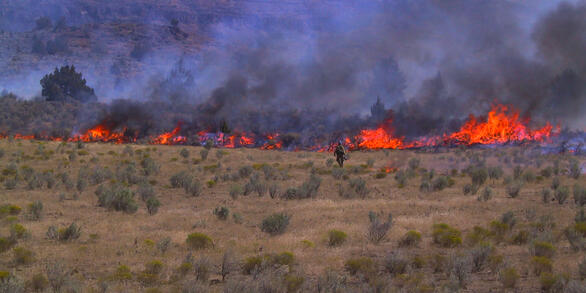
FORT researchers provide sound science to support the Department of the Interior in its efforts to streamline reliable energy development, enhance cost efficiency in public lands management, and manage fire-prone habitats for public safety.
Filter Total Items: 137

Biological Invasions of Riparian Ecosystems
Beginning in the early twentieth century, non-native trees and shrubs, including tamarisk (also commonly known as saltcedar) and Russian-olive, were introduced to the United States for use as ornamental plants and in erosion-control plantings. These plants spread extensively, becoming the third and fourth most frequently occurring woody riparian plants in the American West.

Streamflow-fluvial Geomorphology-riparian Vegetation Interactions
The foundation for applying science to river and riparian restoration contexts lies in a basic understanding of the factors that drive riparian vegetation dynamics. Much of our research is focused on clarifying relationships between streamflow, fluvial geomorphology, and riparian vegetation, including various feedbacks.

Energy Development and Changing Land Uses
Applied research and integrated regional assessments emphasize spatially explicit analyses of ecosystem components affected by energy development and land-use change in the western United States. Topics include sagebrush-steppe ecology; sagebrush habitat assessments; the effects of human activities (including energy development, transportation, and recreation) on habitats and wildlife behavior...

Wyoming Landscape Conservation Initiative: Inventory and Long-Term Monitoring
The Wyoming Landscape Conservation Initiative (WLCI) addresses effects of land-use and habitat changes on Southwest Wyoming’s natural resources. In partnership with twelve Federal, State, and local natural resource agencies, and non-governmental organizations– FORT and ten other USGS centers are conducting dozens of integrated science projects to assess the status of Southwest Wyoming’s natural...

Wyoming Landscape Conservation Initiative: Mechanistic Studies of Wildlife
The Wyoming Landscape Conservation Initiative (WLCI) addresses effects of land-use and habitat changes on Southwest Wyoming’s natural resources. In partnership with twelve Federal, State, and local natural resource agencies, and non-governmental organizations– FORT and ten other USGS centers are conducting dozens of integrated science projects to assess the status of Southwest Wyoming’s natural...

Wyoming Landscape Conservation Initiative: Baseline Synthesis
The Wyoming Landscape Conservation Initiative (WLCI) addresses effects of land-use and habitat changes on Southwest Wyoming’s natural resources. In partnership with twelve Federal, State, and local natural resource agencies, and non-governmental organizations– FORT and ten other USGS centers are conducting dozens of integrated science projects to assess the status of Southwest Wyoming’s natural...
Wyoming Landscape Conservation Initiative: Effectiveness Monitoring
The Wyoming Landscape Conservation Initiative (WLCI) addresses effects of land-use and habitat changes on Southwest Wyoming’s natural resources. In partnership with twelve Federal, State, and local natural resource agencies, and non-governmental organizations– FORT and ten other USGS centers are conducting dozens of integrated science projects to assess the status of Southwest Wyoming’s natural...

Grassland Ecology and Conservation
Grasslands are arguably one of the most anthropogenically stressed ecosystems of the western United States. The highly endangered black-footed ferret and prairie dogs epitomize grassland mammals of high conservation concern.

Landscape and Habitat Assessment
A central focus of this program is to conduct multi-scale assessments in order to develop related geospatial decision-support tools and methods. The program includes synthesizing broad-scale datasets and developing innovative approaches to assess the vulnerability and resilience of wildlife habitats and ecosystems, relative to land management decisions and ecosystem stressors on Department of the...

The Western Mountain Initiative (WMI)
Western Mountain Initiative (WMI) is a long-term collaboration between FORT, WERC, NOROCK, USFS, NPS, LANL, and universities worldwide to address changes in montane forests and watersheds due to climate change. Current emphases include altered forest disturbance regimes (fire, die-off, insect outbreaks) and hydrology; interactions between plants, water, snow, nutrient cycles, and climate; and...

Tree Mortality Patterns and Processes
Episodic droughts have long been known to trigger accelerated tree mortality in forests worldwide, including in the Southwest U.S. Scientific understanding of the process drivers and spatial patterns of tree mortality is surprisingly limited, constraining our ability to model forest responses to projected increases in drought. The onset of regional drought since the late 1990s has resulted in...

Post-fire Recovery Patterns in Southwestern Forests
High-severity crown fires in Southwestern dry-conifer forests — resulting from fire suppression, fuel buildups, and drought — are creating large treeless areas that are historically unprecedented in size. These recent stand-replacing fires have reset extensive portions of Southwest forest landscapes, fostering post-fire successional vegetation that can alter ecological recovery trajectories away...