U.S. flag

An official website of the United States government

Land Management

Learn more about FORT research on land management.

Filter Total Items: 131

Integration of Genetic and Demographic Data to Assess the Relative Importance of Connectivity and Habitat in Sage-Grouse Populations

Using the existing rangewide genetic and demographic data, scientists from the USGS, USDA Forest Service, and University of Waterloo will assess the relative contributions of habitat and genetic connectivity to lek size and stability.
Integration of Genetic and Demographic Data to Assess the Relative Importance of Connectivity and Habitat in Sage-Grouse Populations

Integration of Genetic and Demographic Data to Assess the Relative Importance of Connectivity and Habitat in Sage-Grouse Populations

Using the existing rangewide genetic and demographic data, scientists from the USGS, USDA Forest Service, and University of Waterloo will assess the relative contributions of habitat and genetic connectivity to lek size and stability.
Learn More

Forecasting the Spatiotemporal Dynamics of Sagebrush in Wyoming Under a Changing Climate

Prioritizing landscapes for sage-grouse habitat conservation is complicated by long-term changes in climate.
Forecasting the Spatiotemporal Dynamics of Sagebrush in Wyoming Under a Changing Climate

Forecasting the Spatiotemporal Dynamics of Sagebrush in Wyoming Under a Changing Climate

Prioritizing landscapes for sage-grouse habitat conservation is complicated by long-term changes in climate.
Learn More

Defining Multi-Scaled Functional Landscape Connectivity for the Sagebrush Biome to Support Management and Conservation Planning of Multiple Species

USGS and Colorado State University scientists are modelling multispecies connectivity through intact and disturbed areas of the sagebrush landscape.
Defining Multi-Scaled Functional Landscape Connectivity for the Sagebrush Biome to Support Management and Conservation Planning of Multiple Species

Defining Multi-Scaled Functional Landscape Connectivity for the Sagebrush Biome to Support Management and Conservation Planning of Multiple Species

USGS and Colorado State University scientists are modelling multispecies connectivity through intact and disturbed areas of the sagebrush landscape.
Learn More

Greater Sage-Grouse and Mule Deer Population Viability Analysis Across Scales

USGS and Colorado State University scientists will use data about sage-grouse and mule deer population data across Wyoming to evaluate the effectiveness of disturbance thresholds and investigate the efficacy of other disturbance metrics.
Greater Sage-Grouse and Mule Deer Population Viability Analysis Across Scales

Greater Sage-Grouse and Mule Deer Population Viability Analysis Across Scales

USGS and Colorado State University scientists will use data about sage-grouse and mule deer population data across Wyoming to evaluate the effectiveness of disturbance thresholds and investigate the efficacy of other disturbance metrics.
Learn More

Building the Sage-Grouse Umbrella with Songbird Habitat Models

USGS and Colorado State University scientists are using data and hierarchical community models to create predictive surfaces of bird use by habitat type and comparing these predictions to habitat prioritization derived from sage-grouse locations.
Building the Sage-Grouse Umbrella with Songbird Habitat Models

Building the Sage-Grouse Umbrella with Songbird Habitat Models

USGS and Colorado State University scientists are using data and hierarchical community models to create predictive surfaces of bird use by habitat type and comparing these predictions to habitat prioritization derived from sage-grouse locations.
Learn More

Using the Past and the Present To Understand Fire Ecology in the Range of the Gunnison Sage-Grouse

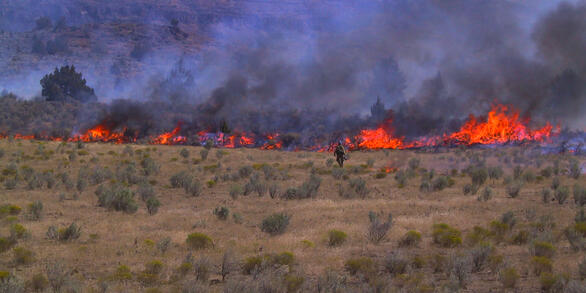
Little is known about the role of fire in the sagebrush ecosystem within the range of the Gunnison sage-grouse ( Centrocercus minimus), and fire has been mostly absent from these systems in the 20th century, partially owing to active fire suppression.
Using the Past and the Present To Understand Fire Ecology in the Range of the Gunnison Sage-Grouse

Using the Past and the Present To Understand Fire Ecology in the Range of the Gunnison Sage-Grouse

Little is known about the role of fire in the sagebrush ecosystem within the range of the Gunnison sage-grouse ( Centrocercus minimus), and fire has been mostly absent from these systems in the 20th century, partially owing to active fire suppression.
Learn More

Using Long-Term Remote Sensing and an Automated Reference Toolset To Estimate and Predict Post-Development Recovery Potential

USGS scientists are using a time-varying approach to monitor and predict recovery of sagebrush ecosystems following disturbance.
Using Long-Term Remote Sensing and an Automated Reference Toolset To Estimate and Predict Post-Development Recovery Potential

Using Long-Term Remote Sensing and an Automated Reference Toolset To Estimate and Predict Post-Development Recovery Potential

USGS scientists are using a time-varying approach to monitor and predict recovery of sagebrush ecosystems following disturbance.
Learn More

Greater Sage-Grouse Science (2015–17): Synthesis and Potential Management Implications

USGS led an interagency team of Federal and State agency biologists to develop a report that synthesizes greater sage-grouse scientific literature.
Greater Sage-Grouse Science (2015–17): Synthesis and Potential Management Implications

Greater Sage-Grouse Science (2015–17): Synthesis and Potential Management Implications

USGS led an interagency team of Federal and State agency biologists to develop a report that synthesizes greater sage-grouse scientific literature.
Learn More

Smart Energy Development: Tools for Informed Development & Successful Reclamation

The USGS is developing science and decision support tools to inform policy and management decisions about various aspects of the energy development life cycle.
Smart Energy Development: Tools for Informed Development & Successful Reclamation

Smart Energy Development: Tools for Informed Development & Successful Reclamation

The USGS is developing science and decision support tools to inform policy and management decisions about various aspects of the energy development life cycle.
Learn More

Higher and Farther: Patterns of Development within Protected Areas

There is a well-known bias in the location of protected areas both within the US and globally. Lands protected for conservation tend to be located on less productive soils at high elevations far from cities. USGS is exploring whether this ‘high and far’ paradigm applies within protected areas as well. That is, does human modification within lands that already have some degree of protection, also...
Higher and Farther: Patterns of Development within Protected Areas

Higher and Farther: Patterns of Development within Protected Areas

There is a well-known bias in the location of protected areas both within the US and globally. Lands protected for conservation tend to be located on less productive soils at high elevations far from cities. USGS is exploring whether this ‘high and far’ paradigm applies within protected areas as well. That is, does human modification within lands that already have some degree of protection, also...
Learn More

Informing Habitat Management for Desert Tortoise

There is increasing support for adopting landscape approaches to resource management, including monitoring threats that affect multiple resources across broad extents. However, there remains a need to assess potential threats to individual species of conservation concern. USGS is evaluating the extent to which a generalized indicator of terrestrial development can be used to inform and evaluate...
Informing Habitat Management for Desert Tortoise

Informing Habitat Management for Desert Tortoise

There is increasing support for adopting landscape approaches to resource management, including monitoring threats that affect multiple resources across broad extents. However, there remains a need to assess potential threats to individual species of conservation concern. USGS is evaluating the extent to which a generalized indicator of terrestrial development can be used to inform and evaluate...
Learn More

Quantifying Ecological Integrity in Terrestrial systems

Ecological integrity describes the condition of ecological systems, and has been quantified in aquatic systems for decades. The U.S. Forest Service is now required to monitor ecological integrity, and the Bureau of Land Management has an interest in doing so as well. As a result, USGS is working to define and quantify the concept of ecological integrity in terrestrial, multiple use landscapes to...
Quantifying Ecological Integrity in Terrestrial systems

Quantifying Ecological Integrity in Terrestrial systems

Ecological integrity describes the condition of ecological systems, and has been quantified in aquatic systems for decades. The U.S. Forest Service is now required to monitor ecological integrity, and the Bureau of Land Management has an interest in doing so as well. As a result, USGS is working to define and quantify the concept of ecological integrity in terrestrial, multiple use landscapes to...
Learn More
Was this page helpful?