



Land Management
Land Management
Learn more about FORT research on land management.
Land management research in support of the Department of the Interior
Land management research in support of the Department of the Interior
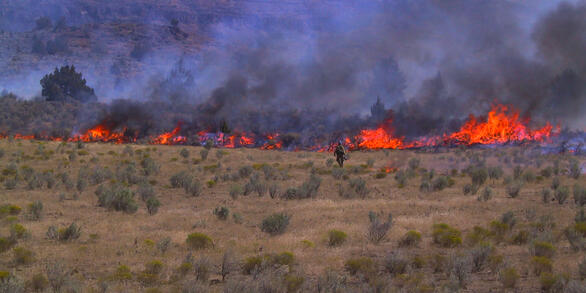
FORT researchers provide sound science to support the Department of the Interior in its efforts to streamline reliable energy development, enhance cost efficiency in public lands management, and manage fire-prone habitats for public safety.
Filter Total Items: 137

Prioritizing conifer removal for multi-species outcomes
Wildlife management is frequently conducted to benefit a single species, despite evidence that suggests such an approach often fails to adequately address the needs of other species within a region. Managing for multiple species’ habitat requirements is even more critical when large scale habitat management efforts change vegetation conditions at the landscape scale, or when management occurs at...

Assessing invasive annual grass treatment efficacy across the sagebrush biome
We are using existing datasets that span broad spatial and temporal extents to model the efficacy of invasive annual grass treatments across the sagebrush biome and the influence of environmental factors on their success. The models we develop will be used to generate maps of predicted treatment efficacy across the biome, which will be integrated into the Land Treatment Exploration Tool for land...

Wild horse and livestock influences on vegetation and wildlife in sagebrush ecosystems: Implications for refining and validating Appropriate Management Level (AML)
USGS researchers are conducting a comprehensive study of wild horse and livestock records across the greater sage-grouse range to investigate impacts on vegetation and wildlife (specifically, sage-grouse and songbirds). Researchers will use these results to evaluate Appropriate Management Levels for wild horse and burros, and projections of vegetation productivity under changing conditions.

Using simulation models to project and evaluate post-fire success in restoring sage-grouse habitat over large landscapes
Wildfires are increasingly destroying wildlife habitat in sagebrush ( Artemisia species) ecosystems, and managers need approaches to scope the pace and degree to which post-fire restoration actions can re-create habitat in dynamic landscapes. Sagebrush recovery takes a long time, and it can be difficult to anticipate restoration outcomes over large, diverse landscapes that have experienced decades...

Simulating the influence of sagebrush restoration on post-fire sage-grouse population recovery
Increased wildfire-induced loss of sagebrush in North American shrublands are outpacing natural recovery and leading to substantial habitat loss for sagebrush-obligate species like sage-grouse. Transplanting sagebrush ( Artemisia species) is a possible strategy for revegetating burned areas, but little is known about sage-grouse or other wildlife responses to restoration strategies.

Developing a toolkit for coproducing actionable science to support public land management
Coproduction is a highly collaborative approach to conducting science that focuses on producing actionable products that are used to inform natural resource management decisions. This project will develop an informational toolkit to facilitate coproduction between resource managers and science providers in the context of federal public land management.

Mapping Grassland Bird Community Distribution under a Changing Landscape
Researchers from the U.S. Geological Survey, the U.S. Department of Agriculture-Agricultural Research Service, and University of Arizona are studying the distribution of grassland bird communities across the western Great Plains to anticipate how species distributions may respond to a changing landscape.

Long-term, Place-based, Science and Ecological Monitoring
For over 30 years we have monitored the ecosystem dynamics of the mesas and mountains of northern New Mexico, co-located with mangers. We use a place-based science approach, defined as “science that is founded on long-term, repeated, field data and observations, as well as traditional knowledges, and regularly engages local managers and community members.” This approach enables us to provide land...

Using public litigation records to identify priority science and data needs for the Bureau of Land Management
The Bureau of Land Management (BLM) manages a large area of public lands in the western U.S. for multiple uses and values. Because some of these uses and values may conflict, the agency’s decisions can be controversial and are often challenged. In this study, researchers analyzed public legal records to help identify priority information needs that could strengthen science-based decision-making in...

Biology, Impacts and Control of Invasive Reptiles in the Everglades
Invasive species are considered to be second only to habitat degradation in terms of negative impacts on the Earth’s ecosystems, and our scientists make up a significant proportion of the global expertise in the rapidly-growing problem of invasive reptiles.

Invasive Annual Grass (IAG) Spatial Dataset Compilation and Synthesis
USGS is working closely with partners in the Bureau of Land Management (BLM), U.S. Fish and Wildlife Service (USFWS), and the Intermountain West Joint Venture (IMJV) to collect and summarize spatial datasets that describe measurable aspects of invasive annual grasses (e.g., biomass or presence) across the western United Stated and beyond. The products developed through this project provide...
Optimization of Management Actions for Restoration Success and Wildlife Populations
USGS researchers, in collaboration with the Wyoming Landscape Conservation Initiative and other partners, are developing a statistically based prioritization tool that will aid agencies in their management decisions.