Helicopter conducting low-level flights. Image courtesy Sander Geophysics Ltd.
Images
Images
Helicopter conducting low-level flights. Image courtesy Sander Geophysics Ltd.
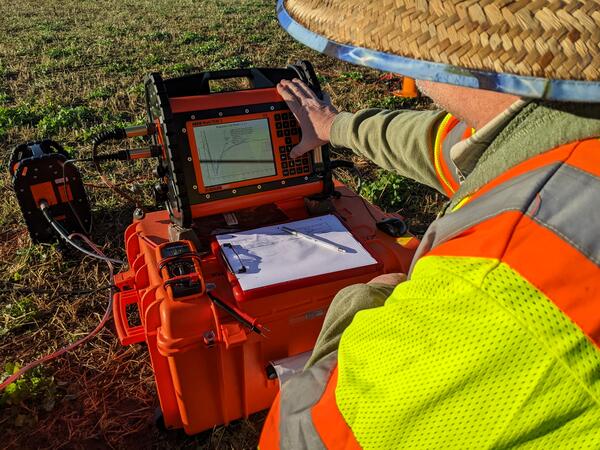
Geologists in the field at Pennington Mountain. The orange instrument is a portable gamma spectrometer. University of Maine-Presque Isle professor Chunzeng Wang (the lead author) is in front, Preston Bass is carrying the meter.
A low-flying helicopter towing a geophysical device collects scientific data on groundwater and geology. Information collected during these surveys can help with studying critical mineral resources, natural hazards and groundwater potential.
A helicopter rigged with an airborne geophysical survey collecting equipment. Information collected during these surveys can help with studying critical mineral resources, natural hazards and groundwater potential. A cow is here too.
Three geologists looking at igneous textures in granitic rocks
Three geologists looking at igneous textures in granitic rocksAlaska Science Center geologist Doug Kreiner and University of Alaska, Fairbanks professor Sean Regan look at igneous textures in granitic rocks hosting gold at the Pogo gold mine with Pogo exploration geologists.
Three geologists looking at igneous textures in granitic rocks
Three geologists looking at igneous textures in granitic rocksAlaska Science Center geologist Doug Kreiner and University of Alaska, Fairbanks professor Sean Regan look at igneous textures in granitic rocks hosting gold at the Pogo gold mine with Pogo exploration geologists.
Geologists discuss the district-scale geology at Pogo Mine, Alaska
Geologists discuss the district-scale geology at Pogo Mine, AlaskaAlaska Science Center geologist Doug Kreiner and University of Alaska, Fairbanks professor Sean Regan discuss the district-scale geology with the chief exploration geologist at Pogo Mine. This is a new collaborative study with USGS, UAF and Pogo Mine, to collaborate on unraveling the genesis of Pogo, an important producer of gold in Alaska with critical mi
Geologists discuss the district-scale geology at Pogo Mine, Alaska
Geologists discuss the district-scale geology at Pogo Mine, AlaskaAlaska Science Center geologist Doug Kreiner and University of Alaska, Fairbanks professor Sean Regan discuss the district-scale geology with the chief exploration geologist at Pogo Mine. This is a new collaborative study with USGS, UAF and Pogo Mine, to collaborate on unraveling the genesis of Pogo, an important producer of gold in Alaska with critical mi
Exposure of breccia marking trace of normal fault. Clasts of country rock include Eocene granite dike materials and thus provide an age for the fault as Eocene or younger.
Bokan Mountain, Alaska.
Photographs of commercial, expanded vermiculite ore.
Photographs of commercial, expanded vermiculite ore.Figure 1. Photographs of commercial, expanded vermiculite ore from the four major historical sources: Libby, Montana; Palabora, South Africa; Louisa, Virginia; and Enoree, South Carolina. Scale of the rightmost image in each set is the same as the left image unless otherwise labeled.
Photographs of commercial, expanded vermiculite ore.
Photographs of commercial, expanded vermiculite ore.Figure 1. Photographs of commercial, expanded vermiculite ore from the four major historical sources: Libby, Montana; Palabora, South Africa; Louisa, Virginia; and Enoree, South Carolina. Scale of the rightmost image in each set is the same as the left image unless otherwise labeled.
Monazite grains with rare earth elements lanthenum, cerium and neodinium are associated with zirconium, pyrite and potassium feldspar. Mineral identification performed by a combination of scanning of electron microscopy (SEM) and electron microprobe.
USGS scientist David Fey walking through the Eureka Graben in the Silverton caldera complex.
Layered deposit of unconsolidated heavy mineral sands along the shores of Folly Beach, South Carolina.
Intensely altered propylitic rocks (red and yellow) in the Red Mountain mining district, overprinting the regional, propylitically altered igneous rocks (grayish-green), peaks at top of image. View to west.
Sample of eudialyte (pink) within layered vein consisting of quartz, albite, and sodic amphibole, Dora Bay, Alaska. Size of sample is 11 by 9 cm. Sample of coarse-grained, tabular bastnäsite within matrix of ferruginous dolomite, Birthday Claim, Mountain Pass, California. Photographs by Philip Verplanck, U.S. Geological Survey. SIR 2010-5070-J
USGS Scientists Seeking Finchite by the Sulfur Springs Draw in Texas
USGS Scientists Seeking Finchite by the Sulfur Springs Draw in TexasBetween Lamesa and Big Spring, Texas, runs the Sulfur Spring Draw, a dry creek. It's the site of an economic calcrete-type uranium deposit, the Sulfur Springs Draw Deposit, where a new mineral was discovered in 2015.
USGS Scientists Seeking Finchite by the Sulfur Springs Draw in Texas
USGS Scientists Seeking Finchite by the Sulfur Springs Draw in TexasBetween Lamesa and Big Spring, Texas, runs the Sulfur Spring Draw, a dry creek. It's the site of an economic calcrete-type uranium deposit, the Sulfur Springs Draw Deposit, where a new mineral was discovered in 2015.
A scanning electron microscope image of the newly discovered mineral finchite. The Denver Microbeam Lab provided this scan of finchite in order to help describe and identify the mineral as a new one. Finchite is a uranium mineral first observed in Martin County, Texas.
A sample of finchite, a newly discovered uranium mineral. Finchite is the yellow material on the surface of the rock. Finchite is found in the late Pleistocene sediments deposited during the Illinoian glacial stage.
USGS Scientist Examining Texas Rock Layers for Finchite Minerals
USGS Scientist Examining Texas Rock Layers for Finchite MineralsUSGS scientist Bradley Van Gosen examines rock layers for the newly discovered mineral finchite near Lamesa, Texas.
USGS Scientist Examining Texas Rock Layers for Finchite Minerals
USGS Scientist Examining Texas Rock Layers for Finchite MineralsUSGS scientist Bradley Van Gosen examines rock layers for the newly discovered mineral finchite near Lamesa, Texas.
A calcrete outcropping near Sulfur Springs Draw in Texas. This deposit dates to the Pliocene and Pleistocene, and hosts uranium-vanadate minerals.
A uranium-vanadate mineral in calcrete. This sample came from near the Sulfur Springs Draw in Texas. USGS conducted an assessment of uranium resources in this region in 2015.
Microscopic gold and lead particles surrounded by organic and phosphorus-rich material in a municipal biosolids sample (combined surface topography and atomic weight images).