



Water Quality
Water Quality
Filter Total Items: 38

Integrated Water Science Basins: Willamette River
The Willamette River Basin reflects the conflicting water demands between humans and ecosystems—particularly salmon— and the challenge resource managers face throughout the Pacific Northwest.
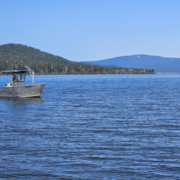
The Klamath Falls Field Office
The Oregon Water Science Center’s Klamath Falls Field Office provides surface-water and water-quality data to support the basin’s most pressing water-resource and ecosystem needs.

Water-quality monitoring during reservoir drawdowns
The USGS is monitoring water-quality above, within, and below Middle Fork Willamette and the South Santiam River dams using field-based and remote-sensing approaches to understand how reservoir drawdowns influence downstream water-quality conditions.

Oregon Water Science Center's Malheur Lake Portfolio
USGS scientists have partnered with local groups to learn about the processes affecting turbidity in Malheur Lake. Located in southeastern Oregon, Malheur Lake and the surrounding refuge provide critical habitat to birds migrating along the Pacific Flyway.
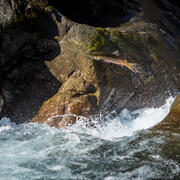
Monitoring tire-derived chemicals in stormwater
The USGS, in partnership with the Oregon Department of Transportation (ODOT) and other state and federal agencies, is studying a contaminant called 6PPD-quinone.

Modeling tire-derived chemicals in stormwater
The USGS and the Environmental Protection Agency are working together using advanced modeling tools to understand how 6PPD-quinone moves through watersheds and how green infrastructure can reduce its impact.

Water Quality in Keno Reach of the Klamath River
The U.S. Geological Survey, U.S. Bureau of Reclamation, and Watercourse Engineering, Inc. are collaborating to develop knowledge and tools to better manage water quality in the Link-Keno reach of the Klamath River and the Lost River.
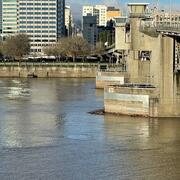
The “Super Monitor”: Tracking Willamette River water quality in Portland
Nicknamed the ‘Super Monitor,’ this site has measured key water-quality values every 15 minutes since 2009.

Tualatin River Basin Water Quality Assessment
In 1990, the USGS began assessing water-quality in the Tualatin River. More then 30 years later, we are still monitoring conditions in the basin and conducting investigations to better understand stream processes within the basin.

Nutrient and Sediment Loading to Upper Klamath Lake
The U.S. Geological Survey (USGS) computes time-series of total phosphorus (TP) and suspended-sediment concentrations (SSC) and loads entering Upper Klamath Lake using continuous turbidity sensor records, discrete TP and SSC data, and continuously computed streamflow.
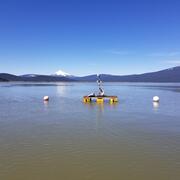
Integrating water availability in the Klamath Basin: from drought to dam removal
The USGS Water Resources Mission Area is assessing how much water is available for human and ecological needs in the United States and identifying where and when the Nation may have challenges meeting its demand for water. This information helps decision makers manage and distribute water in ways that balance competing needs. Due to its complex and competing water demands, ecological significance...
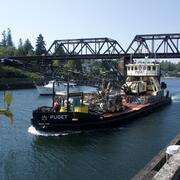
Lake Washington Ship Canal Sustainable Rivers Project
The U.S. Geological Survey (USGS) and the U.S. Army Corps of Engineers (USACE) are refining a water quality model to better understand temperature and salinity dynamics in the Lake Washington Ship Canal. This effort is supported by the Sustainable Rivers Program, a partnership between the USACE and The Nature Conservancy (TNC).