



Big Southern Butte, Idaho. The butte is among the largest rhyolite domes in the world and is located in the eastern Snake River Plain. Photo by James Neeley, BLM (https://flic.kr/p/CsA4TV).
Images
Volcano Science Center images.
Filter Total Items: 621

Big Southern Butte, Idaho
Big Southern Butte, Idaho. The butte is among the largest rhyolite domes in the world and is located in the eastern Snake River Plain. Photo by James Neeley, BLM (https://flic.kr/p/CsA4TV).

Frosted trees in the Fairy Falls area of Yellowstone National Park near the Firehole River
Frosted trees in the Fairy Falls area of Yellowstone National Park near the Firehole RiverFrosted trees in the Fairy Falls area of Yellowstone National Park near the Firehole River. National Park Service photo by Annie Carlson, 2014.
Frosted trees in the Fairy Falls area of Yellowstone National Park near the Firehole River
Frosted trees in the Fairy Falls area of Yellowstone National Park near the Firehole RiverFrosted trees in the Fairy Falls area of Yellowstone National Park near the Firehole River. National Park Service photo by Annie Carlson, 2014.

Schematic cross section of the magmatic and hydrothermal systems underlying Yellowstone Caldera
Schematic cross section of the magmatic and hydrothermal systems underlying Yellowstone CalderaSchematic cross section of the magmatic and hydrothermal systems underlying Yellowstone Caldera, showing magmatic volatiles emitted during crystallization of the rhyolitic magma and/or from basalt intrusions or convection, and the hypothesized relation with earthquake swarms on the caldera margins. The exsolved fluids accumulate at lithostatic pressures in the
Schematic cross section of the magmatic and hydrothermal systems underlying Yellowstone Caldera
Schematic cross section of the magmatic and hydrothermal systems underlying Yellowstone CalderaSchematic cross section of the magmatic and hydrothermal systems underlying Yellowstone Caldera, showing magmatic volatiles emitted during crystallization of the rhyolitic magma and/or from basalt intrusions or convection, and the hypothesized relation with earthquake swarms on the caldera margins. The exsolved fluids accumulate at lithostatic pressures in the

Lidar coverage of the Hebgen and Red Canyon faults collected in 2014
Lidar coverage of the Hebgen and Red Canyon faults collected in 2014Lidar coverage of the Hebgen and Red Canyon faults collected in 2014. Magenta lines show fault scarps mapped by USGS geologists shortly after the 1959 earthquake. Yellow lines show fault scarps interpreted from lidar data 55 years after the earthquake.
Lidar coverage of the Hebgen and Red Canyon faults collected in 2014
Lidar coverage of the Hebgen and Red Canyon faults collected in 2014Lidar coverage of the Hebgen and Red Canyon faults collected in 2014. Magenta lines show fault scarps mapped by USGS geologists shortly after the 1959 earthquake. Yellow lines show fault scarps interpreted from lidar data 55 years after the earthquake.

Lava Mountain, Wyoming
Lava Mountain, Wyoming. (A) View from Dubois, WY, in the Wind River basin looking northwest ~30 km toward Lava Mountain.
Lava Mountain, Wyoming. (A) View from Dubois, WY, in the Wind River basin looking northwest ~30 km toward Lava Mountain.
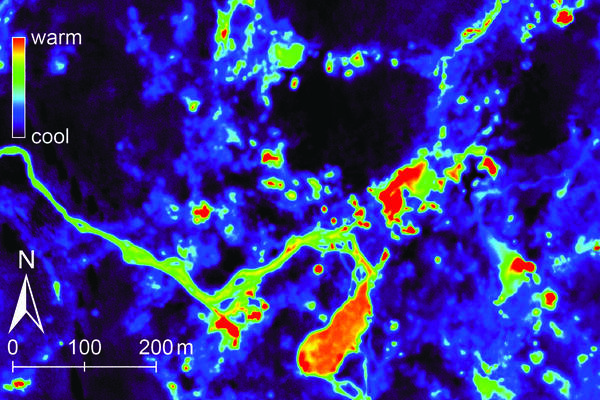
Thermal infrared image of a portion of Norris Geyser Basin, Yellowstone National Park
Thermal infrared image of a portion of Norris Geyser Basin, Yellowstone National ParkThermal infrared image of a portion of Norris Geyser Basin, Yellowstone National Park, acquired from an airborne thermal survey in October 2014. Warm colors indicate higher temperatures, and cooler colors are lower temperatures.
Thermal infrared image of a portion of Norris Geyser Basin, Yellowstone National Park
Thermal infrared image of a portion of Norris Geyser Basin, Yellowstone National ParkThermal infrared image of a portion of Norris Geyser Basin, Yellowstone National Park, acquired from an airborne thermal survey in October 2014. Warm colors indicate higher temperatures, and cooler colors are lower temperatures.

Mud Pot within the Mud Volcano thermal area of Yellowstone National Park
Mud Pot within the Mud Volcano thermal area of Yellowstone National ParkA mud pot in the Obsidian Pool Thermal Area, near Mud Volcano. The large amounts of suspended sediment make the thermal water much more viscous than pure water. Photo by Shaul Hurwitz, September 2014.
Mud Pot within the Mud Volcano thermal area of Yellowstone National Park
Mud Pot within the Mud Volcano thermal area of Yellowstone National ParkA mud pot in the Obsidian Pool Thermal Area, near Mud Volcano. The large amounts of suspended sediment make the thermal water much more viscous than pure water. Photo by Shaul Hurwitz, September 2014.
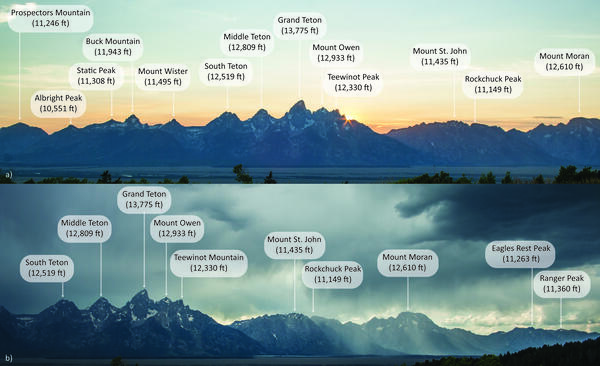
Teton Range, Wyoming
Images of a) the southern Teton Mountains and b) the northern Teton Mountains as seen from the Bridger-Teton National Forest. USGS photos by Stanley Mordensky, August 2014.
Images of a) the southern Teton Mountains and b) the northern Teton Mountains as seen from the Bridger-Teton National Forest. USGS photos by Stanley Mordensky, August 2014.

Photo of the Old Faithful Inn lobby
Photo of the Old Faithful Inn lobby, which features a six-story-tall fireplace and chimney made from rocks quarried form a rhyolite lava flow in Yellowstone. NPS photo by Jim Peaco, July 22, 2013.
Photo of the Old Faithful Inn lobby, which features a six-story-tall fireplace and chimney made from rocks quarried form a rhyolite lava flow in Yellowstone. NPS photo by Jim Peaco, July 22, 2013.
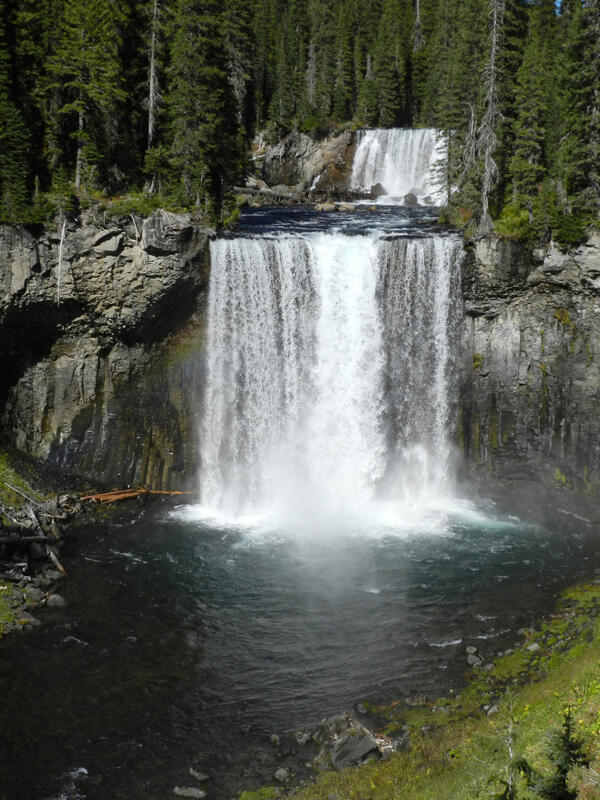
Colonnade Falls on the Bechler River, Yellowstone National Park
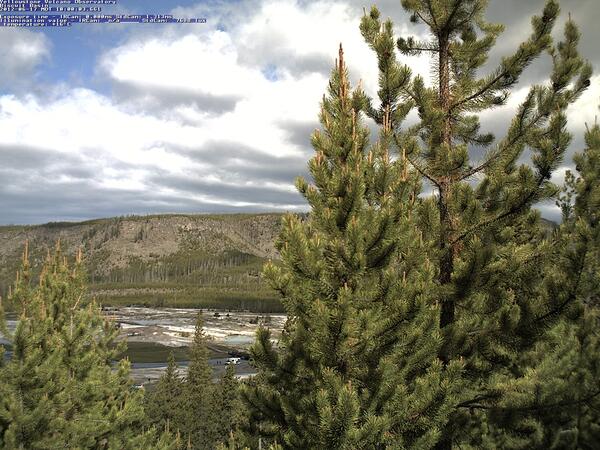
Image of Biscuit Basin (visible between the trees) captured by the YVO mobile webcam on June 17, 2012
Image of Biscuit Basin (visible between the trees) captured by the YVO mobile webcam on June 17, 2012Image of Biscuit Basin (visible between the trees) captured by the YVO mobile webcam on June 17, 2012, when it was positioned on a hill just east of the basin.
Image of Biscuit Basin (visible between the trees) captured by the YVO mobile webcam on June 17, 2012
Image of Biscuit Basin (visible between the trees) captured by the YVO mobile webcam on June 17, 2012Image of Biscuit Basin (visible between the trees) captured by the YVO mobile webcam on June 17, 2012, when it was positioned on a hill just east of the basin.

View north along U.S. Route 20 from near Ashton, ID, at the margin of the Huckleberry Ridge Tuff in the distance
View north along U.S. Route 20 from near Ashton, ID, at the margin of the Huckleberry Ridge Tuff in the distanceGoogle maps photo taken just north of Ashton, ID, along U.S. Route 20. The photo was taken looking north towards Island Park, ID. The forested ridge in the distance marks the margin of a caldera that formed 2.08 million years ago, when the Huckleberry Ridge Tuff erupted.
View north along U.S. Route 20 from near Ashton, ID, at the margin of the Huckleberry Ridge Tuff in the distance
View north along U.S. Route 20 from near Ashton, ID, at the margin of the Huckleberry Ridge Tuff in the distanceGoogle maps photo taken just north of Ashton, ID, along U.S. Route 20. The photo was taken looking north towards Island Park, ID. The forested ridge in the distance marks the margin of a caldera that formed 2.08 million years ago, when the Huckleberry Ridge Tuff erupted.
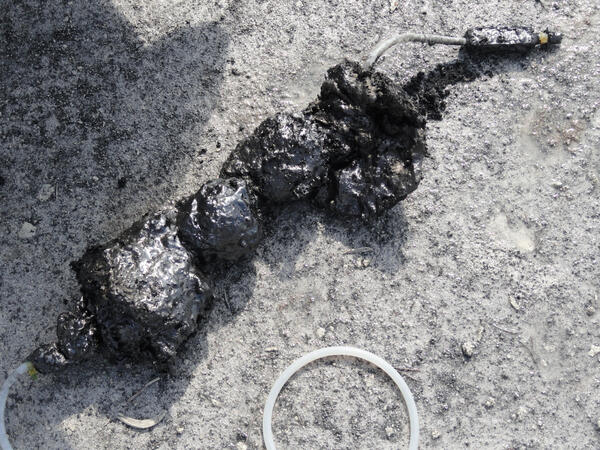
Sulfur “cinder” from Cinder Pool in Norris Geyser Basin, Yellowstone National Park
Sulfur “cinder” from Cinder Pool in Norris Geyser Basin, Yellowstone National ParkSulfur “cinder” attached to a sampling tube that was extracted from Cinder Pool in Norris Geyser Basin. The “cinder” is sulfur that existed as a molten layer at the bottom of the pool and was carried upward by gas and solidified. The black color is due to the presence of finely dispersed pyrite.
Sulfur “cinder” from Cinder Pool in Norris Geyser Basin, Yellowstone National Park
Sulfur “cinder” from Cinder Pool in Norris Geyser Basin, Yellowstone National ParkSulfur “cinder” attached to a sampling tube that was extracted from Cinder Pool in Norris Geyser Basin. The “cinder” is sulfur that existed as a molten layer at the bottom of the pool and was carried upward by gas and solidified. The black color is due to the presence of finely dispersed pyrite.
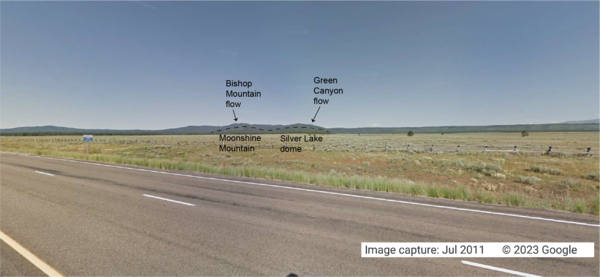
Looking west from the intersection of U.S. Route 20 and Old Hwy 47, in Idaho, at lava flows associated with the Henrys Fork caldera
Looking west from the intersection of U.S. Route 20 and Old Hwy 47, in Idaho, at lava flows associated with the Henrys Fork calderaGoogle Maps photo taken at the intersection of U.S. Route 20 and Old Hwy 47 in Idaho, looking west. The tops of Moonshine Mountain and Silver Lake dome, rhyolite lava flows located inside the caldera, are indicated with a dashed black line.
Looking west from the intersection of U.S. Route 20 and Old Hwy 47, in Idaho, at lava flows associated with the Henrys Fork caldera
Looking west from the intersection of U.S. Route 20 and Old Hwy 47, in Idaho, at lava flows associated with the Henrys Fork calderaGoogle Maps photo taken at the intersection of U.S. Route 20 and Old Hwy 47 in Idaho, looking west. The tops of Moonshine Mountain and Silver Lake dome, rhyolite lava flows located inside the caldera, are indicated with a dashed black line.
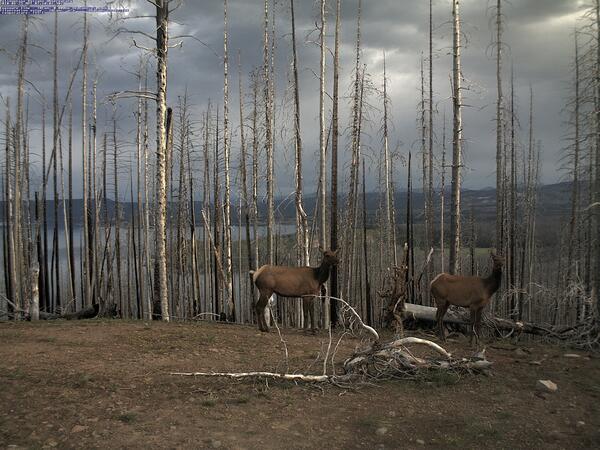
Image of elk captured by the YVO mobile webcam on June 25, 2010
Image of elk captured by the YVO mobile webcam on June 25, 2010Image of elk captured by the YVO mobile webcam on June 25, 2010, when it was positioned atop Lake Butte with a view of the north side of Yellowstone Lake.
Image of elk captured by the YVO mobile webcam on June 25, 2010
Image of elk captured by the YVO mobile webcam on June 25, 2010Image of elk captured by the YVO mobile webcam on June 25, 2010, when it was positioned atop Lake Butte with a view of the north side of Yellowstone Lake.

Overview of central West Thumb Geyser Basin
Overview of central West Thumb Geyser Basin. USGS photo by Pat Shanks, 2009.
Overview of central West Thumb Geyser Basin. USGS photo by Pat Shanks, 2009.

Photo of the Madison Museum, Yellowstone National Park
Photo of the Madison Museum, Yellowstone National ParkPhoto of the Madison Museum, built in 1930 and designed by Herbert Maier. This structure exemplifies the National Park Rustic style, using natural materials and artisan craftmanship that are intended to blend buildings into the surrounding environment, “suggesting the smallness of man in relation to nature” (Herbert Maier).
Photo of the Madison Museum, Yellowstone National Park
Photo of the Madison Museum, Yellowstone National ParkPhoto of the Madison Museum, built in 1930 and designed by Herbert Maier. This structure exemplifies the National Park Rustic style, using natural materials and artisan craftmanship that are intended to blend buildings into the surrounding environment, “suggesting the smallness of man in relation to nature” (Herbert Maier).

Bob Fournier measuring the gas-to-water ratio (gas/steam) at drill site Y2 in Yellowstone National Park
Bob Fournier measuring the gas-to-water ratio (gas/steam) at drill site Y2 in Yellowstone National ParkBob Fournier measuring the gas-to-water ratio (gas/steam) at drill site Y2, near Hot Lake on Firehole Lake Drive in Lower Geyser Basin, Yellowstone National Park, in the late 1960s. USGS Photo.
Bob Fournier measuring the gas-to-water ratio (gas/steam) at drill site Y2 in Yellowstone National Park
Bob Fournier measuring the gas-to-water ratio (gas/steam) at drill site Y2 in Yellowstone National ParkBob Fournier measuring the gas-to-water ratio (gas/steam) at drill site Y2, near Hot Lake on Firehole Lake Drive in Lower Geyser Basin, Yellowstone National Park, in the late 1960s. USGS Photo.

Yellowstone caldera viewed from Mount Washburn
Yellowstone caldera viewed from Mount Washburn. The caldera is the low-lying area extending from the foothills of Mount Washburn in the foreground to the rugged mountains on the horizon. The incised valley of the Yellowstone River stretches from left to right in the middle distance. Steep valley walls are illuminated by sunlight in the center. 
Yellowstone caldera viewed from Mount Washburn. The caldera is the low-lying area extending from the foothills of Mount Washburn in the foreground to the rugged mountains on the horizon. The incised valley of the Yellowstone River stretches from left to right in the middle distance. Steep valley walls are illuminated by sunlight in the center. 

Schematic illustration of waterfall formation
Schematic illustration of waterfall formation in which a hard rock that is more resistant to erosion is atop a softer rock that is less resistant to erosion. Source: Wikimedia (https://commons.wikimedia.org/wiki/File:WaterfallCreationDiagram.svg).

Schematic illustration of waterfall formation in which a hard rock that is more resistant to erosion is atop a softer rock that is less resistant to erosion. Source: Wikimedia (https://commons.wikimedia.org/wiki/File:WaterfallCreationDiagram.svg).

Terrace Springs, northeast of Madison Junction, Yellowstone National Park
Terrace Springs, northeast of Madison Junction, Yellowstone National ParkThe water at Terrace Springs, northeast of Madison Junction in Yellowstone National Park, is relatively cold (about 60 °C or 140 °F), but the water is still saturated with CO2-rich bubbles. Photo by Shaul Hurwitz in September 2008.
Terrace Springs, northeast of Madison Junction, Yellowstone National Park
Terrace Springs, northeast of Madison Junction, Yellowstone National ParkThe water at Terrace Springs, northeast of Madison Junction in Yellowstone National Park, is relatively cold (about 60 °C or 140 °F), but the water is still saturated with CO2-rich bubbles. Photo by Shaul Hurwitz in September 2008.