



Michelle Coombs is a volcanologist with the U.S. Geological Survey Volcano Hazards Program. She works out of the Alaska Science Center in Anchorage, Alaska.
Images
Volcano Science Center images.
Filter Total Items: 621

Michelle Coombs
Michelle Coombs is a volcanologist with the U.S. Geological Survey Volcano Hazards Program. She works out of the Alaska Science Center in Anchorage, Alaska.

Regional map of southeastern Idaho showing Stanley earthquakes
Regional map of southeastern Idaho showing Stanley earthquakesRegional map of southeastern Idaho showing the relative location of Yellowstone National Park and the Stanley earthquake aftershocks. Yellowstone National Park (outlined in yellow) is at least 275 km away from the 2020 Mw6.5 Stanley earthquake. Several active faults (in red) are located between the Stanley earthquake and Yellowstone Caldera.
Regional map of southeastern Idaho showing Stanley earthquakes
Regional map of southeastern Idaho showing Stanley earthquakesRegional map of southeastern Idaho showing the relative location of Yellowstone National Park and the Stanley earthquake aftershocks. Yellowstone National Park (outlined in yellow) is at least 275 km away from the 2020 Mw6.5 Stanley earthquake. Several active faults (in red) are located between the Stanley earthquake and Yellowstone Caldera.

Cumulative number of aftershocks greater than magnitude 2.5 following the 2020 magnitude 6.5 Stanley earthquake
Cumulative number of aftershocks greater than magnitude 2.5 following the 2020 magnitude 6.5 Stanley earthquakeCumulative number of aftershocks greater than magnitude 2.5 following the March 30, 2020, magnitude-6.5 Stanley earthquake in central Idaho. The black line shows the observed aftershocks, the red line shows the predicted number of aftershocks. Aftershocks are a normal and expected phenomenon following strong tectonic earthquakes.
Cumulative number of aftershocks greater than magnitude 2.5 following the 2020 magnitude 6.5 Stanley earthquake
Cumulative number of aftershocks greater than magnitude 2.5 following the 2020 magnitude 6.5 Stanley earthquakeCumulative number of aftershocks greater than magnitude 2.5 following the March 30, 2020, magnitude-6.5 Stanley earthquake in central Idaho. The black line shows the observed aftershocks, the red line shows the predicted number of aftershocks. Aftershocks are a normal and expected phenomenon following strong tectonic earthquakes.

Colloidal_Pool_maps_and_photos.png
Comparison of (a) 1904 Historical map with (b) 1988 USGS map. Colloidal Pool is a large, labeled pool roughly located on a straight line between Hurricane vent and Whirligig Geyser on the 1988 map (b); this same transect on the 1904 map (a) shows no feature at that location (white circle).
Comparison of (a) 1904 Historical map with (b) 1988 USGS map. Colloidal Pool is a large, labeled pool roughly located on a straight line between Hurricane vent and Whirligig Geyser on the 1988 map (b); this same transect on the 1904 map (a) shows no feature at that location (white circle).

SEM_Colloidal_poolpng.png
Scanning electron microscopy (SEM) images of the Colloidal Pool colloids (images are a combination of backscatter and secondary electrons). The colloids are a mixture of clay particles, hydrated silica, alunite, and diatoms.
Scanning electron microscopy (SEM) images of the Colloidal Pool colloids (images are a combination of backscatter and secondary electrons). The colloids are a mixture of clay particles, hydrated silica, alunite, and diatoms.

A branching root cast from grasses that grew on the ashy lahars deposited along the ancestral Missouri River system
A branching root cast from grasses that grew on the ashy lahars deposited along the ancestral Missouri River systemA branching root cast from grasses that grew on the ashy lahars deposited along the ancestral Missouri River system. Plant roots growing in calcareous soils made holes that were filled with calcite after the organics rotted away. Photo by Rob Thomas, August 2021.
A branching root cast from grasses that grew on the ashy lahars deposited along the ancestral Missouri River system
A branching root cast from grasses that grew on the ashy lahars deposited along the ancestral Missouri River systemA branching root cast from grasses that grew on the ashy lahars deposited along the ancestral Missouri River system. Plant roots growing in calcareous soils made holes that were filled with calcite after the organics rotted away. Photo by Rob Thomas, August 2021.

View of White Mountain from the Sunlight Basin Road
View of White Mountain from the Sunlight Basin RoadA view of White Mountain -- a deposit of the Heart Mountain detachment -- from the Sunlight Basin Road in Wyoming. Much of the evidence supporting the lamprophyre diatreme triggering mechanism theory for the landslide was gathered at White Mountain.
View of White Mountain from the Sunlight Basin Road
View of White Mountain from the Sunlight Basin RoadA view of White Mountain -- a deposit of the Heart Mountain detachment -- from the Sunlight Basin Road in Wyoming. Much of the evidence supporting the lamprophyre diatreme triggering mechanism theory for the landslide was gathered at White Mountain.

Site of the former Fountain Hotel in Yellowstone National Park
Site of the former Fountain Hotel in Yellowstone National ParkSite of the former Fountain Hotel in Yellowstone National Park. Red arrows indicate the location of the pipe that ran through the meadow between Leather Pool and the site of the Fountain Hotel (yellow arrow). Yellowstone National Park photo by Annie Carlson, October 2021.
Site of the former Fountain Hotel in Yellowstone National Park
Site of the former Fountain Hotel in Yellowstone National ParkSite of the former Fountain Hotel in Yellowstone National Park. Red arrows indicate the location of the pipe that ran through the meadow between Leather Pool and the site of the Fountain Hotel (yellow arrow). Yellowstone National Park photo by Annie Carlson, October 2021.

Yellowstone interferogram from Sentinel-1 spanning September 22, 2020 to September 17, 2021
Yellowstone interferogram from Sentinel-1 spanning September 22, 2020 to September 17, 2021Interferogram created from data collected on September 22, 2020, and September 17, 2021, by the Sentinel-1 satellite system. Colored fringes indicate a change in distance (called range change) between the satellite and ground surface that is caused by surface deformation.
Yellowstone interferogram from Sentinel-1 spanning September 22, 2020 to September 17, 2021
Yellowstone interferogram from Sentinel-1 spanning September 22, 2020 to September 17, 2021Interferogram created from data collected on September 22, 2020, and September 17, 2021, by the Sentinel-1 satellite system. Colored fringes indicate a change in distance (called range change) between the satellite and ground surface that is caused by surface deformation.

“Hey Bear” volcano, Wyoming, with Raggedtop Mountain in the background
“Hey Bear” volcano, Wyoming, with Raggedtop Mountain in the background“Hey Bear” volcano, Wyoming, with Raggedtop Mountain in the background. Hey Bear volcano is a small scoria cone that is about 1.3 million years old and that erupted over Eocene (~50 million-year-old) rocks (noted by yellow dotted line). Photo by Matthew Brueseke, Kansas State University, August 2021, used with permission.
“Hey Bear” volcano, Wyoming, with Raggedtop Mountain in the background
“Hey Bear” volcano, Wyoming, with Raggedtop Mountain in the background“Hey Bear” volcano, Wyoming, with Raggedtop Mountain in the background. Hey Bear volcano is a small scoria cone that is about 1.3 million years old and that erupted over Eocene (~50 million-year-old) rocks (noted by yellow dotted line). Photo by Matthew Brueseke, Kansas State University, August 2021, used with permission.

Tabular blocks of layered ash in a matrix of cross-bedded ash deposited by ancestral Missouri River
Tabular blocks of layered ash in a matrix of cross-bedded ash deposited by ancestral Missouri RiverTypical exposure of tabular blocks of layered ash in a matrix of cross-bedded ash. The tabular blocks were deposited, rapidly hardened, and ripped up and transported downstream along the ancestral Missouri River system with another pulse of ash and water, forming the cross-bedded matrix.
Tabular blocks of layered ash in a matrix of cross-bedded ash deposited by ancestral Missouri River
Tabular blocks of layered ash in a matrix of cross-bedded ash deposited by ancestral Missouri RiverTypical exposure of tabular blocks of layered ash in a matrix of cross-bedded ash. The tabular blocks were deposited, rapidly hardened, and ripped up and transported downstream along the ancestral Missouri River system with another pulse of ash and water, forming the cross-bedded matrix.

Twin Buttes in Lower Geyser Basin, with Excelsior Geyser of Midway Geyser Basin in the foreground
Twin Buttes in Lower Geyser Basin, with Excelsior Geyser of Midway Geyser Basin in the foregroundPhotograph of Twin Buttes in Lower Geyser Basin looking to the northwest, with Excelsior Geyser of Midway Geyser Basin in the foreground. Twin Buttes is a thermal kame that formed when glaciers covered the area, and hydrothermal activity below the ice led to melting and the deposition and cementation of glacial sediments.
Twin Buttes in Lower Geyser Basin, with Excelsior Geyser of Midway Geyser Basin in the foreground
Twin Buttes in Lower Geyser Basin, with Excelsior Geyser of Midway Geyser Basin in the foregroundPhotograph of Twin Buttes in Lower Geyser Basin looking to the northwest, with Excelsior Geyser of Midway Geyser Basin in the foreground. Twin Buttes is a thermal kame that formed when glaciers covered the area, and hydrothermal activity below the ice led to melting and the deposition and cementation of glacial sediments.

Imperial Geyser, Lower Geyser Basin, Yellowstone National Park
Imperial Geyser, Lower Geyser Basin, Yellowstone National ParkImperial Geyser, Lower Geyser Basin, Yellowstone National Park. USGS photo by Lauren Harrison, July 2021.
Imperial Geyser, Lower Geyser Basin, Yellowstone National Park
Imperial Geyser, Lower Geyser Basin, Yellowstone National ParkImperial Geyser, Lower Geyser Basin, Yellowstone National Park. USGS photo by Lauren Harrison, July 2021.
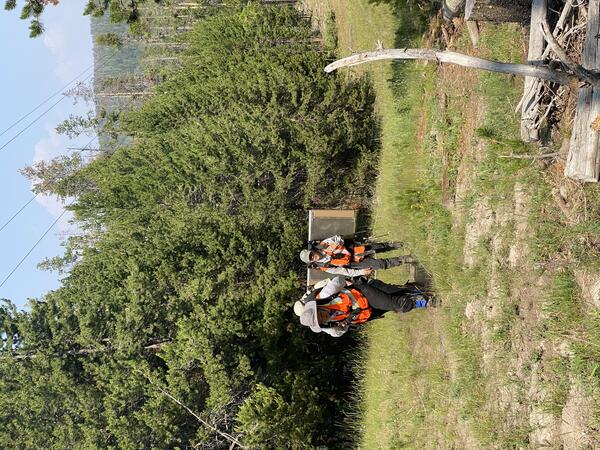
USGS scientists carrying field equipment to set up a gas monitoring station in Yellowstone National Park
USGS scientists carrying field equipment to set up a gas monitoring station in Yellowstone National ParkUSGS scientists Laura Dobeck and Sara Peek carrying field equipment to set up a gas monitoring station in Yellowstone National Park. USGS photo by Jennifer Lewicki, July 13, 2021.
USGS scientists carrying field equipment to set up a gas monitoring station in Yellowstone National Park
USGS scientists carrying field equipment to set up a gas monitoring station in Yellowstone National ParkUSGS scientists Laura Dobeck and Sara Peek carrying field equipment to set up a gas monitoring station in Yellowstone National Park. USGS photo by Jennifer Lewicki, July 13, 2021.

Field team installs scanning DOAS at Mount St. Helens
Field team installs scanning DOAS at Mount St. HelensUSGS Cascades Volcano Observatory Physical Science Technician Brian Meyers installs a data telemetry antenna on a volcano monitoring station at Mount St. Helens. A DOAS scanner is mounted above the flat-panel antenna at the top of the mast.
Field team installs scanning DOAS at Mount St. Helens
Field team installs scanning DOAS at Mount St. HelensUSGS Cascades Volcano Observatory Physical Science Technician Brian Meyers installs a data telemetry antenna on a volcano monitoring station at Mount St. Helens. A DOAS scanner is mounted above the flat-panel antenna at the top of the mast.

Mount Hood and Fault-plane Solution for June 5, 2021 Earthquake
Mount Hood and Fault-plane Solution for June 5, 2021 EarthquakePhoto of Mount Hood taken June 7, 2003. The fault-plane solution for the M 3.9 earthquake that occurred on June 5, 2021 is in the lower right corner.
Mount Hood and Fault-plane Solution for June 5, 2021 Earthquake
Mount Hood and Fault-plane Solution for June 5, 2021 EarthquakePhoto of Mount Hood taken June 7, 2003. The fault-plane solution for the M 3.9 earthquake that occurred on June 5, 2021 is in the lower right corner.
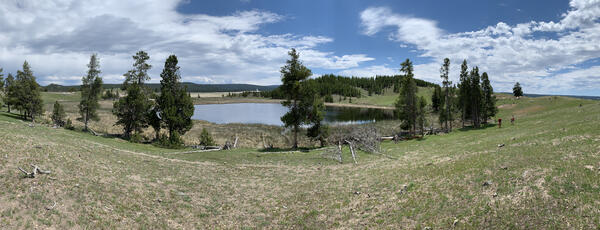
Rush Lake, Lower Geyser Basin, Yellowstone National Park
Rush Lake, Lower Geyser Basin, Yellowstone National ParkRush Lake in Lower Geyser Basin, Yellowstone National Park, contains over 23 feet of sediment on its floor. Pollen, charcoal, and diatoms in sediment cores were used to reconstruct the ecological history of the region over the last 15,000 years. Photo by Cathy Whitlock, Montana State University, June 2021.
Rush Lake, Lower Geyser Basin, Yellowstone National Park
Rush Lake, Lower Geyser Basin, Yellowstone National ParkRush Lake in Lower Geyser Basin, Yellowstone National Park, contains over 23 feet of sediment on its floor. Pollen, charcoal, and diatoms in sediment cores were used to reconstruct the ecological history of the region over the last 15,000 years. Photo by Cathy Whitlock, Montana State University, June 2021.

Monument Geyser Basin
View of Monument Geyser Basin in Yellowstone National Park, with one of the silica spire "monuments" (from which the basin gets its name) in the foreground. USGS photo by Mike Poland, May 15, 2021.
View of Monument Geyser Basin in Yellowstone National Park, with one of the silica spire "monuments" (from which the basin gets its name) in the foreground. USGS photo by Mike Poland, May 15, 2021.

Roaring Mountain, Yellowstone National Park
Roaring Mountain, an acid-sulfate thermal area about 5 miles south of Norris Geyser Basin along the Norris-Mammoth road. At times during the late 1800s and early 1900s, the sound of gas escaping from vents could be heard over a mile away, but today the thermal area is mostly quiet, although remains intensely hot with over 100 megawatts of geothermal radiative
Roaring Mountain, an acid-sulfate thermal area about 5 miles south of Norris Geyser Basin along the Norris-Mammoth road. At times during the late 1800s and early 1900s, the sound of gas escaping from vents could be heard over a mile away, but today the thermal area is mostly quiet, although remains intensely hot with over 100 megawatts of geothermal radiative

The two dominant rock types found on Mount Everts, Yellowstone National Park
The two dominant rock types found on Mount Everts, Yellowstone National ParkPhotographs of the two dominant rock types found on Mount Everts: the Everts Formation (photo by Natali Kragh, May 18, 2021) and the Landslide Creek Formation (photo by Emma Kerins, May 2021). Notice the difference in scale between these two units, indicated by the pencil and field book.
The two dominant rock types found on Mount Everts, Yellowstone National Park
The two dominant rock types found on Mount Everts, Yellowstone National ParkPhotographs of the two dominant rock types found on Mount Everts: the Everts Formation (photo by Natali Kragh, May 18, 2021) and the Landslide Creek Formation (photo by Emma Kerins, May 2021). Notice the difference in scale between these two units, indicated by the pencil and field book.

Washington State Governor Proclaims May 2021 as Volcano Awareness Mont
Washington State Governor Proclaims May 2021 as Volcano Awareness MontWashington State Governor Proclaims May 2021 as Volcano Awareness Month.
Washington State Governor Proclaims May 2021 as Volcano Awareness Mont
Washington State Governor Proclaims May 2021 as Volcano Awareness MontWashington State Governor Proclaims May 2021 as Volcano Awareness Month.