



Honey bees live and work in highly collaborative, social colonies with a sole reproducing queen, and they make honey by storing nectar from flowering plants in their hives for use during food scarcities.
Images
Images
Filter Total Items: 9454

Honey Bees Make Life Sweet
Honey bees live and work in highly collaborative, social colonies with a sole reproducing queen, and they make honey by storing nectar from flowering plants in their hives for use during food scarcities.

Lead Shot in the Fall Zone
Lead shot in the fall zone at the Broadkiln Sportsman's Club (quarter-coin for scale).
Lead shot in the fall zone at the Broadkiln Sportsman's Club (quarter-coin for scale).

Looking Up from Shake Table
Looking straight up from the center of the Shake Table.
Looking straight up from the center of the Shake Table.

Bois de Sioux River
The Bois de Sioux river channel near White Rock, SD.
The Bois de Sioux river channel near White Rock, SD.

Bois de Sioux River
The Bois de Sioux river channel near White Rock, SD.
The Bois de Sioux river channel near White Rock, SD.

USGS Employee At Work
Christian Bongard collects data from a weather station in the Shenandoah National Park.
Christian Bongard collects data from a weather station in the Shenandoah National Park.

USGS Employee At Work
Mike Sabatino (volunteer for science) wires a weather station in the Shenandoah National Park
Mike Sabatino (volunteer for science) wires a weather station in the Shenandoah National Park

Road Repair in Indian Country
Workers repairing a road.

Road Repair in Indian Country
Workers repairing a road.

Amakihi Honeycreeper
During the past decade populations of this honeycreeper have begun to rebound at lower elevations on most of the main Hawaiian Islands, in spite of high prevalence of infection with avian malaria.
During the past decade populations of this honeycreeper have begun to rebound at lower elevations on most of the main Hawaiian Islands, in spite of high prevalence of infection with avian malaria.

Rightmeyer House at Back Bay NWR
This photo shows the Righmeyer House at Back Bay National Wildlife Refuge, which will be rehabilitated with Recovery Act funding to house the refuge's offices. Related to the R5GA Repair Rightmeyer House Back Bay NWR project.
This photo shows the Righmeyer House at Back Bay National Wildlife Refuge, which will be rehabilitated with Recovery Act funding to house the refuge's offices. Related to the R5GA Repair Rightmeyer House Back Bay NWR project.

Pond Liner Replacement
This pond liner replacement process will be used to replace 9 deteriorated clay pond liners with polyethylene liners that help hatchery employees at Garrison Dam National Fish Hatchery produce more fish at a larger size with less effort. Related to the R6PC Replace 9 Clay Pond Liners Garrison Dam NFH project.
This pond liner replacement process will be used to replace 9 deteriorated clay pond liners with polyethylene liners that help hatchery employees at Garrison Dam National Fish Hatchery produce more fish at a larger size with less effort. Related to the R6PC Replace 9 Clay Pond Liners Garrison Dam NFH project.
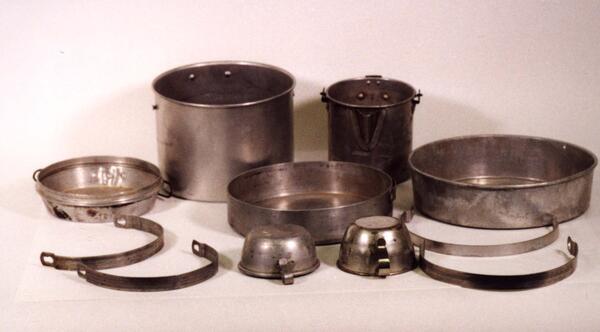
Mess Kit
This is a set of food preparation tools used in the field. Included in the mess kit are cups, pans, interchangeable lids and handles, a strainer, a coffeepot and a hot water pot. This kit was used by field scientists in the west.
Object ID: USGS-000135-136, 138-144, 146 & 148-150
This is a set of food preparation tools used in the field. Included in the mess kit are cups, pans, interchangeable lids and handles, a strainer, a coffeepot and a hot water pot. This kit was used by field scientists in the west.
Object ID: USGS-000135-136, 138-144, 146 & 148-150
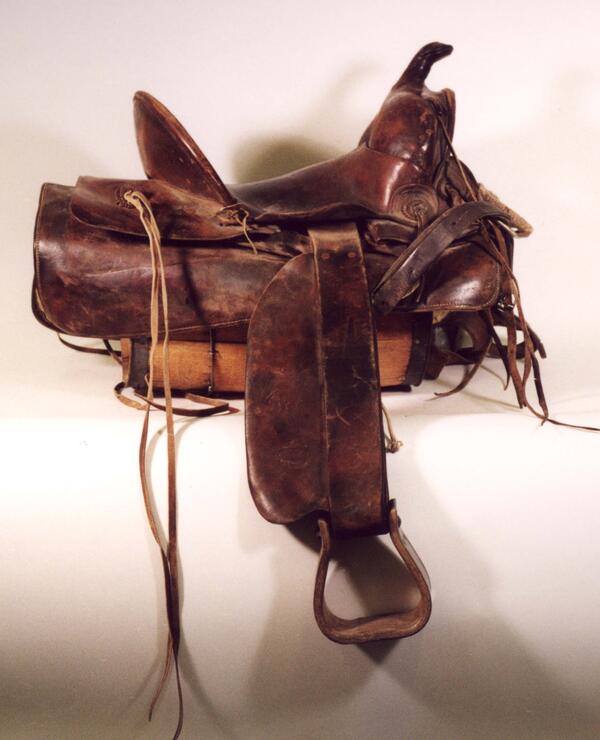
Arnold Hague's Saddle
This is Arnold Hague's saddle. The saddle is likely about 120 years old and in the western style with a sheepskin liner. Arnold Hague used this saddle on his expeditions in the west.
Object ID: USGS-000015
This is Arnold Hague's saddle. The saddle is likely about 120 years old and in the western style with a sheepskin liner. Arnold Hague used this saddle on his expeditions in the west.
Object ID: USGS-000015
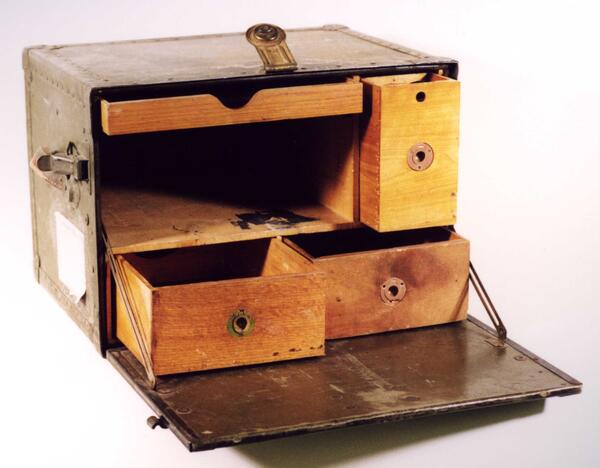
Portable Field Desk
This desk, used in the field, was originally made for the US Army. The drawers all pull into the desk and the writing surface of the desk then folds up for transport. Often, scientists took advantage of surplus items for their field work.
Object ID: USGS-000017
This desk, used in the field, was originally made for the US Army. The drawers all pull into the desk and the writing surface of the desk then folds up for transport. Often, scientists took advantage of surplus items for their field work.
Object ID: USGS-000017
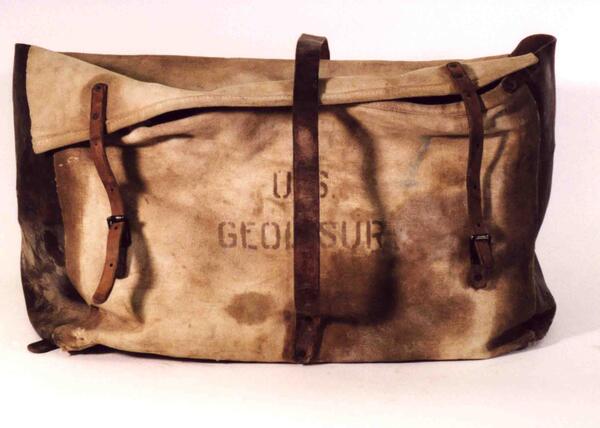
Canvas Pannier
This is one of many heavy, canvas and leather panniers. They were used by Arnold Hague in the late 1800s and are no longer made or used. Many are imprinted with "US Geol. Sur."
Object ID: USGS-000037
This is one of many heavy, canvas and leather panniers. They were used by Arnold Hague in the late 1800s and are no longer made or used. Many are imprinted with "US Geol. Sur."
Object ID: USGS-000037
Canvas Cinch
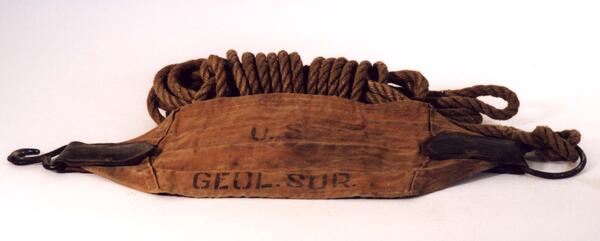
This canvas cinch was developed by Dr. J. D. Love. This type of cinch was used to protect sores from developing on animals that carried surveying or camp equipment for field scientists.
Object ID: USGS-000039
This canvas cinch was developed by Dr. J. D. Love. This type of cinch was used to protect sores from developing on animals that carried surveying or camp equipment for field scientists.
Object ID: USGS-000039
Animal Halter
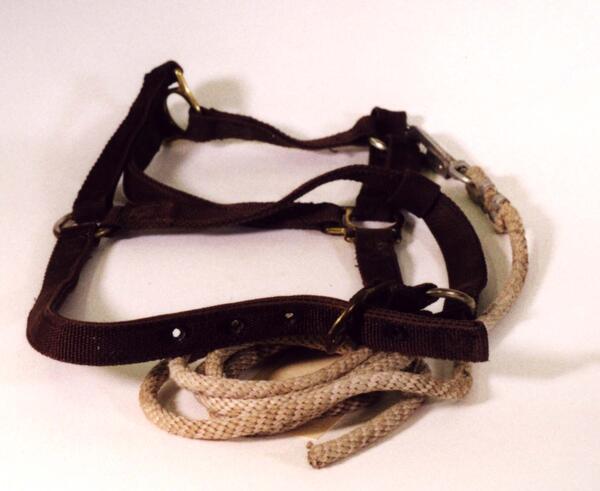
This is one of many objects used by field scientists in the care of their animals. This type of halter was used to provide an easy way to hold on to animals that might otherwise become unruly or wander away.
Object ID: USGS-000076
This is one of many objects used by field scientists in the care of their animals. This type of halter was used to provide an easy way to hold on to animals that might otherwise become unruly or wander away.
Object ID: USGS-000076
Hobble
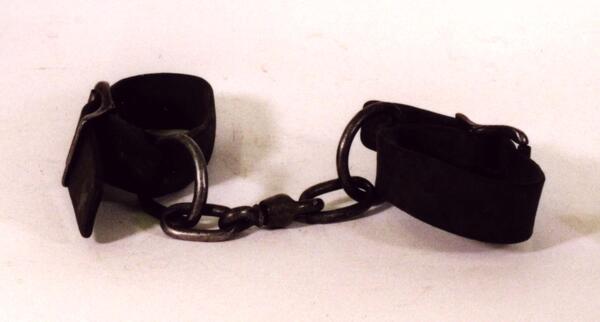
This is one of many objects used by scientists in the care of their animals. This hobble, consisting of two leather straps connected with a chain, was placed around the feet of an animal to keep it from straying far.
Object ID: USGS-000084
This is one of many objects used by scientists in the care of their animals. This hobble, consisting of two leather straps connected with a chain, was placed around the feet of an animal to keep it from straying far.
Object ID: USGS-000084
Frederick Street, Edinburgh by James Hutton
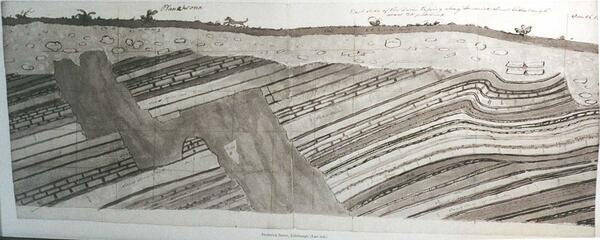
This is a replica of a watercolor done by James Hutton when he was doing his field work in Scotland. It is titled, Frederick Street, Edinburgh.
Object ID: USGS-575011
This is a replica of a watercolor done by James Hutton when he was doing his field work in Scotland. It is titled, Frederick Street, Edinburgh.
Object ID: USGS-575011
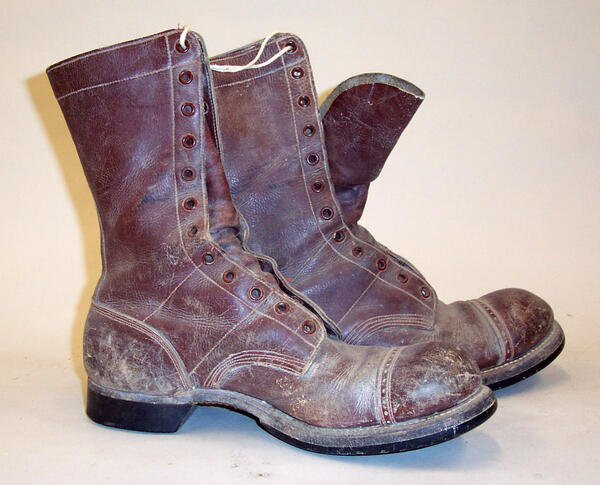
Leather Boots
The soles of made of heavy-duty rubber with metal studs.
Object ID: USGS-000212
The soles of made of heavy-duty rubber with metal studs.
Object ID: USGS-000212