U.S. flag

An official website of the United States government

Images

Images related to natural hazards.

Filter Total Items: 7275
Hawaiian Volcano Observatory on rim of Kīlauea Volcano's summit cal...
HVO on rim of Kīlauea's summit caldera overlooking Halema‘uma‘u, Ha...

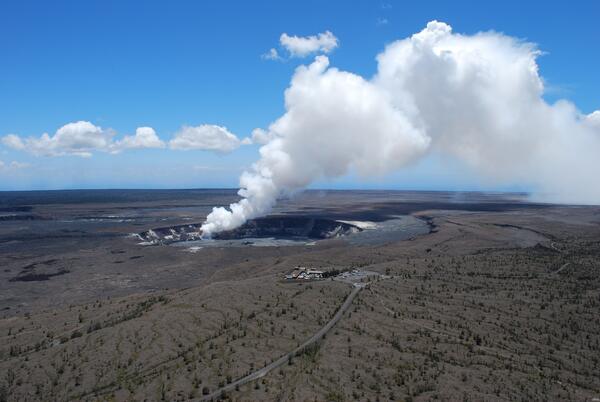
The Hawaiian Volcano Observatory, the first volcano observatory in the United States, is located on the west rim of Kīlauea Volcano's summit caldera in Hawai‘i Volcanoes National Park. A volcanic gas plume rises from a vent that opened in 2008 at the base of the south wall of Halema‘uma‘u Crater. Crater Rim Drive in foreground.

The Hawaiian Volcano Observatory, the first volcano observatory in the United States, is located on the west rim of Kīlauea Volcano's summit caldera in Hawai‘i Volcanoes National Park. A volcanic gas plume rises from a vent that opened in 2008 at the base of the south wall of Halema‘uma‘u Crater. Crater Rim Drive in foreground.

USGS Hawaiian Volcano Observatory, Kīlauea Volcano, Hawaii...
USGS HVO, Kīlauea, Hawaii

The Hawaiian Volcano Observatory perched on the west rim of Kīlauea Volcano's summit caldera, overlooks Halema‘uma‘u Crater, where a new vent that opened in March 2008 emits a volcanic gas plume.

The Hawaiian Volcano Observatory perched on the west rim of Kīlauea Volcano's summit caldera, overlooks Halema‘uma‘u Crater, where a new vent that opened in March 2008 emits a volcanic gas plume.

Image: USGS Hawaiian Volcano Observatory
USGS Hawaiian Volcano Observatory

The USGS Hawaiian Volcano Observatory is perched on the rim of Kilauea Volcano's summit caldera (next to the Thomas A. Jaggar Museum in Hawai'i Volcanoes National Park), providing a spectacular view of the active vent in Halema‘uma‘u Crater.

The USGS Hawaiian Volcano Observatory is perched on the rim of Kilauea Volcano's summit caldera (next to the Thomas A. Jaggar Museum in Hawai'i Volcanoes National Park), providing a spectacular view of the active vent in Halema‘uma‘u Crater.

Hawaiian Volcano Observatory on rim of Kīlauea Volcano's summit cal...
HVO on rim of Kīlauea's summit caldera overlooking Halema‘uma‘u, Ha...

The U.S. Geological Survey's Hawaiian Volcano Observatory, the first volcano observatory in the United States, is located on the west rim of Kīlauea Volcano's summit caldera in Hawai‘i Volcanoes National Park. A volcanic gas plume rises from a vent that opened in 2008 at the base of the south wall of Halema‘uma‘u Crater. Crater Rim Drive in foreground.

The U.S. Geological Survey's Hawaiian Volcano Observatory, the first volcano observatory in the United States, is located on the west rim of Kīlauea Volcano's summit caldera in Hawai‘i Volcanoes National Park. A volcanic gas plume rises from a vent that opened in 2008 at the base of the south wall of Halema‘uma‘u Crater. Crater Rim Drive in foreground.

Image: The USGS Hawaiian Volcano Observatory Monitors Kilauea's Summit Eruption
The USGS Hawaiian Volcano Observatory Monitors Kilauea's Summit Eruption

The USGS Hawaiian Volcano Observatory (foreground) is located on the caldera rim of Kilauea Volcano, Hawai'i—the most active volcano in the world.  The observatory's location provides an excellent view of summit eruptive activity, which began in 2008.

The USGS Hawaiian Volcano Observatory (foreground) is located on the caldera rim of Kilauea Volcano, Hawai'i—the most active volcano in the world.  The observatory's location provides an excellent view of summit eruptive activity, which began in 2008.

Image: The USGS Hawaiian Volcano Observatory Monitors Kilauea's Summit Eruption
USGS Hawaiian Volcano Observatory Monitors Kilauea's Summit Eruption

The USGS Hawaiian Volcano Observatory (foreground) is located on the caldera rim of Kilauea Volcano, Hawai'i—the most active volcano in the world.  The observatory's location provides an excellent view of summit eruptive activity, which began in 2008.

The USGS Hawaiian Volcano Observatory (foreground) is located on the caldera rim of Kilauea Volcano, Hawai'i—the most active volcano in the world.  The observatory's location provides an excellent view of summit eruptive activity, which began in 2008.

Lidar instrument uses light pulses to measure distances to the grou...
Lidar instrument uses light pulses to measure distances to ground s...

Lidar instrument uses light pulses to measure distances to the ground surface in the Kīlauea Caldera, Hawaii. Measurements are used to make a Digital Elevation Model - a very accurate topographic map.

Lidar instrument uses light pulses to measure distances to the ground surface in the Kīlauea Caldera, Hawaii. Measurements are used to make a Digital Elevation Model - a very accurate topographic map.

Aerial photograph of a Canadian and a US ship in the Arctic Ocean
U.S. and Canadian Ships in Arctic Ocean

Helicopter view of Canadian Coast Guard Ship Louis S. St. Laurent (top) and U.S. Coast Guard Cutter Healy (bottom) on the Arctic Ocean. This was during a scientific expedition to map the extended continental shelf in the Arctic Ocean.

Helicopter view of Canadian Coast Guard Ship Louis S. St. Laurent (top) and U.S. Coast Guard Cutter Healy (bottom) on the Arctic Ocean. This was during a scientific expedition to map the extended continental shelf in the Arctic Ocean.

Image: Permafrost Erosion Measurement
Permafrost Erosion Measurement

USGS researcher Benjamin Jones examines a collapsed block of ice-rich permafrost on Barter Island along Alaska's Arctic coast.

Nighttime view of tephra-jet explosion, Kīlauea Volcano, Hawai‘i...
Nighttime view of tephra-jet explosion, Kīlauea, Hawai‘i

Incandescent arcs trace the path of lava fragments cast out during a tephra-jet explosion at the Waikupanaha ocean entry in 2008. This is a relatively small explosion, reaching a few tens of meters (yards) height, while one earlier in the day was nearly 70 meters (230 ft) in height.

Incandescent arcs trace the path of lava fragments cast out during a tephra-jet explosion at the Waikupanaha ocean entry in 2008. This is a relatively small explosion, reaching a few tens of meters (yards) height, while one earlier in the day was nearly 70 meters (230 ft) in height.

Image: Littoral Explosion At Kilauea Volcano, Hawai'i
Littoral Explosion At Kilauea Volcano, Hawai'i

When lava from the Pu'u 'Ō'ō-Kupaianaha eruption, active since 1983, meets the ocean, large littoral explosions can result.

Crater Lake Caldera with Wizard Island cinder cone and lava flows, ...

Crater Lake Caldera with Wizard Island cinder cone and lava flows, some of the youngest features in the caldera as seen from Merriam Point. Viewed toward the south. Oregon

image related to volcanoes. See description
Fissure 8 continues to send lava to the sea

The early morning helicopter overflight of the lower East Rift Zone shows lava continuing to enter the sea at Ahalanui. The southern margin of the flow remains about a quarter mile from the boat ramp at Isaac Hale Park (jetty visible in the center left of the photo). View to the northeast.

The early morning helicopter overflight of the lower East Rift Zone shows lava continuing to enter the sea at Ahalanui. The southern margin of the flow remains about a quarter mile from the boat ramp at Isaac Hale Park (jetty visible in the center left of the photo). View to the northeast.

Image: 2008 Donghekou Landslide
2008 Donghekou Landslide

Photograph of the Donghekou Landslide, triggered by the 2008 Wenchuan, China Earthquake. This landslide had 3 sources areas: the mountain slope at the top right of the photograph a second area primarily resulting in a rockslide that occurred to the left of the scientists, and one to the right, across the river (not shown in picture).

Photograph of the Donghekou Landslide, triggered by the 2008 Wenchuan, China Earthquake. This landslide had 3 sources areas: the mountain slope at the top right of the photograph a second area primarily resulting in a rockslide that occurred to the left of the scientists, and one to the right, across the river (not shown in picture).

Image: 2008 Donghekou Landslide
2008 Donghekou Landslide

Photograph of the Donghekou Landslide, triggered by the 2008 Wenchuan, China Earthquake. This landslide had 3 sources areas: the mountain slope at the top right of the photograph a second area primarily resulting in a rockslide that occurred to the left of the scientists, and one to the right, across the river (not shown in picture).

Photograph of the Donghekou Landslide, triggered by the 2008 Wenchuan, China Earthquake. This landslide had 3 sources areas: the mountain slope at the top right of the photograph a second area primarily resulting in a rockslide that occurred to the left of the scientists, and one to the right, across the river (not shown in picture).

View looking along a set of train tracks that run along a low, man-made berm along the edge of water.
Edmonds, WA train tracks

Train tracks and overwater structures along Browns Bay in Edmonds, Washington often occur on developed shorelines of Puget Sound. The built environment can interrupt the flow of sediment from back-beach bluffs to the intertidal zone, attenuate and redirect alongshore currents, and reduce upper beach habitat.

Train tracks and overwater structures along Browns Bay in Edmonds, Washington often occur on developed shorelines of Puget Sound. The built environment can interrupt the flow of sediment from back-beach bluffs to the intertidal zone, attenuate and redirect alongshore currents, and reduce upper beach habitat.

Image: Creek Bank and Flood Plain
Creek Bank and Flood Plain

High bank and flood plain of Short Creek (a tributary of the Souris River in North Dakota) below International Boundary near Roche Percee, Saskatchewan, Canada.

High bank and flood plain of Short Creek (a tributary of the Souris River in North Dakota) below International Boundary near Roche Percee, Saskatchewan, Canada.

Was this page helpful?