U.S. flag

An official website of the United States government

Images

Images related to natural hazards.

Filter Total Items: 7266
Static stress change models

Static stress change models for known or hypothesized faults in the Hispaniola and Puerto Rico subduction segments due to (a) slip on a patch of the Puerto Rico subduction zone, and (b) slip on a patch of the Hispaniola subduction zone. An open arrow denotes slip direction and the patches are marked by dashed rectangles.

Static stress change models for known or hypothesized faults in the Hispaniola and Puerto Rico subduction segments due to (a) slip on a patch of the Puerto Rico subduction zone, and (b) slip on a patch of the Hispaniola subduction zone. An open arrow denotes slip direction and the patches are marked by dashed rectangles.

HVO geologist on rim of Halema‘uma‘u Crater downloading camera imag...
Geologist on rim of Halema‘uma‘u downloading camera images, Kīlauea...

HVO geologist downloads images collected with infrared cameras set up on the rim of Halema‘uma‘u Crater. The cameras are aimed at an erupting lava lake to conduct a thermal survey of the lake's surface.

Seismologist installing equipment at station NED on Mount St. Helen...

Seismologist installing equipment at station NED on Mount St. Helens, Washington. Mount Rainier in distance.

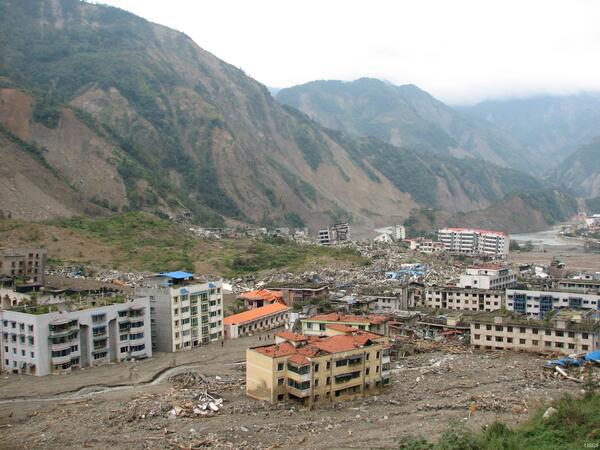
Image: Damage from 2008 Great Sichuan Earthquake in China
Damage from 2008 Great Sichuan Earthquake in China

The May 12, 2008, Great Sichuan Earthquake, also called the Wenchuan Earthquake, occurred at 14:28 local time, in Sichuan Province, China. The earthquake magnitudes were Mw = 7.9 (USGS), Ms = 8.0 (Chinese Earthquake Administration). The epicenter was 80 km west-northwest of Chengdu, the capital city of Sichuan province.

The May 12, 2008, Great Sichuan Earthquake, also called the Wenchuan Earthquake, occurred at 14:28 local time, in Sichuan Province, China. The earthquake magnitudes were Mw = 7.9 (USGS), Ms = 8.0 (Chinese Earthquake Administration). The epicenter was 80 km west-northwest of Chengdu, the capital city of Sichuan province.

Image: Utilities on San Andreas Fault
Utilities on San Andreas Fault

Directly on the San Andreas with high pressure gas lines underground and high voltage power lines overhead at Cajon Pass, CA

Directly on the San Andreas with high pressure gas lines underground and high voltage power lines overhead at Cajon Pass, CA

Image: Utilities on San Andreas Fault
Utilities on San Andreas Fault

Directly on the San Andreas with high pressure gas lines underground and high voltage power lines overhead at Cajon Pass, CA

Directly on the San Andreas with high pressure gas lines underground and high voltage power lines overhead at Cajon Pass, CA

mountainside with trees covering an obvious old landslide
Slumgullion Landslide

Photograph of the active (upslope from the highway that crosses the landslide deposit) and inactive (downslope from the highway) parts of the Slumgullion landslide in Hinsdale County, Colorado.

Photograph of the active (upslope from the highway that crosses the landslide deposit) and inactive (downslope from the highway) parts of the Slumgullion landslide in Hinsdale County, Colorado.

Sulfur flow (darker gray area) on an altered ground surface at Brim...

Sulfur flow (darker gray area) on an altered ground surface at Brimstone Basin, Yellowstone Lake in background.

Gas flows up, appearing to boil, through the water of Alluvium Cree...

Gas flows up, appearing to boil, through the water of Alluvium Creek, Brimstone Basin, Yellowstone. Large funnel is used to trap gas, which is then sent to a collection bottle through the tubing.

Volcanic-gas plumes emitted by ocean entry, Pu‘u ‘Ō‘ō vent, and Hal...

Volcanic-gas plumes mark the sites where lava flows from Pu‘u ‘Ō‘ō enter the ocean on Kīlauea's south coast (far left), the Pu‘u ‘Ō‘ō cone (left) on the East Rift Zone, and Halema‘uma‘u Crater at the summit (right). Structures visible in middle left primarily located around the Volcano Golf and Country Club and Kīlauea Military Camp.

Volcanic-gas plumes mark the sites where lava flows from Pu‘u ‘Ō‘ō enter the ocean on Kīlauea's south coast (far left), the Pu‘u ‘Ō‘ō cone (left) on the East Rift Zone, and Halema‘uma‘u Crater at the summit (right). Structures visible in middle left primarily located around the Volcano Golf and Country Club and Kīlauea Military Camp.

Hawaiian Volcano Observatory on rim of Kīlauea Volcano's summit cal...
HVO on rim of Kīlauea's summit caldera overlooking Halema‘uma‘u, Ha...

The Hawaiian Volcano Observatory, the first volcano observatory in the United States, is located on the west rim of Kīlauea Volcano's summit caldera in Hawai‘i Volcanoes National Park. A volcanic gas plume rises from a vent that opened in 2008 at the base of the south wall of Halema‘uma‘u Crater. Crater Rim Drive in foreground.

The Hawaiian Volcano Observatory, the first volcano observatory in the United States, is located on the west rim of Kīlauea Volcano's summit caldera in Hawai‘i Volcanoes National Park. A volcanic gas plume rises from a vent that opened in 2008 at the base of the south wall of Halema‘uma‘u Crater. Crater Rim Drive in foreground.

USGS Hawaiian Volcano Observatory, Kīlauea Volcano, Hawaii...
USGS HVO, Kīlauea, Hawaii

The Hawaiian Volcano Observatory perched on the west rim of Kīlauea Volcano's summit caldera, overlooks Halema‘uma‘u Crater, where a new vent that opened in March 2008 emits a volcanic gas plume.

The Hawaiian Volcano Observatory perched on the west rim of Kīlauea Volcano's summit caldera, overlooks Halema‘uma‘u Crater, where a new vent that opened in March 2008 emits a volcanic gas plume.

Image: USGS Hawaiian Volcano Observatory
USGS Hawaiian Volcano Observatory

The USGS Hawaiian Volcano Observatory is perched on the rim of Kilauea Volcano's summit caldera (next to the Thomas A. Jaggar Museum in Hawai'i Volcanoes National Park), providing a spectacular view of the active vent in Halema‘uma‘u Crater.

The USGS Hawaiian Volcano Observatory is perched on the rim of Kilauea Volcano's summit caldera (next to the Thomas A. Jaggar Museum in Hawai'i Volcanoes National Park), providing a spectacular view of the active vent in Halema‘uma‘u Crater.

image related to volcanoes. See description
Hawaiian Volcano Observatory field geologists track activity at fissure 8 (pictu

Hawaiian Volcano Observatory field geologists track activity at fissure 8 (pictured in the background). Crews collect fissure 8 tephra (Pele's hair, pumice, and other lightweight volcanic glass fragments) for geochemical analyses and characterization of changes in lava fountain behavior.

Hawaiian Volcano Observatory field geologists track activity at fissure 8 (pictured in the background). Crews collect fissure 8 tephra (Pele's hair, pumice, and other lightweight volcanic glass fragments) for geochemical analyses and characterization of changes in lava fountain behavior.

Hawaiian Volcano Observatory on rim of Kīlauea Volcano's summit cal...
HVO on rim of Kīlauea's summit caldera overlooking Halema‘uma‘u, Ha...

The U.S. Geological Survey's Hawaiian Volcano Observatory, the first volcano observatory in the United States, is located on the west rim of Kīlauea Volcano's summit caldera in Hawai‘i Volcanoes National Park. A volcanic gas plume rises from a vent that opened in 2008 at the base of the south wall of Halema‘uma‘u Crater. Crater Rim Drive in foreground.

The U.S. Geological Survey's Hawaiian Volcano Observatory, the first volcano observatory in the United States, is located on the west rim of Kīlauea Volcano's summit caldera in Hawai‘i Volcanoes National Park. A volcanic gas plume rises from a vent that opened in 2008 at the base of the south wall of Halema‘uma‘u Crater. Crater Rim Drive in foreground.

Image: The USGS Hawaiian Volcano Observatory Monitors Kilauea's Summit Eruption
The USGS Hawaiian Volcano Observatory Monitors Kilauea's Summit Eruption

The USGS Hawaiian Volcano Observatory (foreground) is located on the caldera rim of Kilauea Volcano, Hawai'i—the most active volcano in the world.  The observatory's location provides an excellent view of summit eruptive activity, which began in 2008.

The USGS Hawaiian Volcano Observatory (foreground) is located on the caldera rim of Kilauea Volcano, Hawai'i—the most active volcano in the world.  The observatory's location provides an excellent view of summit eruptive activity, which began in 2008.

Image: The USGS Hawaiian Volcano Observatory Monitors Kilauea's Summit Eruption
USGS Hawaiian Volcano Observatory Monitors Kilauea's Summit Eruption

The USGS Hawaiian Volcano Observatory (foreground) is located on the caldera rim of Kilauea Volcano, Hawai'i—the most active volcano in the world.  The observatory's location provides an excellent view of summit eruptive activity, which began in 2008.

The USGS Hawaiian Volcano Observatory (foreground) is located on the caldera rim of Kilauea Volcano, Hawai'i—the most active volcano in the world.  The observatory's location provides an excellent view of summit eruptive activity, which began in 2008.

Lidar instrument uses light pulses to measure distances to the grou...
Lidar instrument uses light pulses to measure distances to ground s...

Lidar instrument uses light pulses to measure distances to the ground surface in the Kīlauea Caldera, Hawaii. Measurements are used to make a Digital Elevation Model - a very accurate topographic map.

Lidar instrument uses light pulses to measure distances to the ground surface in the Kīlauea Caldera, Hawaii. Measurements are used to make a Digital Elevation Model - a very accurate topographic map.

Aerial photograph of a Canadian and a US ship in the Arctic Ocean
U.S. and Canadian Ships in Arctic Ocean

Helicopter view of Canadian Coast Guard Ship Louis S. St. Laurent (top) and U.S. Coast Guard Cutter Healy (bottom) on the Arctic Ocean. This was during a scientific expedition to map the extended continental shelf in the Arctic Ocean.

Helicopter view of Canadian Coast Guard Ship Louis S. St. Laurent (top) and U.S. Coast Guard Cutter Healy (bottom) on the Arctic Ocean. This was during a scientific expedition to map the extended continental shelf in the Arctic Ocean.

Was this page helpful?