



Strike-slip faults are vertical (or nearly vertical) fractures where the blocks have mostly moved horizontally. If the block opposite an observer looking across the fault moves to the right, the slip style is termed right-lateral; if the block moves to the left, the motion is termed left-lateral.
Videos
Explore a wide variety of videos that highlight natural hazards, the risks they pose and the science we conduct to better understand and prepare for them.
Natural Hazards We Might Face
Natural Hazards We Might Face

Learn about the natural hazards you might face and how science can help us be better prepared.
Explore Earthquake Preparedness Videos
Explore Earthquake Preparedness Videos
Earthquake hazards are a national risk, with nearly half of Americans living in areas prone to potentially damaging earthquakes. Learn about tools and resources that can help us all be better prepared.
Filter Total Items: 764

Strike-Slip Fault
Strike-slip faults are vertical (or nearly vertical) fractures where the blocks have mostly moved horizontally. If the block opposite an observer looking across the fault moves to the right, the slip style is termed right-lateral; if the block moves to the left, the motion is termed left-lateral.

Wavefront
The wavefront is the instantaneous boundary between the seismic waves in the earth material, and the material that the seismic energy has not yet reached. As a seismic wave propagates through the earth, the wavefront moves.
The wavefront is the instantaneous boundary between the seismic waves in the earth material, and the material that the seismic energy has not yet reached. As a seismic wave propagates through the earth, the wavefront moves.

Great Circle
The shortest path between two points on the surface of a sphere lies along a great circle. On a 2-dimensional map, this looks like a line, but when it's on a 3-dimensional sphere, it's an arc... part of a circle.
The shortest path between two points on the surface of a sphere lies along a great circle. On a 2-dimensional map, this looks like a line, but when it's on a 3-dimensional sphere, it's an arc... part of a circle.
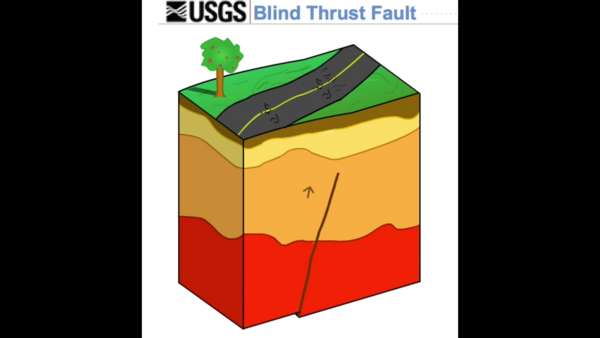
Blind Thrust Fault
A thrust fault that does not rupture all the way up to the surface so there is no evidence of it on the ground. It is buried under the uppermost layers of rock in the crust.
A thrust fault that does not rupture all the way up to the surface so there is no evidence of it on the ground. It is buried under the uppermost layers of rock in the crust.

Directivity
Directivity is an effect of a fault rupturing whereby earthquake ground motion in the direction of rupture propagation is more severe than that in other directions from the earthquake source.
Directivity is an effect of a fault rupturing whereby earthquake ground motion in the direction of rupture propagation is more severe than that in other directions from the earthquake source.

Normal Fault
Normal, or Dip-slip, faults are inclined fractures where the blocks have mostly shifted vertically. If the rock mass above an inclined fault moves down, the fault is termed normal, whereas if the rock above the fault moves up, the fault is termed a Reverse fault.
Normal, or Dip-slip, faults are inclined fractures where the blocks have mostly shifted vertically. If the rock mass above an inclined fault moves down, the fault is termed normal, whereas if the rock above the fault moves up, the fault is termed a Reverse fault.

Thrust Fault
A thrust fault is a reverse fault with a dip of 45° or less, a very low angle. This animation shows a reverse fault which is a steeper-angle fault, but it moves the same way.
A thrust fault is a reverse fault with a dip of 45° or less, a very low angle. This animation shows a reverse fault which is a steeper-angle fault, but it moves the same way.

Debris Flow Monitoring at Chalk Cliffs, CO (2014)
The USGS and its cooperators have installed debris-flow monitoring equipment in the largest drainage basin at Chalk Cliffs, CO. Data collection at this site supports research on the hydrologic factors that control debris-flow initiation, entrainment, and flow dynamics.
The USGS and its cooperators have installed debris-flow monitoring equipment in the largest drainage basin at Chalk Cliffs, CO. Data collection at this site supports research on the hydrologic factors that control debris-flow initiation, entrainment, and flow dynamics.

Time-lapse Photography of Barter Island in Alaska
This time-lapse of Barter Island in Alaska during three summer months in 2014, shows the pack ice melting and the subsequent effects to the beach and permafrost cliffs from storms and summer temperatures. This camera sat on a fallen snow fence to capture storm events.
This time-lapse of Barter Island in Alaska during three summer months in 2014, shows the pack ice melting and the subsequent effects to the beach and permafrost cliffs from storms and summer temperatures. This camera sat on a fallen snow fence to capture storm events.
Changing Smoke Conditions from Slide Fire, Flagstaff, Arizona, May 21, 2014
Changing Smoke Conditions from Slide Fire, Flagstaff, Arizona, May 21, 2014Changing sky conditions and smoke from the Slide fire, a major wildfire near Flagstaff, Arizona, are apparent in this sequence of natural-color, hemispheric images acquired on May 21, 2014. Individual images are collected at 10-minute intervals at the USGS Flagstaff Science Campus by the High Dynamic Range All-Sky Imaging System (HDR-ASIS).
Changing Smoke Conditions from Slide Fire, Flagstaff, Arizona, May 21, 2014
Changing Smoke Conditions from Slide Fire, Flagstaff, Arizona, May 21, 2014Changing sky conditions and smoke from the Slide fire, a major wildfire near Flagstaff, Arizona, are apparent in this sequence of natural-color, hemispheric images acquired on May 21, 2014. Individual images are collected at 10-minute intervals at the USGS Flagstaff Science Campus by the High Dynamic Range All-Sky Imaging System (HDR-ASIS).
1964 Quake: The Great Alaska Earthquake (SPANISH)
See English version already posted in Gallery

1964 Quake: The Great Alaska Earthquake
"1964 Quake: The Great Alaska Earthquake" is an eleven minute video highlighting the impacts and effects of America's largest recorded earthquake. It is an expanded version of the four minute video "Magnitude 9.2". Both were created as part of USGS activities acknowledging the fifty year anniversary of the quake on March 27, 2014.
"1964 Quake: The Great Alaska Earthquake" is an eleven minute video highlighting the impacts and effects of America's largest recorded earthquake. It is an expanded version of the four minute video "Magnitude 9.2". Both were created as part of USGS activities acknowledging the fifty year anniversary of the quake on March 27, 2014.

Winter storm deposits snow on Mauna Loa's summit
This Quicktime video shows a time-lapse sequence spanning from dawn to dusk on Tuesday, January 28, using images collected by our webcam near the summit of Mauna Loa Volcano (13,680 ft above sea level).
This Quicktime video shows a time-lapse sequence spanning from dawn to dusk on Tuesday, January 28, using images collected by our webcam near the summit of Mauna Loa Volcano (13,680 ft above sea level).

The Yellowstone Volcano: Past, Present and Future
Public Lecture on Yellowstone Volcano by Jake Lowenstern at Menlo Park, CA on January 23, 2014. The Q&A at the end of the talk can be found on the original source video (Source URL).
Public Lecture on Yellowstone Volcano by Jake Lowenstern at Menlo Park, CA on January 23, 2014. The Q&A at the end of the talk can be found on the original source video (Source URL).

Busy Day in the Sed Lab
Time lapse video of Angela Tan working in the USGS Sediment Lab Suite and Carbon Analysis Laboratory at the Pacific Coastal and Marine Science Center in Santa Cruz, California.
Time lapse video of Angela Tan working in the USGS Sediment Lab Suite and Carbon Analysis Laboratory at the Pacific Coastal and Marine Science Center in Santa Cruz, California.

Living with Fire: Chaparral Removal
Southern California's fire ecology is unlike that of anywhere else in the United States. Fire control strategies developed for mountain forests don't have the same results here. So can science help uncover new answers to help Southern California communities manage and live with wildfires?
Southern California's fire ecology is unlike that of anywhere else in the United States. Fire control strategies developed for mountain forests don't have the same results here. So can science help uncover new answers to help Southern California communities manage and live with wildfires?

Living Near the Epicenter of the M5.8 Mineral, Virginia, Earthquake
Living Near the Epicenter of the M5.8 Mineral, Virginia, EarthquakeWatch video interviews with four people discussing their experiences near the epicenter of the magnitude 5.8 earthquake in central Virginia on August 23, 2011. Tens of millions of people in the eastern U.S. and southeastern Canada were startled by sudden ground shaking from this earthquake, which was among the largest to occur in this region in the last century.
Living Near the Epicenter of the M5.8 Mineral, Virginia, Earthquake
Living Near the Epicenter of the M5.8 Mineral, Virginia, EarthquakeWatch video interviews with four people discussing their experiences near the epicenter of the magnitude 5.8 earthquake in central Virginia on August 23, 2011. Tens of millions of people in the eastern U.S. and southeastern Canada were startled by sudden ground shaking from this earthquake, which was among the largest to occur in this region in the last century.
The 20th Century's Greatest Volcanic Eruption- Mt Katmai 100 Years Later
The 20th Century's Greatest Volcanic Eruption- Mt Katmai 100 Years LaterBill Burton discusses the June 6-8, 1912 eruption of Mount Katmai in Alaska which was 30 times larger than the eruption of Mt. St. Helens in 1980. This eruption caused widespread devastation, and inspired heroic efforts at survival by the local people.
The 20th Century's Greatest Volcanic Eruption- Mt Katmai 100 Years Later
The 20th Century's Greatest Volcanic Eruption- Mt Katmai 100 Years LaterBill Burton discusses the June 6-8, 1912 eruption of Mount Katmai in Alaska which was 30 times larger than the eruption of Mt. St. Helens in 1980. This eruption caused widespread devastation, and inspired heroic efforts at survival by the local people.

Volcano Web Shorts 6: Societal Impacts of Volcanism
Volcano Web Shorts 6: Societal Impacts of VolcanismUSGS geologist, Angie Diefenbach, describes how she uses GIS, (Geographic Information Systems) software to study volcanic eruptions and their impacts on society.
Volcano Web Shorts 6: Societal Impacts of Volcanism
Volcano Web Shorts 6: Societal Impacts of VolcanismUSGS geologist, Angie Diefenbach, describes how she uses GIS, (Geographic Information Systems) software to study volcanic eruptions and their impacts on society.

Volcano Web Shorts 2: Debris Flows
Debris flows are hazardous flows of rock, sediment and water that surge down mountain slopes and into adjacent valleys. Hydrologist Richard Iverson describes the nature of debris-flow research and explains how debris flow experiments are conducted at the USGS Debris Flow Flume, west of Eugene, Oregon.
Debris flows are hazardous flows of rock, sediment and water that surge down mountain slopes and into adjacent valleys. Hydrologist Richard Iverson describes the nature of debris-flow research and explains how debris flow experiments are conducted at the USGS Debris Flow Flume, west of Eugene, Oregon.

Volcano Web Shorts 3: Seismology
USGS volcano seismologist, Seth Moran, describes how seismology and seismic networks are used to mitigate volcanic hazards.
USGS volcano seismologist, Seth Moran, describes how seismology and seismic networks are used to mitigate volcanic hazards.