



What inspired a USGS geologist to study how dam removal changes rivers. Profile of Amy East.
Videos
Explore a wide variety of videos that highlight natural hazards, the risks they pose and the science we conduct to better understand and prepare for them.
Natural Hazards We Might Face
Natural Hazards We Might Face

Learn about the natural hazards you might face and how science can help us be better prepared.
Explore Earthquake Preparedness Videos
Explore Earthquake Preparedness Videos
Earthquake hazards are a national risk, with nearly half of Americans living in areas prone to potentially damaging earthquakes. Learn about tools and resources that can help us all be better prepared.
Filter Total Items: 763

Running Rivers
What inspired a USGS geologist to study how dam removal changes rivers. Profile of Amy East.

Catching the Quakes - Using Seismic Signals to Track Debris Flows
Catching the Quakes - Using Seismic Signals to Track Debris FlowsUSGS Research Geophysicist Kate Allstadt conducts experiments at the U.S. Geological Survey debris-flow flume, near Eugene, Oregon. Dr. Allstadt and her group are working toward an understanding of how debris flows generate seismic signals.
Catching the Quakes - Using Seismic Signals to Track Debris Flows
Catching the Quakes - Using Seismic Signals to Track Debris FlowsUSGS Research Geophysicist Kate Allstadt conducts experiments at the U.S. Geological Survey debris-flow flume, near Eugene, Oregon. Dr. Allstadt and her group are working toward an understanding of how debris flows generate seismic signals.

Wave runup during Tropical Storm Colin at Madeira Beach, Florida
Wave runup during Tropical Storm Colin at Madeira Beach, FloridaThis short video demonstrates wave runup and setup on a beach on a stormy day during Tropical Storm Colin. The camera, positioned in the surf zone, shows a multistory building in the background, while waves run up the shallow beach and wash sand from the eroded dune edge (scarp).
Wave runup during Tropical Storm Colin at Madeira Beach, Florida
Wave runup during Tropical Storm Colin at Madeira Beach, FloridaThis short video demonstrates wave runup and setup on a beach on a stormy day during Tropical Storm Colin. The camera, positioned in the surf zone, shows a multistory building in the background, while waves run up the shallow beach and wash sand from the eroded dune edge (scarp).

Breaking Down Reefs, Building Up Beaches
On the remote western coast of Australia lies a UNESCO World Heritage Site above and below the sea. Researchers from the U.S. Geological Survey and University of Western Australia convened here at Ningaloo Reef and Jurabi Coastal Reserve to embark on the most extensive study EVER done into how coral reefs shape our coasts.
On the remote western coast of Australia lies a UNESCO World Heritage Site above and below the sea. Researchers from the U.S. Geological Survey and University of Western Australia convened here at Ningaloo Reef and Jurabi Coastal Reserve to embark on the most extensive study EVER done into how coral reefs shape our coasts.

Shaking of Frontier Building — Anchorage, Alaska, During Mw7.1 Earthquake, January 24, 2016
Shaking of Frontier Building — Anchorage, Alaska, During Mw7.1 Earthquake, January 24, 2016This video presents a visualization of shaking that was recorded in the Frontier Building in Anchorage, Alaska, during the Mw7.1 earthquake, January 24, 2016, Iniskin, Alaska. It exhibits how a tall building behaves and performs during strong earthquake shaking.
Shaking of Frontier Building — Anchorage, Alaska, During Mw7.1 Earthquake, January 24, 2016
Shaking of Frontier Building — Anchorage, Alaska, During Mw7.1 Earthquake, January 24, 2016This video presents a visualization of shaking that was recorded in the Frontier Building in Anchorage, Alaska, during the Mw7.1 earthquake, January 24, 2016, Iniskin, Alaska. It exhibits how a tall building behaves and performs during strong earthquake shaking.

Flat Canyon Trench Excavation, Wasatch Fault Zone, Utah
Flat Canyon Trench Excavation, Wasatch Fault Zone, UtahA time-lapse video of the excavation of the trench for a paleoseismology research project at Flat Canyon, Utah, along the Wasatch fault zone.
Flat Canyon Trench Excavation, Wasatch Fault Zone, Utah
Flat Canyon Trench Excavation, Wasatch Fault Zone, UtahA time-lapse video of the excavation of the trench for a paleoseismology research project at Flat Canyon, Utah, along the Wasatch fault zone.

Peeking into Permafrost
Barter Island sits at the top of the Arctic National Wildlife Refuge in Alaska, and with the Arctic facing quickly rising temperatures, USGS wants to investigate what’s causing the North Slope bluffs to erode so quickly.
Barter Island sits at the top of the Arctic National Wildlife Refuge in Alaska, and with the Arctic facing quickly rising temperatures, USGS wants to investigate what’s causing the North Slope bluffs to erode so quickly.

Post-wildfire Flood and Debris Flow: 2014 Silverado Fire
Post-wildfire Flood and Debris Flow: 2014 Silverado FireIn 2014, the Silverado Fire burned approximately 4 km^2 in Orange County, California. After the fire, the USGS installed an automated rain-triggered camera to monitor post-wildfire flooding and debris flow at the outlet of a small 0.6 km^2 basin within the burn area.
Post-wildfire Flood and Debris Flow: 2014 Silverado Fire
Post-wildfire Flood and Debris Flow: 2014 Silverado FireIn 2014, the Silverado Fire burned approximately 4 km^2 in Orange County, California. After the fire, the USGS installed an automated rain-triggered camera to monitor post-wildfire flooding and debris flow at the outlet of a small 0.6 km^2 basin within the burn area.

PubTalk 04/2015—"Fearfully Grand" Eruptions: Lassen Peak, CA, 1914-17
PubTalk 04/2015—"Fearfully Grand" Eruptions: Lassen Peak, CA, 1914-17Title: A Sight "Fearfully Grand" Eruptions of Lassen Peak, California, 1914 to1917
- A summary of the eruptions and their effects
- Illustrated with historical photographs
PubTalk 04/2015—"Fearfully Grand" Eruptions: Lassen Peak, CA, 1914-17
PubTalk 04/2015—"Fearfully Grand" Eruptions: Lassen Peak, CA, 1914-17Title: A Sight "Fearfully Grand" Eruptions of Lassen Peak, California, 1914 to1917
- A summary of the eruptions and their effects
- Illustrated with historical photographs

Exploring Causes of Coral Disease
The Hawaiian Islands’ beautiful ocean and beaches attract more than 8.5 million tourists each year. The USGS aims to help Hawaii preserve its underwater natural resources by tracing how oceanography may influence coral disease outbreaks.
The Hawaiian Islands’ beautiful ocean and beaches attract more than 8.5 million tourists each year. The USGS aims to help Hawaii preserve its underwater natural resources by tracing how oceanography may influence coral disease outbreaks.

Continuous Gas Monitoring Tracks Volcanic Activity at Mount St. Helens
Continuous Gas Monitoring Tracks Volcanic Activity at Mount St. HelensVolcano gas geochemistry has been around for a long time. Scientists can make gas measurements using very large, very expensive Correlation Spectrometers or collect samples in the field and bring them back for analysis in the lab. But it’s possible we’re missing out on a lot of information because our monitoring capabilities don’t include continuous observation.
Continuous Gas Monitoring Tracks Volcanic Activity at Mount St. Helens
Continuous Gas Monitoring Tracks Volcanic Activity at Mount St. HelensVolcano gas geochemistry has been around for a long time. Scientists can make gas measurements using very large, very expensive Correlation Spectrometers or collect samples in the field and bring them back for analysis in the lab. But it’s possible we’re missing out on a lot of information because our monitoring capabilities don’t include continuous observation.
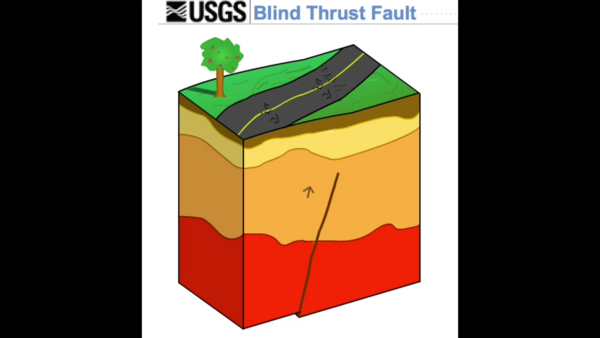
Blind Thrust Fault
A thrust fault that does not rupture all the way up to the surface so there is no evidence of it on the ground. It is buried under the uppermost layers of rock in the crust.
A thrust fault that does not rupture all the way up to the surface so there is no evidence of it on the ground. It is buried under the uppermost layers of rock in the crust.

Foreshocks, Mainshocks, and Aftershocks
Aftershocks are earthquakes that follow the largest shock of an earthquake sequence. They are smaller than the mainshock and within 1-2 fault lengths distance from the mainshock fault. Aftershocks can continue over a period of weeks, months, or years.
Aftershocks are earthquakes that follow the largest shock of an earthquake sequence. They are smaller than the mainshock and within 1-2 fault lengths distance from the mainshock fault. Aftershocks can continue over a period of weeks, months, or years.

Elastic Rebound
Elastic rebound is what happens to the crustal material on either side of a fault during an earthquake. The idea is that a fault is stuck until the strain accumulated in the rock on either side of the fault has overcome the friction making it stick.
Elastic rebound is what happens to the crustal material on either side of a fault during an earthquake. The idea is that a fault is stuck until the strain accumulated in the rock on either side of the fault has overcome the friction making it stick.

Shadow Zone
The shadow zone is the area of the earth from angular distances of 104 to 140 degrees that, for a given earthquake, that does not receive any direct P waves. The shadow zone results from S waves (not shown in animation) being stopped entirely by the liquid core and P waves being bent (refracted) by the liquid core.
The shadow zone is the area of the earth from angular distances of 104 to 140 degrees that, for a given earthquake, that does not receive any direct P waves. The shadow zone results from S waves (not shown in animation) being stopped entirely by the liquid core and P waves being bent (refracted) by the liquid core.

Wavefront
The wavefront is the instantaneous boundary between the seismic waves in the earth material, and the material that the seismic energy has not yet reached. As a seismic wave propagates through the earth, the wavefront moves.
The wavefront is the instantaneous boundary between the seismic waves in the earth material, and the material that the seismic energy has not yet reached. As a seismic wave propagates through the earth, the wavefront moves.

Attenuation
When you throw a pebble in a pond, it makes waves on the surface that move out from the place where the pebble entered the water. The waves are largest where they are formed and gradually get smaller as they move away. This decrease in size, or amplitude, of the waves is called attenuation.
When you throw a pebble in a pond, it makes waves on the surface that move out from the place where the pebble entered the water. The waves are largest where they are formed and gradually get smaller as they move away. This decrease in size, or amplitude, of the waves is called attenuation.

Normal Fault
Normal, or Dip-slip, faults are inclined fractures where the blocks have mostly shifted vertically. If the rock mass above an inclined fault moves down, the fault is termed normal, whereas if the rock above the fault moves up, the fault is termed a Reverse fault.
Normal, or Dip-slip, faults are inclined fractures where the blocks have mostly shifted vertically. If the rock mass above an inclined fault moves down, the fault is termed normal, whereas if the rock above the fault moves up, the fault is termed a Reverse fault.
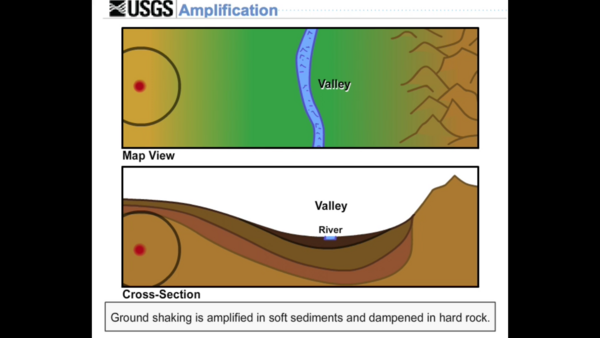
Amplification
Shaking at a site may be increased, or amplified, by focusing of seismic energy caused by the materials in basins or by surface topography such as mountains.
Shaking at a site may be increased, or amplified, by focusing of seismic energy caused by the materials in basins or by surface topography such as mountains.

Asperity
An asperity is an area on a fault that is stuck. The earthquake rupture usually begins at an asperity.
An asperity is an area on a fault that is stuck. The earthquake rupture usually begins at an asperity.

Divergent
A divergent boundary is where two adjacent tectonic plates are moving away from each other.
A divergent boundary is where two adjacent tectonic plates are moving away from each other.