



Drinking and Household Use
Drinking and Household Use
Filter Total Items: 59

Understanding Water Availability
The United States faces growing challenges to its water supply, and we need to know where there is not enough water, where we have more than we need, and the quality of the water. The USGS is charged with understanding and reporting on water availability including influences on water supply (how much water and of what quality) and water demand (how much water do humans and ecosystems need).

Water Quality After Wildfire
Wildfires pose a substantial risk to water supplies because they can lead to severe flooding, erosion, and delivery of sediment, nutrients, and metals to rivers, lakes, and reservoirs. The USGS works with federal and state land managers and local water providers to monitor and assess water quality after wildfires in order to help protect our Nation’s water resources.

CASCaDE: Computational Assessments of Scenarios of Change for the Delta Ecosystem
The Delta of the Sacramento and San Joaquin rivers provides drinking water supplies to two-thirds of Californians, and is a fragile ecosystem home to threatened and endangered species. The CASCaDE project builds on several decades of USGS science to address the goals of achieving water supply reliability and restoring the ecosystems in the Bay-Delta system.

Water-Use Data and Research (WUDR) program
The USGS Water-Use Data and Research (WUDR) program provides financial assistance through cooperative agreements with State water resource agencies to improve the availability, quality, compatibility, and delivery of water-use data that is collected or estimated by States.

Karst Aquifers
Karst terrain is created from the dissolution of soluble rocks, principally limestone and dolomite. Karst areas are characterized by distinctive landforms (like springs, caves, sinkholes) and a unique hydrogeology that results in aquifers that are highly productive but extremely vulnerable to contamination.

Integrated Water Science (IWS) Basins
The U.S. Geological Survey is integrating its water science programs to better address the Nation’s greatest water resource challenges. At the heart of this effort are plans to intensively study several Integrated Water Science (IWS) basins—medium-sized watersheds (10,000-20,000 square miles) and underlying aquifers—over the next decade. The IWS basins will represent a wide range of environmental...

Next Generation Water Observing System: Upper Colorado River Basin
The Next Generation Water Observing System (NGWOS) provides high-fidelity, real-time data on water quantity, quality, and use to support modern prediction and decision-support systems that are necessary for informing water operations on a daily basis and decision-making during water emergencies. The headwaters of the Colorado and Gunnison River Basins provide an opportunity to implement NGWOS in a...
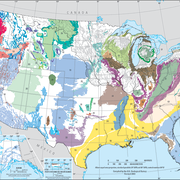
Principal Aquifers of the United States
This website compiles USGS resources and data related to principal aquifers including Aquifer Basics, principal aquifers maps and GIS data, and the National Aquifer Code Reference List.

Atmospheric Warming, Loss of Snow Cover, and Declining Colorado River Flow
Declining snow cover is playing a key role in decreasing the flow of the Colorado River, “the lifeblood of the Southwest,” by enabling increased evaporation. As the warming continues, increasingly severe water shortages are expected.

Harmful Algal Bloom (HAB): Cooperative Matching Funds Projects
New projects from coast to coast will advance the research on harmful algal blooms (HABs) in lakes, reservoirs and rivers. The vivid emerald-colored algal blooms are caused by cyanobacteria, which can produce cyanotoxins that threaten human health and aquatic ecosystems and can cause major economic damage.

National Water-Quality Assessment (NAWQA)
Our surface water, groundwater, and aquatic ecosystems are priceless resources, used by people across the Nation for drinking, irrigation, industry, and recreation. The National Water-Quality Assessment (NAWQA) Project is a leading source of scientific data and knowledge for development of science-based policies and management strategies to improve and protect our water resources.

NWQP Research on Harmful Algal Blooms (HABs)
Harmful algal blooms (HABs) are caused by a complex set of physical, chemical, biological, hydrological, and meteorological conditions. Many unanswered questions remain about occurrence, environmental triggers for toxicity, and the ability to predict the timing, duration, and toxicity of HABs.