U.S. flag

An official website of the United States government

Images

California Volcano Observatory images.

Filter Total Items: 186
Mount Konocti on the western shore of Clear Lake, California

Mount Konocti, a mostly dacitic composite cone, on the western shore of Clear Lake, California. Thurston Lake is in the foreground.

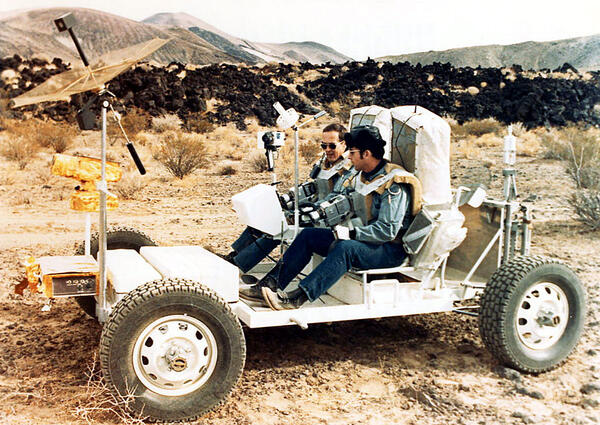
Two white men wearing jeans, button-down shirts, and bulky harnesses with huge rectangular backpacks sit on the frame of a stripped-down white motorized buggy-like vehicle. Their harnesses have two old-fashioned video cameras pointing forward. On the front of the vehicle, a large metallic mesh radio antenna dish is raised on a pole. In the background, mounds of dark, jagged, black lava rock sit in front of a skyline composed of several rounded red hills of volcanic scoria.
Apollo 16 astronauts test a lunar rover in the Coso Volcanic Field, California

Apollo 16 astronauts John Young (right) and Charlie Duke (left) ride in Earth-adapted Lunar Roving Vehicle "Grover" in the Coso Volcanic Field near Ridgecrest California, November 1971. Photo by NASA.

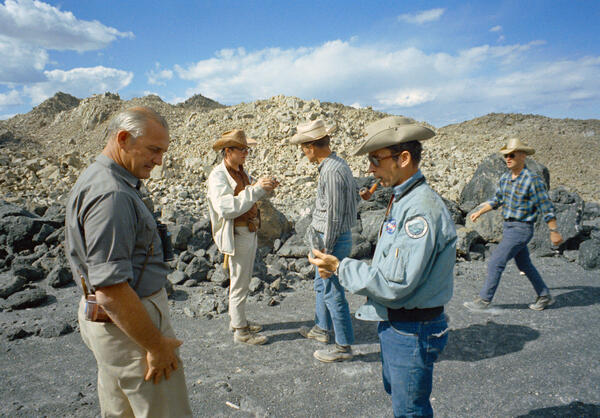
A group of five white men wearing cowboy hats, jeans or khakis, and button-down shirts are standing on a sandy gray surface ringed by large gray boulders of volcanic rock. In the background, a number of bare, rubbly, rocky peaks are lit by afternoon sun. The men are examining hand samples of rocks and one is smoking a pipe.
Apollo 16 astronauts on a geology field trip to Mono Craters, California in June 1971.

University of Texas professor William R. Muelhberger (left foreground) with Apollo 16 commander John W. Young (right foreground), astronaut Charles Duke (center), geologist David Wones (second left), and astronaut Anthony England on an Apollo 16 geology field trip to Mono Craters in June 1971. Photo by NASA.

University of Texas professor William R. Muelhberger (left foreground) with Apollo 16 commander John W. Young (right foreground), astronaut Charles Duke (center), geologist David Wones (second left), and astronaut Anthony England on an Apollo 16 geology field trip to Mono Craters in June 1971. Photo by NASA.

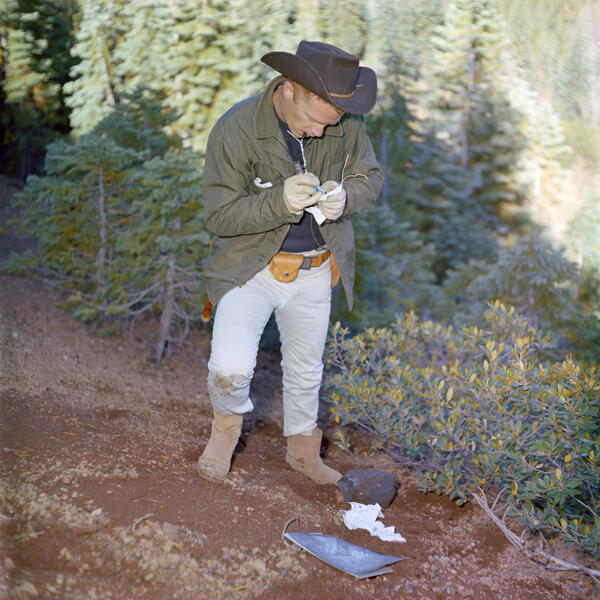
A red-haired man wearing khaki pants, brown boots, a green jacket, and a black cowboy hat stands on a steep, reddish slope surrounded by manzanita bushes and small pine trees. He is taking notes in a small notebook. In the background, a thick pine forest is lit by sunlight.
NASA engineer Donald A. Beattie takes notes during a field visit to Medicine Lake Volcano in September 1965

View of Donald A. Beattie (manager of NASA's lunar surface experiments) during a geological field trip to the Medicine Lake Volcano, California in September 1965. Beattie was joined by astronauts William Anders (Apollo 8), Alan Bean (Apollo 12), and Rusty Schweikert (Apollo 9). Photo by NASA.

View of Donald A. Beattie (manager of NASA's lunar surface experiments) during a geological field trip to the Medicine Lake Volcano, California in September 1965. Beattie was joined by astronauts William Anders (Apollo 8), Alan Bean (Apollo 12), and Rusty Schweikert (Apollo 9). Photo by NASA.

In a black-and-white photo, a small wooden cabin with a peaked roof and single door and window sits in a snowy forest clearing. Snow is piled to chest height around the building and blobs of snow cling to the peak of the roof.
Lassen Volcano Observatory, 1926

The original Lassen Volcano Observatory building, provided by the US Forest Service, about 1926. The observatory consisted of a small office over a 10x10 ft concrete cellar which housed two custom-built seismographs. A small cottage nearby housed Ruy H. Finch, the head of and sole scientist at the Observatory for much of its existence. (Photo by R.H.

The original Lassen Volcano Observatory building, provided by the US Forest Service, about 1926. The observatory consisted of a small office over a 10x10 ft concrete cellar which housed two custom-built seismographs. A small cottage nearby housed Ruy H. Finch, the head of and sole scientist at the Observatory for much of its existence. (Photo by R.H.

A black-and-white photo of a man in a black suit jacket, pinstriped pants, and a dapper fedora. He is standing on a Hawaiian pahoehoe lava flow and peering into a deep ground crack.
Ruy H. Finch (1890-1957)

The founder of the Lassen Volcano Observatory (1926-1935) and second Director of the Hawaiian Volcano Observatory (1940-1951), Ruy Herbert Finch conducted research in both Hawaii and throughout the Western United States.

The founder of the Lassen Volcano Observatory (1926-1935) and second Director of the Hawaiian Volcano Observatory (1940-1951), Ruy Herbert Finch conducted research in both Hawaii and throughout the Western United States.

In a black-and-white photo, a snow-covered mountain peak is streaked with dark mud flowing down its sides in three directions. One flow directly faces the viewer, showing where trees have been mowed over by the debris. Elsewhere on the slopes, pine trees are scattered through the snow.
Lava and mudflows from Lassen Peak, May 22, 1915

Benjamin F. Loomis Historical Photograph Collection: Lassen Peak showing new lava flow on summit and large mudflows on slopes. Photo courtesy of NPS.

Benjamin F. Loomis Historical Photograph Collection: Lassen Peak showing new lava flow on summit and large mudflows on slopes. Photo courtesy of NPS.

A black and white photograph looks across a swath cut through a pine forest by a debris and mud flow that originates at a steaming volcanic peak in the distance. A large crater is visible on the side of the volcano, which is emitting the steam. The rest of the volcano is heavily blanketed in snow.
Historical photograph of Lassen Peak by Benjamin Loomis, May 22, 1915

A second view of Lassen Peak and the Deveastated Area following an explosive eruption and mudflowk. The crater of the volcano is visible, revealing that a lava dome which had previously been growing there was destroyed by the explosion. Subsequently, a lava flow began refilling the crater, and was mistakenly thought to have created the mudflow. 

A second view of Lassen Peak and the Deveastated Area following an explosive eruption and mudflowk. The crater of the volcano is visible, revealing that a lava dome which had previously been growing there was destroyed by the explosion. Subsequently, a lava flow began refilling the crater, and was mistakenly thought to have created the mudflow. 

In this black-and-white photos, a view up a valley shows a bare moonscape of mud, silt, and boulders. In the far distance, a mountain peak rises above lines of pine trees lining the valley's sides.
Mudflows in Lost Creek, Lassen, May 22 1915

Benjamin F. Loomis Historical Photograph Collection: Lost Creek drainage area covered in mud, rocks, and debris from a mudflow off Lassen Peak. Photo courtesy of NPS.

Benjamin F. Loomis Historical Photograph Collection: Lost Creek drainage area covered in mud, rocks, and debris from a mudflow off Lassen Peak. Photo courtesy of NPS.

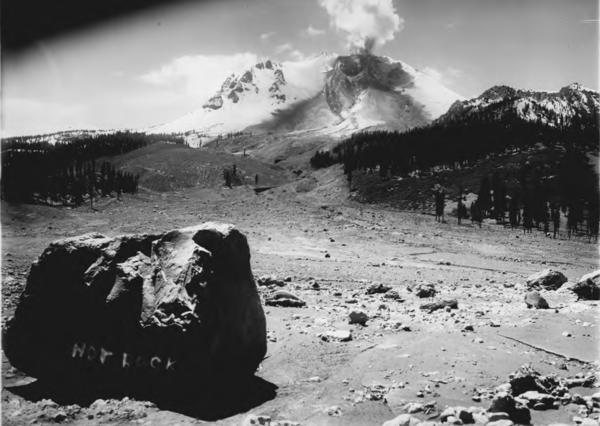
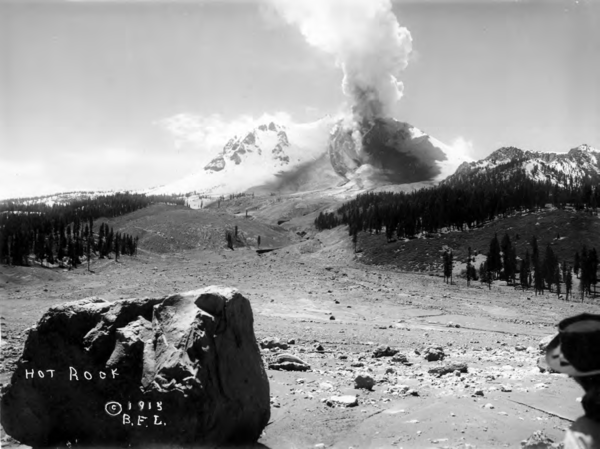
A black and white photograph looks across a swath cut through a pine forest by a debris and mud flow that originates at a steaming volcanic peak in the distance. A large crater is visible on the side of the volcano, which is emitting the steam. The rest of the volcano is heavily blanketed in snow.
Benjamin Loomis photograph of Lassen Peak and the Devastated Area, May 22, 1915

Steam issuing from summit of Lassen Peak from head of Lost Creek following mudflow. "Hot Rock"(large boulder) in foreground. Photographs taken a few hours prior to second major eruption and hot blast.

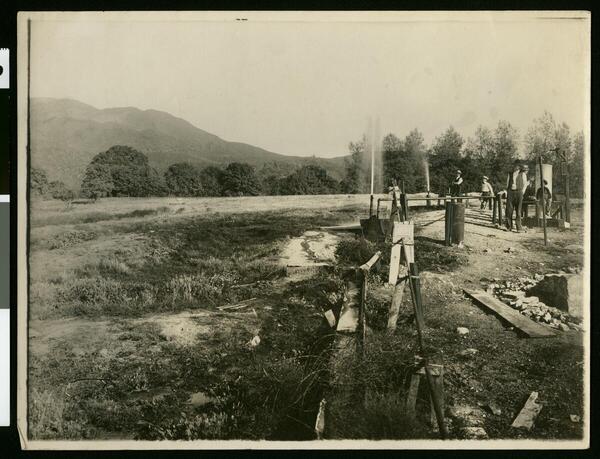
A sepia-toned historical photograph shows an open field with people standing near a row of wooden-framed well structures and pipes. A thin jet of gas or water sprays upward from two of the wells. Forested hills and a mountain rise in the background.
Kelseyville Gas Wells, ca.1910

Photograph of men at the Kelseyville Gas Wells, ca.1910, by M. Rieder. Courtesy of California Historical Society Collection, University of Southern California Digital Libraries. 

Photograph of men at the Kelseyville Gas Wells, ca.1910, by M. Rieder. Courtesy of California Historical Society Collection, University of Southern California Digital Libraries. 

A black-and-white stereograph photo pair shows a horse-drawn cart advancing toward the photographer on a muddy dirt road. In the middle ground, an early-20th century hotel is flanked by other small shops and a single telegraph pole. In the background, a double-peaked snow clad mountain rises high above the town, faded with distance.
Stereograph photo of Mount Shasta and the town of Sisson in 1906

Horse-drawn carriage on road in Sisson, California, El Monte Hotel in foreground, Mount Shasta in the background. Image courtesy of the Library of Congress.

Photograph of the town of Sisson (later (1922) the town of Mt. Shasta) in the distance at the foot of Mount Shasta in winter. Snow covered fir trees in the foreground.
Town of Sisson at the foot of Mount Shasta in winter, ca.1900

Photograph of the town of Sisson (later (1922) the town of Mt. Shasta) in the distance at the foot of Mount Shasta in winter. Snow covered fir trees in the foreground. Photo courtesy of University of Southern California Libraries and California Historical Society. Digitally reproduced by the USC Digital Library.

Photograph of the town of Sisson (later (1922) the town of Mt. Shasta) in the distance at the foot of Mount Shasta in winter. Snow covered fir trees in the foreground. Photo courtesy of University of Southern California Libraries and California Historical Society. Digitally reproduced by the USC Digital Library.

Infographic about the 2019 report "California's Exposure to Volcanic Hazards"
California's Exposure to Volcanic Hazards

Infographic about the 2019 report "California's Exposure to Volcanic Hazards"

USGS Director Jim Reilly being given a tour of the CalVO Ops room by Emily Montgomery-Brown
USGS Director Jim Reilly being given a tour of the CalVO

In a February 5, 2019 visit, USGS Director Jim Reilly was given a tour of CalVO facilities, including the Operations Room. Here Emily Montgomery-Brown explains the networks that monitor California's threatening volcanoes.

In a February 5, 2019 visit, USGS Director Jim Reilly was given a tour of CalVO facilities, including the Operations Room. Here Emily Montgomery-Brown explains the networks that monitor California's threatening volcanoes.

Was this page helpful?