



This panoramic view of the Long Valley Caldera was taken from a lava dome on the north rim of the caldera. USGS photo by Jessica Ball
Images
California Volcano Observatory images.
Filter Total Items: 193
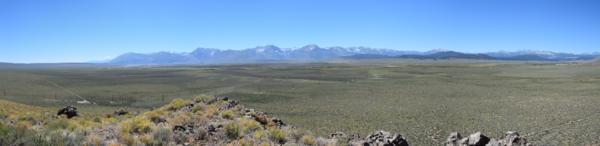
Long Valley Caldera, California
This panoramic view of the Long Valley Caldera was taken from a lava dome on the north rim of the caldera. USGS photo by Jessica Ball
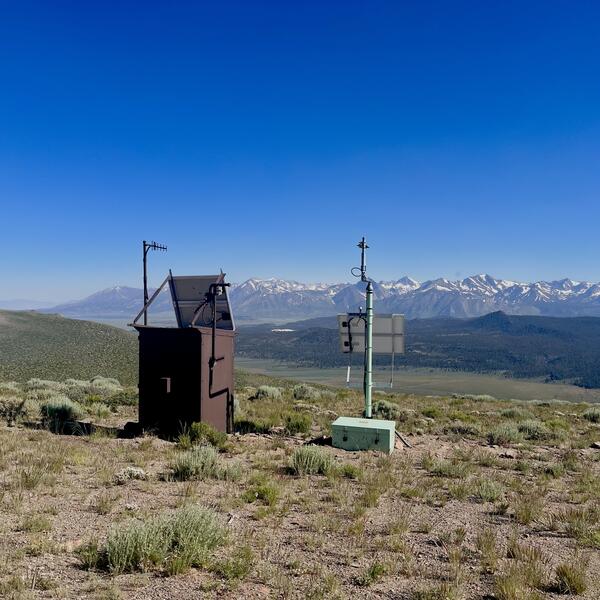
Long Valley seismic and geodetic instruments on Bald Mountain
Long Valley seismic and geodetic instruments on Bald MountainLong Valley from Bald Mountain; seismic and geodetic instrumentation are shown on a hill overlooking Long Valley Caldera and the Sierra Nevada. Photo by Alicia Hotovec-Ellis, USGS.
Long Valley seismic and geodetic instruments on Bald Mountain
Long Valley seismic and geodetic instruments on Bald MountainLong Valley from Bald Mountain; seismic and geodetic instrumentation are shown on a hill overlooking Long Valley Caldera and the Sierra Nevada. Photo by Alicia Hotovec-Ellis, USGS.
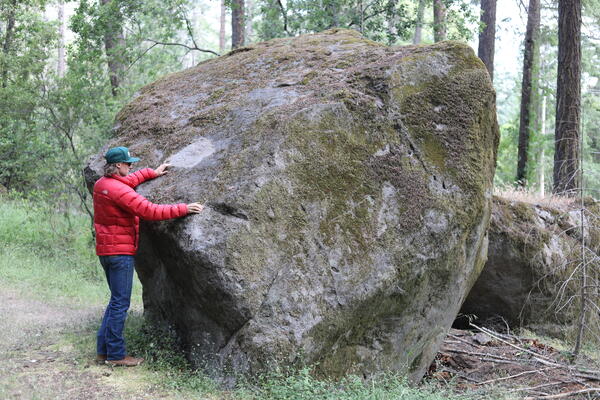
Black Forest landslide boulder, Clear Lake Volcanic Field
Black Forest landslide boulder, Clear Lake Volcanic FieldA prominent feature carved out of the side of Mount Konocti is the Black Forest landslide, which occurred on the eastern side of Buckingham Peak and deposited massive boulders down near the shore of Clear Lake. Determining when the landslide occurred is difficult, but two broad age constraints do exist.
Black Forest landslide boulder, Clear Lake Volcanic Field
Black Forest landslide boulder, Clear Lake Volcanic FieldA prominent feature carved out of the side of Mount Konocti is the Black Forest landslide, which occurred on the eastern side of Buckingham Peak and deposited massive boulders down near the shore of Clear Lake. Determining when the landslide occurred is difficult, but two broad age constraints do exist.
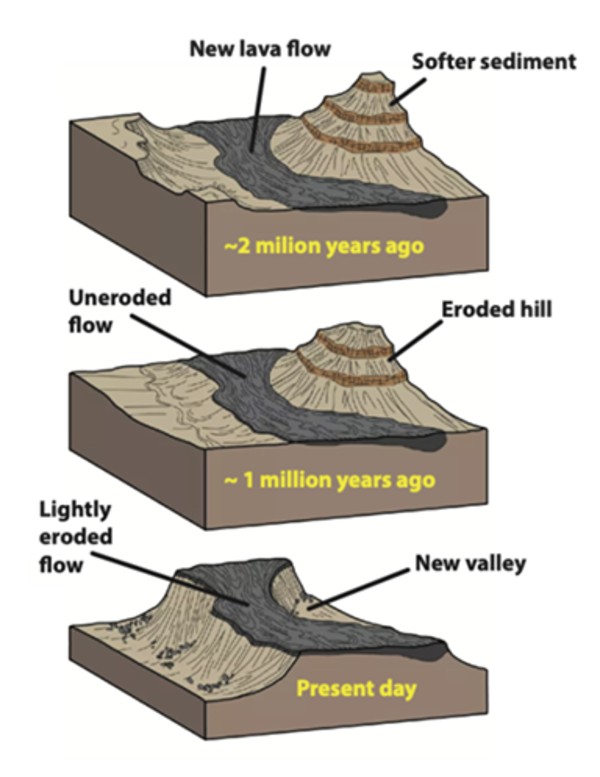
Schematic illustration of inverted topography (NPS)
Schematic illustration of inverted topography (NPS)Schematic illustrations of the formation of inverted topography. Top graphic: Lava flows travel in topographic lows and valleys below surrounding topographic highs. Middle graphic: The hard volcanic rock protects the underlying country rock from erosion, eroding more slowly than the surrounding topography.
Schematic illustration of inverted topography (NPS)
Schematic illustration of inverted topography (NPS)Schematic illustrations of the formation of inverted topography. Top graphic: Lava flows travel in topographic lows and valleys below surrounding topographic highs. Middle graphic: The hard volcanic rock protects the underlying country rock from erosion, eroding more slowly than the surrounding topography.
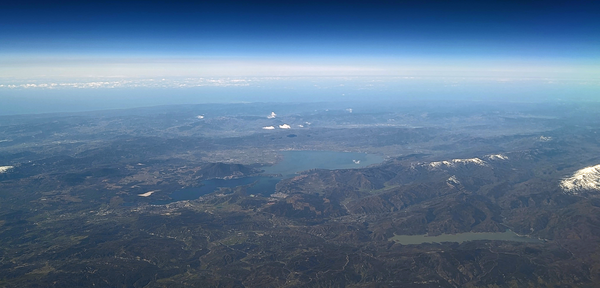
California's Clear Lake Volcanic Field viewed from the air
California's Clear Lake Volcanic Field viewed from the airThe Clear Lake volcanic field is the northernmost and youngest field in a chain of volcanic fields in and near the California Coast Range mountains. Erupted over the past ~2.5 million years, Clear Lake's volcanic features include lava domes, lava flows, and explosive maar craters. USGS photo by J. Ball.
California's Clear Lake Volcanic Field viewed from the air
California's Clear Lake Volcanic Field viewed from the airThe Clear Lake volcanic field is the northernmost and youngest field in a chain of volcanic fields in and near the California Coast Range mountains. Erupted over the past ~2.5 million years, Clear Lake's volcanic features include lava domes, lava flows, and explosive maar craters. USGS photo by J. Ball.
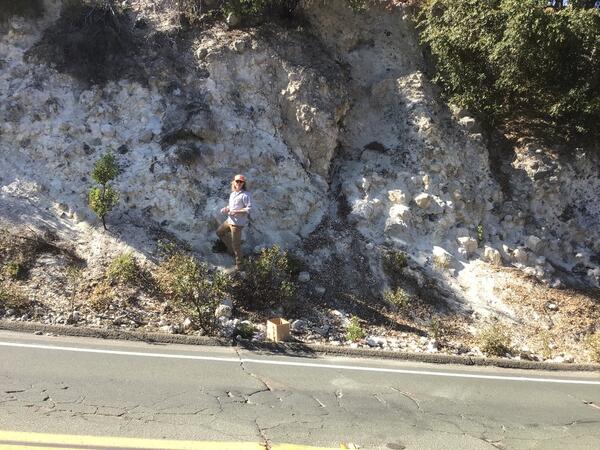
Rhyolite outcrop, Bottle Rock Road, Clear Lake Volcanic Field
Rhyolite outcrop, Bottle Rock Road, Clear Lake Volcanic FieldThe rhyolite outcrop shown here is found along Bottle Rock Rd., which gets its name from the volcanic glass that’s common within this rock unit. Rhyolite is the most silica-rich rock in the Clear Lake Volcanic Field, and Thurston Creek Rhyolite, show here, is around half a million years old.
Rhyolite outcrop, Bottle Rock Road, Clear Lake Volcanic Field
Rhyolite outcrop, Bottle Rock Road, Clear Lake Volcanic FieldThe rhyolite outcrop shown here is found along Bottle Rock Rd., which gets its name from the volcanic glass that’s common within this rock unit. Rhyolite is the most silica-rich rock in the Clear Lake Volcanic Field, and Thurston Creek Rhyolite, show here, is around half a million years old.

Andesite on Highway 175, Clear Lake Volcanic Field, California
Andesite on Highway 175, Clear Lake Volcanic Field, CaliforniaThis outcrop is along Highway 175, near Hobergs, and is comprised of andesite. Andesite contains more silica than basalt, but less than dacite.
Andesite on Highway 175, Clear Lake Volcanic Field, California
Andesite on Highway 175, Clear Lake Volcanic Field, CaliforniaThis outcrop is along Highway 175, near Hobergs, and is comprised of andesite. Andesite contains more silica than basalt, but less than dacite.
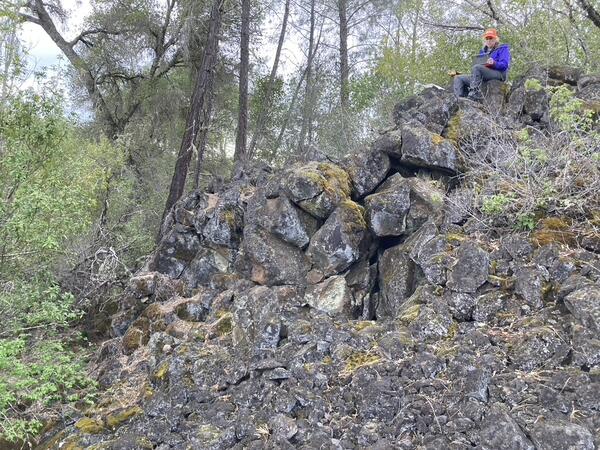
High Valley basaltic andesite lava flow, Clear Lake Volcanic Field, California
High Valley basaltic andesite lava flow, Clear Lake Volcanic Field, CaliforniaThis lava flow is one of five flows of the same composition erupted over a short period of time in the High Valley area. The Round Mountain cinder cone in this area is related to these flows, and all are basaltic andesite, a rock with slightly more silica than basalt and slightly less than andesite.
High Valley basaltic andesite lava flow, Clear Lake Volcanic Field, California
High Valley basaltic andesite lava flow, Clear Lake Volcanic Field, CaliforniaThis lava flow is one of five flows of the same composition erupted over a short period of time in the High Valley area. The Round Mountain cinder cone in this area is related to these flows, and all are basaltic andesite, a rock with slightly more silica than basalt and slightly less than andesite.

Kelsey Creek rhyodacite lava, Clear Lake Volcanic Field, California
Kelsey Creek rhyodacite lava, Clear Lake Volcanic Field, CaliforniaRhyodacite has more silica than dacite and less than rhyolite. This flow-banded rhyodacite is gorgeous in outcrop and is around a half million years old.
Kelsey Creek rhyodacite lava, Clear Lake Volcanic Field, California
Kelsey Creek rhyodacite lava, Clear Lake Volcanic Field, CaliforniaRhyodacite has more silica than dacite and less than rhyolite. This flow-banded rhyodacite is gorgeous in outcrop and is around a half million years old.

Eruption Episode 4 rocks, Clear Lake Volcanic Field, California
Eruption Episode 4 rocks, Clear Lake Volcanic Field, CaliforniaThe cinder cone in the distance is Round Mountain, which is being actively quarried for road rock. Eruption episode 4 is the most recent in the Clear Lake Volcanic Field, and is characterized primarily by lava flows, cinder cones (like the one pictured), and maar deposits.
Eruption Episode 4 rocks, Clear Lake Volcanic Field, California
Eruption Episode 4 rocks, Clear Lake Volcanic Field, CaliforniaThe cinder cone in the distance is Round Mountain, which is being actively quarried for road rock. Eruption episode 4 is the most recent in the Clear Lake Volcanic Field, and is characterized primarily by lava flows, cinder cones (like the one pictured), and maar deposits.
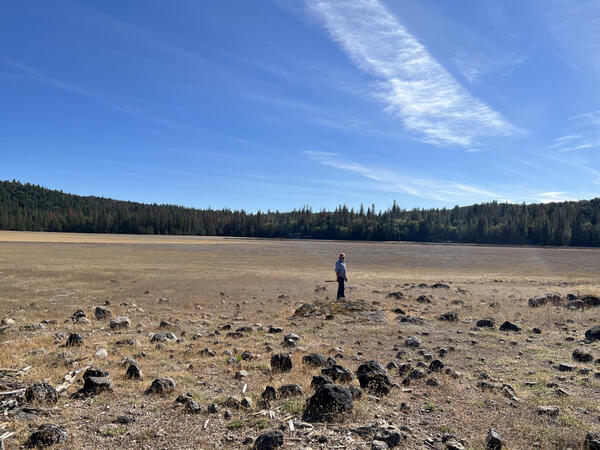
Eruption Episode 2 rocks, Clear Lake Volcanic Field, California
Eruption Episode 2 rocks, Clear Lake Volcanic Field, CaliforniaEruption episode 2 rocks are higher in silica than those characterizing Episode 1, and instead of being primarily lava flows that filled existing valleys, Episode 2 rocks commonly erupted as volcanic domes. Cobb Mountain erupted during this episode, as did Boggs Mountain.
Eruption Episode 2 rocks, Clear Lake Volcanic Field, California
Eruption Episode 2 rocks, Clear Lake Volcanic Field, CaliforniaEruption episode 2 rocks are higher in silica than those characterizing Episode 1, and instead of being primarily lava flows that filled existing valleys, Episode 2 rocks commonly erupted as volcanic domes. Cobb Mountain erupted during this episode, as did Boggs Mountain.

Mount Konocti lava dome complex, Clear Lake Volcanic Field, California
Mount Konocti lava dome complex, Clear Lake Volcanic Field, CaliforniaThis view of Mt. Konocti from within the Clearlake Riviera neighborhood shows the topographic outline of the many discrete volcanic domes that comprise the mountain. Volcanic domes ooze from the ground to form steep-sided domes which can coalesce, forming mountains with multiple peaks. Mt.
Mount Konocti lava dome complex, Clear Lake Volcanic Field, California
Mount Konocti lava dome complex, Clear Lake Volcanic Field, CaliforniaThis view of Mt. Konocti from within the Clearlake Riviera neighborhood shows the topographic outline of the many discrete volcanic domes that comprise the mountain. Volcanic domes ooze from the ground to form steep-sided domes which can coalesce, forming mountains with multiple peaks. Mt.

Maar eruption deposit, Clear Lake Volcanic Field, California
Maar eruption deposit, Clear Lake Volcanic Field, CaliforniaThe layered deposits shown in this picture were created by a maar eruption, when magma and volcanic gasses interact with groundwater to create an explosive eruption. Maar eruptions like these commonly generate craters, some of which can be seen along the western shore of Clear Lake. Soda Bay, near where this photo was taken, is a maar crater.
Maar eruption deposit, Clear Lake Volcanic Field, California
Maar eruption deposit, Clear Lake Volcanic Field, CaliforniaThe layered deposits shown in this picture were created by a maar eruption, when magma and volcanic gasses interact with groundwater to create an explosive eruption. Maar eruptions like these commonly generate craters, some of which can be seen along the western shore of Clear Lake. Soda Bay, near where this photo was taken, is a maar crater.

High Valley basaltic andesite lava flow, Clear Lake Volcanic Field, California
High Valley basaltic andesite lava flow, Clear Lake Volcanic Field, CaliforniaThis lava flow of basaltic andesite composition erupted in the High Valley area. The blocky appearance of this flow top is termed 'A'ā (pronounced "ah-ah"), which is a Hawaiian term for lava flows that have a rough rubbly surface composed of broken lava blocks called clinkers. USGS photo by Dawnika Blatter
High Valley basaltic andesite lava flow, Clear Lake Volcanic Field, California
High Valley basaltic andesite lava flow, Clear Lake Volcanic Field, CaliforniaThis lava flow of basaltic andesite composition erupted in the High Valley area. The blocky appearance of this flow top is termed 'A'ā (pronounced "ah-ah"), which is a Hawaiian term for lava flows that have a rough rubbly surface composed of broken lava blocks called clinkers. USGS photo by Dawnika Blatter

Kyle R. Anderson
Kyle R. Anderson is a Volcano Geophysicist who works at the USGS California Volcano Observatory.
Kyle R. Anderson is a Volcano Geophysicist who works at the USGS California Volcano Observatory.

Dacite, Clear Lake Volcanic Field
This outcropping of rocks along Morgan Valley Road is comprised of dacite, the most common composition in the Clear Lake Volcanic Field. Dacite contains more silica than basalt but less than rhyolite, so it’s commonly referred to as an “intermediate” composition.
This outcropping of rocks along Morgan Valley Road is comprised of dacite, the most common composition in the Clear Lake Volcanic Field. Dacite contains more silica than basalt but less than rhyolite, so it’s commonly referred to as an “intermediate” composition.

Phil Dawson at Mount Shasta
Phil Dawson, a Volcano Seismologist with the California Volcano Observatory, stands next to a volcanic rock on the flank of Mount Shasta, California.
Phil Dawson, a Volcano Seismologist with the California Volcano Observatory, stands next to a volcanic rock on the flank of Mount Shasta, California.

Joshua Crozier
Joshua Crozier is a Mendenhall Postdoctoral Fellow working at the USGS California Volcano Observatory
Joshua Crozier is a Mendenhall Postdoctoral Fellow working at the USGS California Volcano Observatory

Devil's Kitchen hydrothermal area in the Lassen Volcanic Center
Devil's Kitchen hydrothermal area in the Lassen Volcanic CenterDevils Kitchen in the Lassen Volcanic Region (within the bounds of the Lassen Volcanic National Park) is the second largest of Lassen's hydrothermal areas, after Bumpass Hell. Located in the Warner Valley in the southeast corner of the Park, Devils Kitchen contains boiling springs, mudpots, hot streams, and steam vents. USGS photo courtesy of Deb Bergfeld
Devil's Kitchen hydrothermal area in the Lassen Volcanic Center
Devil's Kitchen hydrothermal area in the Lassen Volcanic CenterDevils Kitchen in the Lassen Volcanic Region (within the bounds of the Lassen Volcanic National Park) is the second largest of Lassen's hydrothermal areas, after Bumpass Hell. Located in the Warner Valley in the southeast corner of the Park, Devils Kitchen contains boiling springs, mudpots, hot streams, and steam vents. USGS photo courtesy of Deb Bergfeld
Eruption Episode 1 rocks, Clear Lake Volcanic Field, California
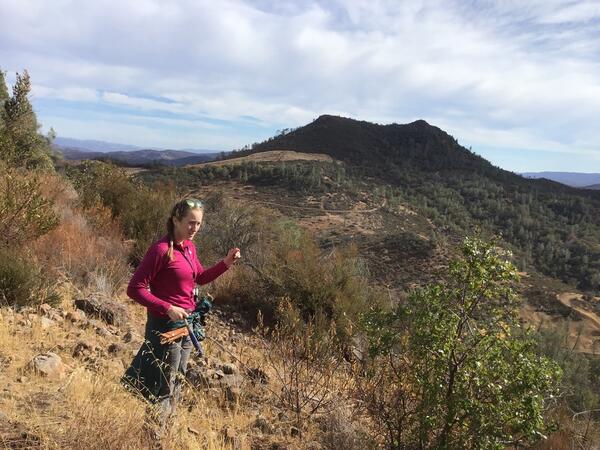
Eruption Episode 1 rocks, Clear Lake Volcanic Field, CaliforniaEruption episode 1 contains the oldest rocks in the Clear Lake Volcanic Field. The rock on the ridge in the background., located off Butts Canyon Road, is a lava flow that erupted around 2 million years ago.
Eruption Episode 1 rocks, Clear Lake Volcanic Field, California
Eruption Episode 1 rocks, Clear Lake Volcanic Field, CaliforniaEruption episode 1 contains the oldest rocks in the Clear Lake Volcanic Field. The rock on the ridge in the background., located off Butts Canyon Road, is a lava flow that erupted around 2 million years ago.
Morro Rock
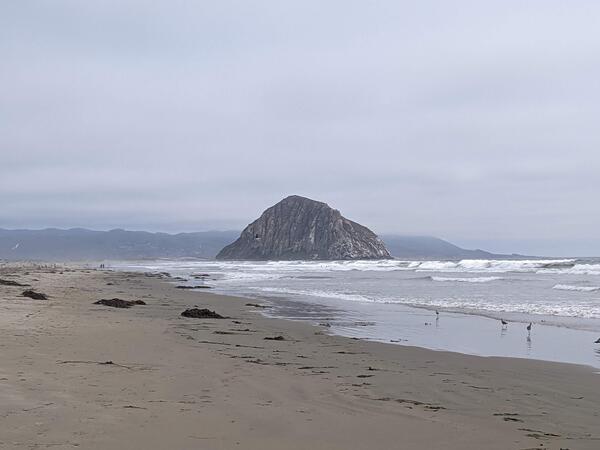
Morro Rock is the westernmost peak in a chain of hills known locally as the “Morros” or the “Nine Sisters.”. It is a volcanic neck or plug composed of dacite which crystallized in the vent of a volcano and was later exposed by erosion. USGS photo by J. Ball
Morro Rock is the westernmost peak in a chain of hills known locally as the “Morros” or the “Nine Sisters.”. It is a volcanic neck or plug composed of dacite which crystallized in the vent of a volcano and was later exposed by erosion. USGS photo by J. Ball