U.S. flag

An official website of the United States government

Images

California Volcano Observatory images.

Filter Total Items: 164
Side-view diagram of a thin oceanic layer of the Earth’s crust diving beneath a thick layer of Continental crust
Subduction zone
Subduction zone
Subduction zone

A subduction zone is formed where two tectonic plates come together and one plate overrides the other. The plate with lower density, usually comprised of continental crust, stays on top while the denser plate, usually made of oceanic crust, is pushed and pulled beneath, into Earth’s mantle.

A subduction zone is formed where two tectonic plates come together and one plate overrides the other. The plate with lower density, usually comprised of continental crust, stays on top while the denser plate, usually made of oceanic crust, is pushed and pulled beneath, into Earth’s mantle.

A side-view diagram showing a cone of mantle rising underneath a layer of oceanic crust with the ocean on top
Divergent spreading center

A spreading center is formed where two tectonic plates are moving away from each other. Magma from the mantle upwells to fill the space made by the diverging plates, and erupts at the boundary to form new crust.

A spreading center is formed where two tectonic plates are moving away from each other. Magma from the mantle upwells to fill the space made by the diverging plates, and erupts at the boundary to form new crust.

A conical, gray, rocky hill rises above a wetland and waterway dotted with bright white wading birds
Salton Buttes
Salton Buttes
Salton Buttes

The Salton Buttes volcanic field is the youngest and southernmost of the fields associated with the North American and Pacific plate boundary. Five obsidian rhyolite domes erupted on the southern shore of the Salton Sea between 6000 and 500 years ago. The area is active geothermally and seismically, with numerous hot springs and mudpots on the surface. 

The Salton Buttes volcanic field is the youngest and southernmost of the fields associated with the North American and Pacific plate boundary. Five obsidian rhyolite domes erupted on the southern shore of the Salton Sea between 6000 and 500 years ago. The area is active geothermally and seismically, with numerous hot springs and mudpots on the surface. 

 A line map of California, Nevada, Oregon, and Idaho is overlaid with tectonic plate boundaries
Mendocino Triple Junction

The Mendocino Triple Junction is a tectonic boundary where three plates (the Pacific, North American, and Juan De Fuca) meet. 

The Mendocino Triple Junction is a tectonic boundary where three plates (the Pacific, North American, and Juan De Fuca) meet. 

An oblique block diagram shows two tectonic plates sliding laterally past each other while sitting atop a section of mantle.
Transform boundary
Transform boundary
Transform boundary

Transform boundaries are formed where two tectonic plates pass laterally by one another. These boundaries are commonly defined by a series of faults, each of which accommodates some of the translational movement between passing plates. Small bends in these boundaries led to the formation of mountains and valleys.

Transform boundaries are formed where two tectonic plates pass laterally by one another. These boundaries are commonly defined by a series of faults, each of which accommodates some of the translational movement between passing plates. Small bends in these boundaries led to the formation of mountains and valleys.

A scientist in a long silver heat-resistant coat, gas mask, and helicopter helmet inspects a just-quenched sample of lava
Sampling molten lava from the middle East Rift Zone Kīlauea eruption in Nāpau Crater, September 17, 2024

USGS Hawaiian Volcano Observatory geologists collected a sample of the middle East Rift Zone Kīlauea eruption in Nāpau Crater, within a closed area Hawaiʻi Volcanoes National Park. Geologists put molten lava into a metal bucket and rapidly quench it with water.

A tall white metal tower with scientific instruments stands on a rooftop of a small building in a mountainous area with scattered rocks and sparse vegetation. In the background, Mammoth Mountain rises as a forested peak under a clear blue sky. The monitoring equipment includes sensors mounted at the top of a 6-meter-high mast for measuring volcanic CO₂ emissions.
Eddy covariance monitoring station at Horseshoe Lake, Mammoth Mountain, California

The eddy covariance station shown in this photo has been continuously measuring CO₂ emissions since 2014, providing half-hourly measurements of volcanic gas flux. Unlike previous seasonal monitoring that was limited by snowpack, this 6-meter-tall tower setup with commercial power allows year-round operation - a first for volcanic gas monitoring in this environment.

The eddy covariance station shown in this photo has been continuously measuring CO₂ emissions since 2014, providing half-hourly measurements of volcanic gas flux. Unlike previous seasonal monitoring that was limited by snowpack, this 6-meter-tall tower setup with commercial power allows year-round operation - a first for volcanic gas monitoring in this environment.

A gray, tree-covered hill – the cinder cone that makes up the “nest” of Goosenest volcano – rises behind a gently upward-sloping landscape of tall dark green pine trees and low light green bushes. Fluffy and streaky white clouds paint a blue sky.
Goosenest volcano, California

On the Cascade crest 35 km north of Mount Shasta, Goosenest is a late Pleistocene andesitic cone about ~1,400 m (~4500 ft) tall. USGS photo by A. Pivarunas.

On the Cascade crest 35 km north of Mount Shasta, Goosenest is a late Pleistocene andesitic cone about ~1,400 m (~4500 ft) tall. USGS photo by A. Pivarunas.

A rocky, steep-sized mountain creek is bordered by dead pine trees and sagebrush. In the distance, a two-peaked volcano scattered with snow rises high above the forested landscape.
Whitney Creek, Mount Shasta, California

Whitney Creek on the slopes of Mount Shasta in northern California is regularly reshaped by debris flows, created by melting snow and ice or precipitation. Although the stream channel itself is relatively small, these flows are capable of carrying large volumes of volcanic debris, including boulders in excess of several meters. USGS photo by J. Ball.

Whitney Creek on the slopes of Mount Shasta in northern California is regularly reshaped by debris flows, created by melting snow and ice or precipitation. Although the stream channel itself is relatively small, these flows are capable of carrying large volumes of volcanic debris, including boulders in excess of several meters. USGS photo by J. Ball.

A photograph taken on the forested lower slopes of a mountain looks toward a snowy peak. A stack of saucer-shaped clouds to the left of the mountain are illuminated by the rays of the sun as they peek over the slopes. In the foreground, pine trees are thrown into stark contrast by the dramatic sky above.
Lenticular clouds over Mount Shasta

Lenticular clouds form when moist air flows up the slopes of a volcano (or other peak), cools, and condenses. The resulting clouds often drop a bit after pushing over the summit, like an eddy over a rock in a stream, and create seemingly stationary shapes that hover over the landscape. USGS photo by Andrew Calvert.

Lenticular clouds form when moist air flows up the slopes of a volcano (or other peak), cools, and condenses. The resulting clouds often drop a bit after pushing over the summit, like an eddy over a rock in a stream, and create seemingly stationary shapes that hover over the landscape. USGS photo by Andrew Calvert.

Shaded relief map showing Lassen Volcanic National Park, with Lassen Peak labeled in the northern portion of the map, Growler & Morgan hot springs to the southwest, and the June 24 2024 swarm to the southeast
Lassen Volcanic Center earthquake swarm of June 24, 2024

This map shows the location of the June 24, 2024 earthquake swarm at the Lassen Volcanic Center relative to Lassen Peak and Growler & Morgan Hot Springs. Earthquakes are indicated by white, blue, and yellow circles, scaled to the earthquake size.

This map shows the location of the June 24, 2024 earthquake swarm at the Lassen Volcanic Center relative to Lassen Peak and Growler & Morgan Hot Springs. Earthquakes are indicated by white, blue, and yellow circles, scaled to the earthquake size.

Helicorder record showing dozens of tiny earthquake traces occurring over 12 hours, with each line comprising 15 minutes and earthquakes looking like drum cymbals turned on their sides.
LSIB helicorder trace from the Lassen Volcanic Center on June 24, 2024.

This digital helicorder record from station LSIB on the Northern California Seismic Network emphasizes the dozens of tiny earthquakes in Lassen's June 24 swarm. Earch line of the helicorder shows 15 minutes of time, with the entire record covering 24 hours.

This digital helicorder record from station LSIB on the Northern California Seismic Network emphasizes the dozens of tiny earthquakes in Lassen's June 24 swarm. Earch line of the helicorder shows 15 minutes of time, with the entire record covering 24 hours.

A photograph of a fracture filled with light grey ash and multi-colored rock fragments that is cutting through dark obsidian rock. A finger included for scale indicates that the fracture is about the width of a human hand, and some of the largest angular rock fragments are finger-sized. In the background, a rubble-covered surface of the Panum lava dome is visible.
Panum Crater tuffisite

Tuffisite veins form during eruptions, when a mix of hot volcanic gas and rock fragments are forced through fractures in cooled lava. USGS photo by J. Crozier.

Tuffisite veins form during eruptions, when a mix of hot volcanic gas and rock fragments are forced through fractures in cooled lava. USGS photo by J. Crozier.

Viewed from overhead, the gray and rubbly rhyolite lava domes of the Mono-Inyo Craters are interspersed with smooth patches of volcanic ash and scoria. In the distance, a snow-capped mountain range surrounds a broad lake.
Rhyolite lava domes of the Mono Craters

Mono Craters consists of a series of high-silica rhyolite lava domes, many erupted within the last 10,000 years. The domes are often steep, glassy, and contain very few phenocrysts.

Mono Craters consists of a series of high-silica rhyolite lava domes, many erupted within the last 10,000 years. The domes are often steep, glassy, and contain very few phenocrysts.

Rock outcrops showing rhyolite lava flow textures from Long Valley and Yellowstone calderas
Rhyolite lava flow textures from Long Valley and Yellowstone calderas

Rhyolite lava flow textures from Long Valley and Yellowstone calderas.  A) Photograph of well-developed spherulites in a lava flow from Long Valley Caldera in Eastern California. This high-silica rhyolite flow is very similar to the Central Plateau Member rhyolites of the Yellowstone Plateau Volcanic Field and exhibits many of the same textures.

Rhyolite lava flow textures from Long Valley and Yellowstone calderas.  A) Photograph of well-developed spherulites in a lava flow from Long Valley Caldera in Eastern California. This high-silica rhyolite flow is very similar to the Central Plateau Member rhyolites of the Yellowstone Plateau Volcanic Field and exhibits many of the same textures.

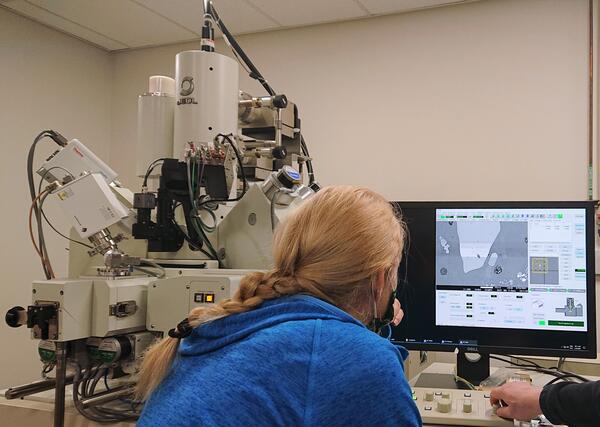
Mass spectrometer, used to measure the ration of atoms with different masses, in the USGS laboratory at Moffett Field, California

A mass spectrometer is used to measure the ratio of atoms with different masses—in this case, the different isotopes of argon gas, which can be used to determine the age of a volcanic rock. Left: a side view of a mass spectrometer at the USGS Argon Geochronology Laboratory in Moffett Field, CA. Right: a close-up view of the sample chamber in this mass spectrometer.

Microscopic view of different groundmass textures in rocks

Microscopic view of different groundmass textures in rocks. On the left, this groundmass is a good choice for argon dating, as it consists of abundant interconnected crystals. On the right, the groundmass consists predominantly of glass (black because it does not transmit cross-polarized light) and is a poor choice for argon dating.

Microscopic view of different groundmass textures in rocks. On the left, this groundmass is a good choice for argon dating, as it consists of abundant interconnected crystals. On the right, the groundmass consists predominantly of glass (black because it does not transmit cross-polarized light) and is a poor choice for argon dating.

A rectangular beige building with a large, glass-fronted lobby is viewed at an angle. The building is surrounded by mulched landscaping and in the left background is a huge dirigible hangar under construction.
Laboratory Building 800 at Moffett Field, California

Building 800 at the USGS Moffett Field campus houses shared laboratory space for multiple science centers. USGS photo by Jessica Ball.

Building 800 at the USGS Moffett Field campus houses shared laboratory space for multiple science centers. USGS photo by Jessica Ball.

Landscape view of rolling hills with labeled "New vineyard" and "Lava flows" areas, separated by a red dashed line
Inverted topography in the Clear Lake Volcanic Field

From this vantage point, the remnants of a Clear Lake volcanic field lava flow can be seen forming the prominent ridge across Highway 20. They are iron-rich and a popular location for vineyard cultivation.

From this vantage point, the remnants of a Clear Lake volcanic field lava flow can be seen forming the prominent ridge across Highway 20. They are iron-rich and a popular location for vineyard cultivation.

A rocky hill covered in chaparral rises above the gray roof of a motel. A fire road cuts a reddish path across the top.
Cerro San Luis Obispo, Islay Hills volcanic complex

Islay Hills is a chain of peaks also known as the Nine Sisters (or “Morros”).

A volcanic gas sampling setup including glass sample bottle connected by tubing to an inverted plastic funnel positioned over a bubbling pool near Salton Buttes, California. A long pole extends from the sampling area, and the surrounding terrain appears dry and fractured.
Volcanic gas sampling at a mud pool, Salton Buttes, California

To sample volcanic gases, inverted funnels connected to an evacuated sample bottle by tubing are sealed over a fumarole. Painter's poles are used to reach gas vents across dangerous (hot, unstable, or fragile) ground. 

To sample volcanic gases, inverted funnels connected to an evacuated sample bottle by tubing are sealed over a fumarole. Painter's poles are used to reach gas vents across dangerous (hot, unstable, or fragile) ground. 

Was this page helpful?