



Chaos Jumbles (foreground) is a rockfall avalanche that formed around 340 years ago when one of the Chaos Crags domes (background) collapsed.
Images
California Volcano Observatory images.
Filter Total Items: 193

Chaos Crags in Lassen Volcanic National Park
Chaos Jumbles (foreground) is a rockfall avalanche that formed around 340 years ago when one of the Chaos Crags domes (background) collapsed.

View of Chaos Crags in Lassen Volcanic National Park from Lassen Peak.
View of Chaos Crags in Lassen Volcanic National Park from Lassen Peak.Chaos Crags is a series of lava domes that erupted about 1,100 years ago from the Lassen Volcanic Center.
View of Chaos Crags in Lassen Volcanic National Park from Lassen Peak.
View of Chaos Crags in Lassen Volcanic National Park from Lassen Peak.Chaos Crags is a series of lava domes that erupted about 1,100 years ago from the Lassen Volcanic Center.
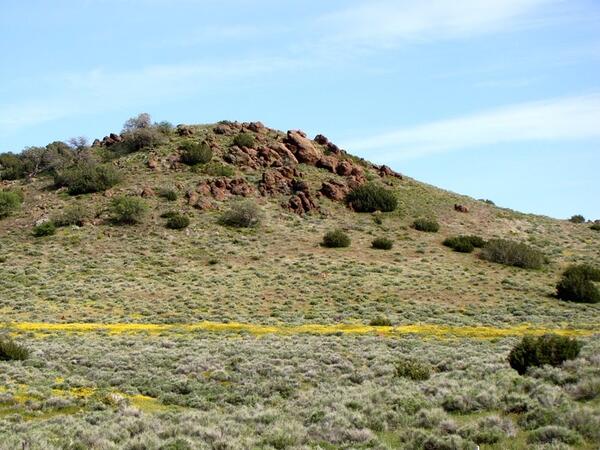
Neenach Volcanic Field
The Neenach Volcanic Field was formed by the same eruptions as the Pinnacles, and the two were split by the movement of the San Andreas Fault over 23 million years. The remnants of the eastern part of the largely rhyolitic volcanic formations remain in Southern California,195 miles (314 kilometers) away. Photo courtesy of Garry Hayes, Modesto Junior College.
The Neenach Volcanic Field was formed by the same eruptions as the Pinnacles, and the two were split by the movement of the San Andreas Fault over 23 million years. The remnants of the eastern part of the largely rhyolitic volcanic formations remain in Southern California,195 miles (314 kilometers) away. Photo courtesy of Garry Hayes, Modesto Junior College.

South Sister volcano viewed northward from the east shore of Sparks Lake.
South Sister volcano viewed northward from the east shore of Sparks Lake.The photo includes five rhyolitic units of different ages: Unforested 2-ka rhyolite of "Devils chain" rests on forested 35,000 year old flow lobe from adjacent Devils Hill dome. Three pale-gray spurs form sharp salients that extend to elevations only 550 m (1640 ft) below the darker andesitic summit of South Sister.
South Sister volcano viewed northward from the east shore of Sparks Lake.
South Sister volcano viewed northward from the east shore of Sparks Lake.The photo includes five rhyolitic units of different ages: Unforested 2-ka rhyolite of "Devils chain" rests on forested 35,000 year old flow lobe from adjacent Devils Hill dome. Three pale-gray spurs form sharp salients that extend to elevations only 550 m (1640 ft) below the darker andesitic summit of South Sister.

Judy Fierstein and Wes Hildreth at South Sister volcano, Oregon, 2009
Judy Fierstein and Wes Hildreth at South Sister volcano, Oregon, 2009Wes Hildreth and Judy Fierstein, seen here in 2009 on the east shore of Sparks Lake near Oregon's South Sister volcano, were longtime field and research partners Their work showed how mapping and understanding geologic field relationships provide an unequaled framework for interpretation of laboratory-generated data; and how well-honed curiosity, acute observat
Judy Fierstein and Wes Hildreth at South Sister volcano, Oregon, 2009
Judy Fierstein and Wes Hildreth at South Sister volcano, Oregon, 2009Wes Hildreth and Judy Fierstein, seen here in 2009 on the east shore of Sparks Lake near Oregon's South Sister volcano, were longtime field and research partners Their work showed how mapping and understanding geologic field relationships provide an unequaled framework for interpretation of laboratory-generated data; and how well-honed curiosity, acute observat

Soil-temperature measurement at Hot Creek in Long Valley Caldera, CA.
Soil-temperature measurement at Hot Creek in Long Valley Caldera, CA.Soil-temperature measurement at Hot Creek in Long Valley Caldera, California.
Soil-temperature measurement at Hot Creek in Long Valley Caldera, CA.
Soil-temperature measurement at Hot Creek in Long Valley Caldera, CA.Soil-temperature measurement at Hot Creek in Long Valley Caldera, California.
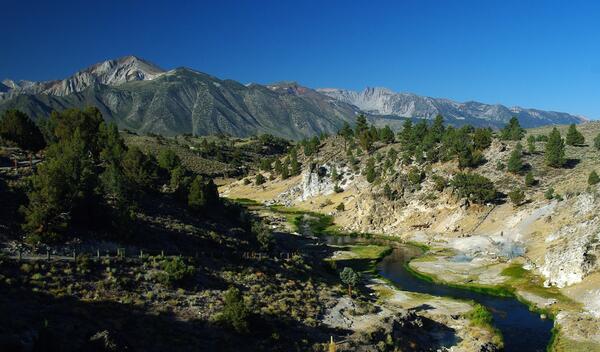
Hot Creek Gorge viewed upstream toward the SW; the steep walls of t...
Hot Creek Gorge viewed upstream toward the SW; the steep walls of t...Hot Creek Gorge viewed upstream toward the southwest; the steep walls of the gorge consist of a single rhyolite lava flow erupted from a vent 4 km (2.5 mi) to the south.
Hot Creek Gorge viewed upstream toward the SW; the steep walls of t...
Hot Creek Gorge viewed upstream toward the SW; the steep walls of t...Hot Creek Gorge viewed upstream toward the southwest; the steep walls of the gorge consist of a single rhyolite lava flow erupted from a vent 4 km (2.5 mi) to the south.
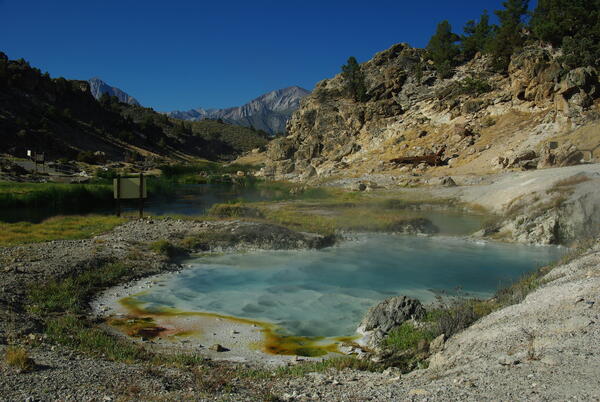
Bubbling Spring, a feature of Hot Creek in the Long Valley Caldera,...
Bubbling Spring, a feature of Hot Creek in the Long Valley Caldera,...Bubbling Spring, a feature of Hot Creek in the Long Valley Caldera, California, occasionally "boils" due to high water temperature.
Bubbling Spring, a feature of Hot Creek in the Long Valley Caldera,...
Bubbling Spring, a feature of Hot Creek in the Long Valley Caldera,...Bubbling Spring, a feature of Hot Creek in the Long Valley Caldera, California, occasionally "boils" due to high water temperature.

Cinder Cone in Lassen Volcanic National Park
Cinder Cone erupted in the year 1666 in the Lassen Volcanic Region of northern California.
Cinder Cone erupted in the year 1666 in the Lassen Volcanic Region of northern California.

Aerial view west across the upper part of Medicine Lake Volcano tow...
Aerial view west across the upper part of Medicine Lake Volcano tow...Medicine Lake lies within the shallow basin of Medicine Lake caldera. Glass Mountain flow, draped over the east side of the volcano, is the youngest lava flow at the volcano. The northeasternmost dacite tongue extends nearly to the bottom of the photo (distal lobes are outlined to enhance visibility).
Aerial view west across the upper part of Medicine Lake Volcano tow...
Aerial view west across the upper part of Medicine Lake Volcano tow...Medicine Lake lies within the shallow basin of Medicine Lake caldera. Glass Mountain flow, draped over the east side of the volcano, is the youngest lava flow at the volcano. The northeasternmost dacite tongue extends nearly to the bottom of the photo (distal lobes are outlined to enhance visibility).

Glass Mountain obsidian flow at Medicine Lake volcano, CA.
Glass Mountain obsidian flow at Medicine Lake volcano, CA.Glass Mountain obsidian flow at Medicine Lake volcano, California. Glass Mountain is a spectacular, nearly treeless, steep-sided rhyolite and dacite obsidian flow that erupted just outside the eastern caldera rim and flowed down the steep eastern flank of Medicine Lake volcano.
Glass Mountain obsidian flow at Medicine Lake volcano, CA.
Glass Mountain obsidian flow at Medicine Lake volcano, CA.Glass Mountain obsidian flow at Medicine Lake volcano, California. Glass Mountain is a spectacular, nearly treeless, steep-sided rhyolite and dacite obsidian flow that erupted just outside the eastern caldera rim and flowed down the steep eastern flank of Medicine Lake volcano.

Hydrothermal system and water flow in the subsurface beneath Long V...
Hydrothermal system and water flow in the subsurface beneath Long V...Hydrothermal system and water flow in the subsurface beneath Long Valley Caldera, California. Cartoon Illustration from USGS FS 2007-3045.
Hydrothermal system and water flow in the subsurface beneath Long V...
Hydrothermal system and water flow in the subsurface beneath Long V...Hydrothermal system and water flow in the subsurface beneath Long Valley Caldera, California. Cartoon Illustration from USGS FS 2007-3045.

Mount Shasta, CA
Aerial photo of Mount Shasta's southwestern flank in a low-snow period. The Hotlum cone is on the right, while the Shastina dome is to the left.
Aerial photo of Mount Shasta's southwestern flank in a low-snow period. The Hotlum cone is on the right, while the Shastina dome is to the left.

Hot Spring Cove, Paoha Island, Mono Lake Volcanic Field
Hot Spring Cove, Paoha Island, Mono Lake Volcanic FieldHot springs and their associated rising steam may be found in Hot Spring Cove on the southeastern point of Paoha Island in the Mono Lake Volcanic Field. USGS photo by Deborah Bergfeld.
Hot Spring Cove, Paoha Island, Mono Lake Volcanic Field
Hot Spring Cove, Paoha Island, Mono Lake Volcanic FieldHot springs and their associated rising steam may be found in Hot Spring Cove on the southeastern point of Paoha Island in the Mono Lake Volcanic Field. USGS photo by Deborah Bergfeld.
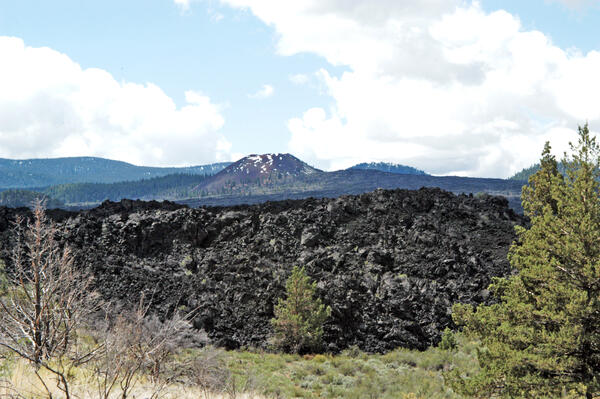
Callahan Lava Flow, Medicine Lake Volcano
Photograph looking south across the rugged andesitic northern end of the compositionally zoned Callahan Flow toward the main vent at Cinder Butte (partly covered by snow.) USGS photograph by Tanya Blacic
Photograph looking south across the rugged andesitic northern end of the compositionally zoned Callahan Flow toward the main vent at Cinder Butte (partly covered by snow.) USGS photograph by Tanya Blacic
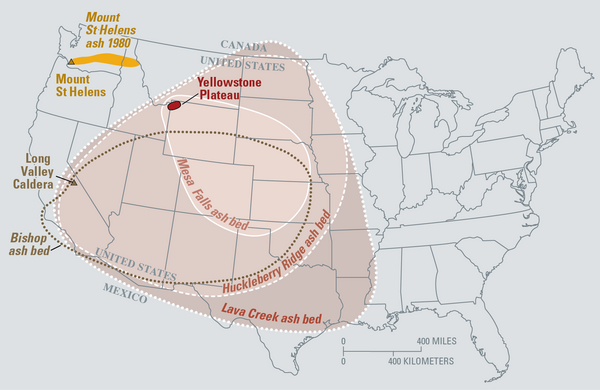
Map of the known ash-fall boundaries for several U.S. eruptions
Map of the known ash-fall boundaries for several U.S. eruptionsEruptions of the Yellowstone volcanic system have included the two largest volcanic eruptions in North America in the past few million years; the third largest was at Long Valley in California and produced the Bishop ash bed. The biggest of the Yellowstone eruptions occurred 2.1 million years ago, depositing the Huckleberry Ridge ash bed.
Map of the known ash-fall boundaries for several U.S. eruptions
Map of the known ash-fall boundaries for several U.S. eruptionsEruptions of the Yellowstone volcanic system have included the two largest volcanic eruptions in North America in the past few million years; the third largest was at Long Valley in California and produced the Bishop ash bed. The biggest of the Yellowstone eruptions occurred 2.1 million years ago, depositing the Huckleberry Ridge ash bed.

USGS scientists measuring temperature in a deep borehole in the Long Valley Caldera
USGS scientists measuring temperature in a deep borehole in the Long Valley CalderaUSGS scientists measuring temperature in a deep borehole in Long Valley Caldera with the Sierra Nevada mountains in the background.
USGS scientists measuring temperature in a deep borehole in the Long Valley Caldera
USGS scientists measuring temperature in a deep borehole in the Long Valley CalderaUSGS scientists measuring temperature in a deep borehole in Long Valley Caldera with the Sierra Nevada mountains in the background.

Wes Hildreth, 2004
USGS scientist Wes Hildreth at a 2004 Meritorious Service Award Ceremony. Photo courtesy of Mike Diggles.
USGS scientist Wes Hildreth at a 2004 Meritorious Service Award Ceremony. Photo courtesy of Mike Diggles.

Gas bubbles through a sample bottle containing alkaline solution
Gas bubbles through a sample bottle containing alkaline solutionGas bubbles through a sample bottle containing alkaline solution, allowing for separation of different gas phases.
Gas bubbles through a sample bottle containing alkaline solution
Gas bubbles through a sample bottle containing alkaline solutionGas bubbles through a sample bottle containing alkaline solution, allowing for separation of different gas phases.
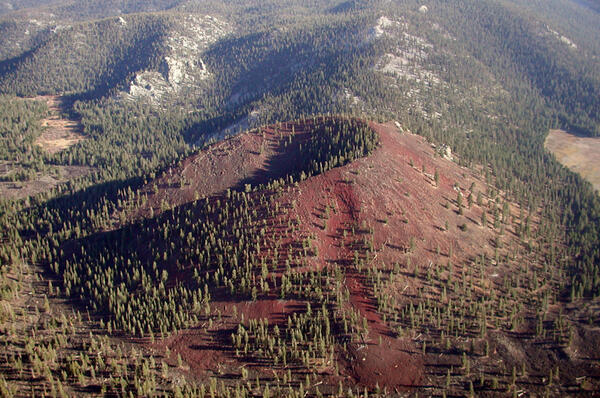
Groundhog scoria cone in the Golden Trout Creek volcanic field, California
Groundhog scoria cone in the Golden Trout Creek volcanic field, CaliforniaGroundhog scoria cone, the youngest of the Golden Trout Creek volcanic field, and the source of a lava flow that traveled 6 km to the west down Golden Trout Creek. The cone erupted through light-colored Mesozoic granitic rocks of the Sierra Nevada batholith visible in the distance. Photo by Rick Howard, 2002 (courtesy of Del Hubbs, U.S. Forest Service).
Groundhog scoria cone in the Golden Trout Creek volcanic field, California
Groundhog scoria cone in the Golden Trout Creek volcanic field, CaliforniaGroundhog scoria cone, the youngest of the Golden Trout Creek volcanic field, and the source of a lava flow that traveled 6 km to the west down Golden Trout Creek. The cone erupted through light-colored Mesozoic granitic rocks of the Sierra Nevada batholith visible in the distance. Photo by Rick Howard, 2002 (courtesy of Del Hubbs, U.S. Forest Service).
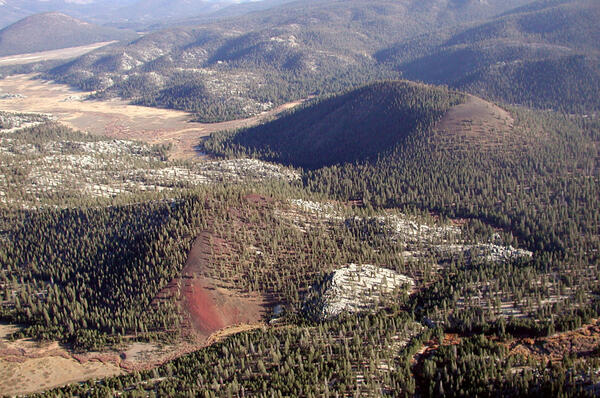
South Fork scoria cone in the Golden Trout Creek volcanic field, California
South Fork scoria cone in the Golden Trout Creek volcanic field, CaliforniaSouth Fork scoria cone (center) is seen from the NW with Ramshaw Meadow (upper left) behind it. Templeton Mountain is the rounded peak beyond South Fork cone, and Olancha Peak on the crest of the Sierra Nevada is on the center horizon.
South Fork scoria cone in the Golden Trout Creek volcanic field, California
South Fork scoria cone in the Golden Trout Creek volcanic field, CaliforniaSouth Fork scoria cone (center) is seen from the NW with Ramshaw Meadow (upper left) behind it. Templeton Mountain is the rounded peak beyond South Fork cone, and Olancha Peak on the crest of the Sierra Nevada is on the center horizon.