



Lava continues to erupt from the west vent in Halema‘uma‘u, and supply the lava lake through a spillway in the spatter cone. On November 12, a small overflow of the perched lava lake levee was visible from the western crater rim. Overflows are an important process for building up perched levees, as they help add height and stability.
Images
Hawaiian Volcano Observatory images of eruptive activity, field work, and more.
Filter Total Items: 4185

Halema‘uma‘u overflow on November 12
Lava continues to erupt from the west vent in Halema‘uma‘u, and supply the lava lake through a spillway in the spatter cone. On November 12, a small overflow of the perched lava lake levee was visible from the western crater rim. Overflows are an important process for building up perched levees, as they help add height and stability.

November 11, 2021—Kīlauea summit eruption reference map
November 11, 2021—Kīlauea summit eruption reference mapThis reference map depicts the ongoing Kīlauea summit eruption on November 11, 2021. One eruptive vent is active within Halema‘uma‘u at this time, along the western edge of the rising lava lake.
November 11, 2021—Kīlauea summit eruption reference map
November 11, 2021—Kīlauea summit eruption reference mapThis reference map depicts the ongoing Kīlauea summit eruption on November 11, 2021. One eruptive vent is active within Halema‘uma‘u at this time, along the western edge of the rising lava lake.

Helicopter Overflight of Halema‘uma‘u
HVO geologists conducted a helicopter overflight of Halema‘uma‘u, at the summit of Kīlauea, on the morning of November 9. A gas plume can be seen rising from the west vent along the crater wall (center left). Mauna Loa is visible in the background. USGS photo by B. Carr.
HVO geologists conducted a helicopter overflight of Halema‘uma‘u, at the summit of Kīlauea, on the morning of November 9. A gas plume can be seen rising from the west vent along the crater wall (center left). Mauna Loa is visible in the background. USGS photo by B. Carr.

Small levee overflow
Following a brief—about one day—decrease in activity from November 7–8, the effusion rate within Halema‘uma‘u crater increased again on November 9. The active lava lake surface, which significantly shrunk during the lower-level of activity, has since grown back to it's previous size.
Following a brief—about one day—decrease in activity from November 7–8, the effusion rate within Halema‘uma‘u crater increased again on November 9. The active lava lake surface, which significantly shrunk during the lower-level of activity, has since grown back to it's previous size.

November 9, 2021—Kīlauea summit thermal map
A helicopter overflight on November 9, 2021, at approximately 8:30 a.m. HST allowed for aerial visual and thermal imagery to be collected of Halema‘uma‘u crater at the summit of Kīlauea. The scale of the thermal map ranges from blue to red, with blue colors indicative of cooler temperatures and red colors indicative of warmer temperatures.
A helicopter overflight on November 9, 2021, at approximately 8:30 a.m. HST allowed for aerial visual and thermal imagery to be collected of Halema‘uma‘u crater at the summit of Kīlauea. The scale of the thermal map ranges from blue to red, with blue colors indicative of cooler temperatures and red colors indicative of warmer temperatures.

Lava spills onto cooled crust
A telephoto view of the western lava lake in Halema‘uma‘u, at the summit of Kīlauea. Around 10:00 a.m. on November 9, geologists in the field witnessed lava from the western part of the active lava lake (right) flowing onto an area of cooled solidified crust (left).
A telephoto view of the western lava lake in Halema‘uma‘u, at the summit of Kīlauea. Around 10:00 a.m. on November 9, geologists in the field witnessed lava from the western part of the active lava lake (right) flowing onto an area of cooled solidified crust (left).

Activity at West Vent
An aerial telephoto view of the western vent in Halema‘uma‘u crater on the morning of November 9. Spattering at the west vent occasionally reached above the level of the cone rim. The ponded lava within the cone was supplying lava to the lake from a tubed over spillway that is slightly elevated above the lava lake surface. USGS photo taken by B. Carr.
An aerial telephoto view of the western vent in Halema‘uma‘u crater on the morning of November 9. Spattering at the west vent occasionally reached above the level of the cone rim. The ponded lava within the cone was supplying lava to the lake from a tubed over spillway that is slightly elevated above the lava lake surface. USGS photo taken by B. Carr.

Lake lake activity in Halema‘uma‘u
During a helicopter overflight of Halema‘uma‘u crater on November 9, HVO geologists observed spattering within the west vent cone and lava entering the lake via a spillway that is now tubed-over. Sulfur dioxide (SO2) emission rates remain elevated with the largest volcanic gas plume coming from the west vent. USGS photo by B. Carr.
During a helicopter overflight of Halema‘uma‘u crater on November 9, HVO geologists observed spattering within the west vent cone and lava entering the lake via a spillway that is now tubed-over. Sulfur dioxide (SO2) emission rates remain elevated with the largest volcanic gas plume coming from the west vent. USGS photo by B. Carr.

Lava sloshing and spattering in west vent in Halema‘uma‘u crater at Kīlauea volcano
Lava sloshing and spattering in west vent in Halema‘uma‘u crater at Kīlauea volcanoA telephoto view of the west vent along the western wall of Halema‘uma‘u crater at the summit of Kīlauea. On November 9, spatter bursts in the west vent cone triggered sloshing on the surface of the ponded lava. Spatter was thrown about 6–9 m (20–30 ft) above the pond surface and occasionally deposited onto the rim of the cone. USGS photo by J. Schmith.
Lava sloshing and spattering in west vent in Halema‘uma‘u crater at Kīlauea volcano
Lava sloshing and spattering in west vent in Halema‘uma‘u crater at Kīlauea volcanoA telephoto view of the west vent along the western wall of Halema‘uma‘u crater at the summit of Kīlauea. On November 9, spatter bursts in the west vent cone triggered sloshing on the surface of the ponded lava. Spatter was thrown about 6–9 m (20–30 ft) above the pond surface and occasionally deposited onto the rim of the cone. USGS photo by J. Schmith.

Compilation of recent thermal maps
This compilation of recent thermal maps shows the evolution of the lava lake in Halema‘uma‘u at the summit of Kīlauea. The scale of the thermal map ranges from blue to red, with blue colors indicative of cooler temperatures and red colors indicative of warmer temperatures.
This compilation of recent thermal maps shows the evolution of the lava lake in Halema‘uma‘u at the summit of Kīlauea. The scale of the thermal map ranges from blue to red, with blue colors indicative of cooler temperatures and red colors indicative of warmer temperatures.
Lava sloshing and spattering in west vent in Halema‘uma‘u
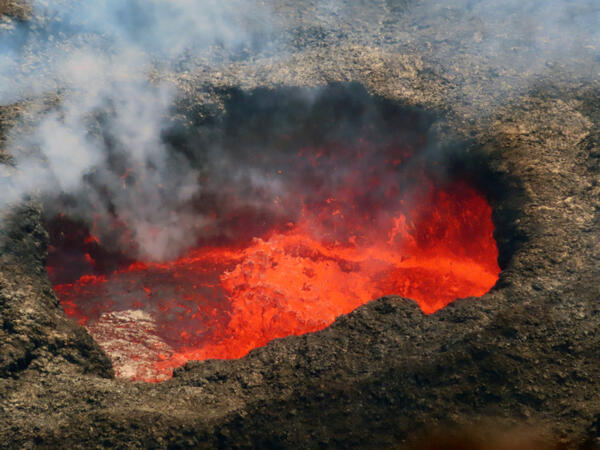
Lava sloshing and spattering in west vent in Halema‘uma‘uA telephoto view of the west vent along the western wall of Halema‘uma‘u crater at the summit of Kīlauea. On November 9, spatter bursts in the west vent cone triggered sloshing on the surface of the ponded lava. Spatter was thrown about 6–9 m (20–30 ft) above the pond surface and occasionally deposited onto the rim of the cone.
Lava sloshing and spattering in west vent in Halema‘uma‘u
Lava sloshing and spattering in west vent in Halema‘uma‘uA telephoto view of the west vent along the western wall of Halema‘uma‘u crater at the summit of Kīlauea. On November 9, spatter bursts in the west vent cone triggered sloshing on the surface of the ponded lava. Spatter was thrown about 6–9 m (20–30 ft) above the pond surface and occasionally deposited onto the rim of the cone.

A view of the plume rising above Halema‘uma‘u
A wide view of the lava lake in Halema‘uma‘u taken during a helicopter overflight on the morning of November 9, 2021. Lava is once again visible in the spillway of the west vent after a brief drop in activity on Monday, November 8.
A wide view of the lava lake in Halema‘uma‘u taken during a helicopter overflight on the morning of November 9, 2021. Lava is once again visible in the spillway of the west vent after a brief drop in activity on Monday, November 8.

November 9, 2021—Kīlauea summit thermal map
A helicopter overflight on November 9, 2021, at approximately 8:30 a.m. HST allowed for aerial visual and thermal imagery to be collected of Halema‘uma‘u crater at the summit of Kīlauea. The scale of the thermal map ranges from blue to red, with blue colors indicative of cooler temperatures and red colors indicative of warmer temperatures.
A helicopter overflight on November 9, 2021, at approximately 8:30 a.m. HST allowed for aerial visual and thermal imagery to be collected of Halema‘uma‘u crater at the summit of Kīlauea. The scale of the thermal map ranges from blue to red, with blue colors indicative of cooler temperatures and red colors indicative of warmer temperatures.

Halema‘uma‘u lava lake surface
A view of the Halema‘uma‘u lava lake taken during a helicopter overflight on the morning of November 9, 2021. Lava is visible in the spillway and in the west vent on the far side of the lava lake (center). There are also several small perched overflows in the northwest quadrant of the lake (near center between the vent and main island). USGS photo by L. Gallant.
A view of the Halema‘uma‘u lava lake taken during a helicopter overflight on the morning of November 9, 2021. Lava is visible in the spillway and in the west vent on the far side of the lava lake (center). There are also several small perched overflows in the northwest quadrant of the lake (near center between the vent and main island). USGS photo by L. Gallant.

Overspill one hour later
A telephoto view in the same area of the western lava lake surface within Halema‘uma‘u. Lava continued to flow from the active western lake surface (right) onto the lower area of cooled solidified crust just north of it (left).
A telephoto view in the same area of the western lava lake surface within Halema‘uma‘u. Lava continued to flow from the active western lake surface (right) onto the lower area of cooled solidified crust just north of it (left).

Plume rising from Halema‘uma‘u crater at Kīlauea volcano in the morning sun
Plume rising from Halema‘uma‘u crater at Kīlauea volcano in the morning sunOn the morning of November 9, a wispy volcanic gas plume (lower left) was visible over Halema‘uma‘u crater, at Kīlauea summit. As the hot plume rose to meet the cool morning air, water vapor formed a cloud above the crater. USGS photo by J. Schmith.
Plume rising from Halema‘uma‘u crater at Kīlauea volcano in the morning sun
Plume rising from Halema‘uma‘u crater at Kīlauea volcano in the morning sunOn the morning of November 9, a wispy volcanic gas plume (lower left) was visible over Halema‘uma‘u crater, at Kīlauea summit. As the hot plume rose to meet the cool morning air, water vapor formed a cloud above the crater. USGS photo by J. Schmith.

Eruption in Halema‘uma‘u, Kīlauea summit - Nov 8, 2021
Eruption in Halema‘uma‘u, Kīlauea summit - Nov 8, 2021The extent of the active lava lake surface (lower right) within Halema‘uma‘u crater, at the summit of Kīlauea, had decreased substantially over the previous day and (at the time of this photo) was limited to the area around the west vent. This photo was taken at 5:48 p.m. HST on November 8, 2021, from the western rim of the crater. USGS photo by J.M. Chang.
Eruption in Halema‘uma‘u, Kīlauea summit - Nov 8, 2021
Eruption in Halema‘uma‘u, Kīlauea summit - Nov 8, 2021The extent of the active lava lake surface (lower right) within Halema‘uma‘u crater, at the summit of Kīlauea, had decreased substantially over the previous day and (at the time of this photo) was limited to the area around the west vent. This photo was taken at 5:48 p.m. HST on November 8, 2021, from the western rim of the crater. USGS photo by J.M. Chang.

Eruption in Halema‘uma‘u, Kīlauea summit - Nov 8, 2021
Eruption in Halema‘uma‘u, Kīlauea summit - Nov 8, 2021Despite the temporary decrease in activity at Halema‘uma‘u crater, at the summit of Kīlauea, spattering was still visible within the west vent cone. This telephoto image was taken from the western rim of the crater during a lower level of eruptive activity on November 8, 2021. USGS photo by J.M. Chang.
Eruption in Halema‘uma‘u, Kīlauea summit - Nov 8, 2021
Eruption in Halema‘uma‘u, Kīlauea summit - Nov 8, 2021Despite the temporary decrease in activity at Halema‘uma‘u crater, at the summit of Kīlauea, spattering was still visible within the west vent cone. This telephoto image was taken from the western rim of the crater during a lower level of eruptive activity on November 8, 2021. USGS photo by J.M. Chang.

November 4, 2021—Kīlauea summit eruption reference map
November 4, 2021—Kīlauea summit eruption reference mapThis reference map depicts the ongoing Kīlauea summit eruption on November 4, 2021. One eruptive vent is active within Halema‘uma‘u at this time, along the western edge of the rising lava lake.
November 4, 2021—Kīlauea summit eruption reference map
November 4, 2021—Kīlauea summit eruption reference mapThis reference map depicts the ongoing Kīlauea summit eruption on November 4, 2021. One eruptive vent is active within Halema‘uma‘u at this time, along the western edge of the rising lava lake.

Eruption within Halema‘uma‘u crater, Kīlauea summit - November 3, 2021
Eruption within Halema‘uma‘u crater, Kīlauea summit - November 3, 2021A photo of the west vent and active western portion of the lava lake within Halema‘uma‘u, at Kīlauea summit. The eastern side of the lava lake (out of view to the right), has a stagnant solidified crust on the surface. USGS photo taken by L. DeSmither on November 3, 2021.
Eruption within Halema‘uma‘u crater, Kīlauea summit - November 3, 2021
Eruption within Halema‘uma‘u crater, Kīlauea summit - November 3, 2021A photo of the west vent and active western portion of the lava lake within Halema‘uma‘u, at Kīlauea summit. The eastern side of the lava lake (out of view to the right), has a stagnant solidified crust on the surface. USGS photo taken by L. DeSmither on November 3, 2021.

Eruption within Halema‘uma‘u crater, Kīlauea summit - November 3, 2021
Eruption within Halema‘uma‘u crater, Kīlauea summit - November 3, 2021The vent in the western wall of Halema‘uma‘u continues to erupt at the summit of Kīlauea. Volcanic gas emissions, primarily from the west vent (right), remain elevated. Sulfur dioxide (SO2) emission rates were measured at around 3,600 tonnes per day on October 28, 2021. USGS photo taken on November 3, 2021, by L. DeSmither.
Eruption within Halema‘uma‘u crater, Kīlauea summit - November 3, 2021
Eruption within Halema‘uma‘u crater, Kīlauea summit - November 3, 2021The vent in the western wall of Halema‘uma‘u continues to erupt at the summit of Kīlauea. Volcanic gas emissions, primarily from the west vent (right), remain elevated. Sulfur dioxide (SO2) emission rates were measured at around 3,600 tonnes per day on October 28, 2021. USGS photo taken on November 3, 2021, by L. DeSmither.