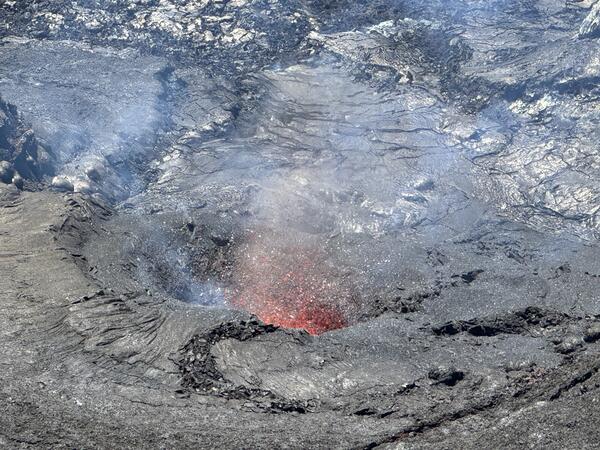
The vent craters within Halema‘uma‘u were mostly obscured by the thick degassing plume the morning of March 21, but there were fleeting views of incandescence in the north crater. This photo shows what appeared to be a small collapse of the crater walls exposing hot material deposited from yesterday's fountaining, as opposed to fresh lava in the crater.
Images
Hawaiian Volcano Observatory images of eruptive activity, field work, and more.
The vent craters within Halema‘uma‘u were mostly obscured by the thick degassing plume the morning of March 21, but there were fleeting views of incandescence in the north crater. This photo shows what appeared to be a small collapse of the crater walls exposing hot material deposited from yesterday's fountaining, as opposed to fresh lava in the crater.
The recent fountaining episodes at the summit of Kīlauea have covered the closed portion of Crater Rim Drive in Hawai‘i Volcanoes National Park with a significant amount of tephra. Tephra is the term for volcanic fragments that the travel through the air before being deposited on the ground.
Another view of the tephra covering Crater Rim Drive, at the summit of Kīlauea volcano. The tephra has also partially filled in some of the Southwest Rift Zone cracks that run perpendicular to the roadway. USGS photo by A. Flinders.
On March 21, USGS Hawaiian Volcano Observatory geologists sampled a small lobe of active lava in the eastern portion of Halema‘uma‘u crater, which represented residual lava oozing out from beneath the solidified crater floor. These ooze-outs have been common following fountaining episodes.
This photo shows the fountaining at Kīlauea summit at about 7:45 a.m. on March 20, during episode 14 of the ongoing eruption. At this time the south fountain was reaching the height of the crater rim, which is about 160 meters (520 feet) above the vent. USGS photo by M. Patrick.
Just after 7:45 a.m. on March 20, the north fountain at the summit of Kīlauea abruptly shut off during episode 14, and the south fountain rose in height. The height was well above the crater rim, roughly 200 meters (650 feet) above the vent. USGS photo by M. Patrick.
Lava fountaining in the southwest portion of Halema‘uma‘u crater from episode 14 of the ongoing Kīlauea summit eruption. The south fountain was dominant around midday, and supplied lava into a long, narrow channel that fed into a circular perched lava pond. USGS photo taken by M. Patrick on March 20, 2025.
An HVO geologist captures video of the episode 14 fountaining at the summit of Kīlauea. The videos are time-synchronized to better compare to geophysical data, for later study. USGS photo taken by M. Patrick on March 20, 2025.
An HVO geologist uses a laser rangefinder to measure vent features during the episode 14 lava fountaining at the summit of Kīlauea. USGS photo by M. Patrick.
As episode 14 lava fountaining occurred during the ongoing Kīlauea summit eruption, the KWcam webcam, F1cam thermal camera and continuous laser rangefinder perched on the crater edge (upper right portion of the photo), provided a continuous record of activity.
Side-by-side comparison of Mauna Loa summit caldera maps from 1841 by Wilkes (top) and 1872 as published by the Pacific Commercial Advertiser newspaper (bottom). Note contour lines in the center of Mokuʻāweoweo caldera on the 1872 map, indicating a deeper depression that was discussed in a narrative of the mapping visit.
Vigorous fountaining began around 6:30 a.m. on March 20, and continued into the early afternoon, as part of episode 14 of the ongoing summit eruption of Kīlauea. In this view from the northeast rim of Kaluapele (the summit caldera), the fountains produce a high outgassing plume, with Mauna Loa on the right side of the photo. USGS photo by M. Patrick.
A telephoto view looking at the top of a lava fountain from episode 14 of the ongoing Halema‘uma‘u eruption. A trio of Koa‘e kea (white-tailed tropicbirds) were flying circles close to the lava fountain, at the summit of Kīlauea, presumably riding the thermal updrafts around the vent. USGS photo by M. Patrick taken on March 20, 2025.
S2cam photograph showing lava fountaining activity during episode 14 of the ongoing summit eruption of Kīlauea. USGS photo.
Once the northern eruptive vent within Halemaʻumaʻu crater at the summit of Kīlauea became active on March 19, it began exhibiting cyclic dome fountaining and lava drainback approximately every 5 minutes. In this image captured from above on the western crater rim, the drainback is evidenced by whirlpool textures in the lava pond's crustal plates. USGS photo by M.
March 19, 2025 — Lava flows in western Halemaʻumaʻu
March 19, 2025 — Lava flows in western HalemaʻumaʻuLater in the morning on March 19, the northern eruptive vent joined its southern counterpart in effusing a lava flow onto the western floor of Halemaʻumaʻu crater at the summit of Kīlauea. Here, both vents and lava flows are seen from above on the western crater rim. USGS photo by M. Zoeller.
March 19, 2025 — Lava flows in western Halemaʻumaʻu
March 19, 2025 — Lava flows in western HalemaʻumaʻuLater in the morning on March 19, the northern eruptive vent joined its southern counterpart in effusing a lava flow onto the western floor of Halemaʻumaʻu crater at the summit of Kīlauea. Here, both vents and lava flows are seen from above on the western crater rim. USGS photo by M. Zoeller.
A closer view of the low dome fountain at the northern eruptive vent within Halemaʻumaʻu crater at the summit of Kīlauea on March 19, 2025. USGS photo by M. Patrick.
At the summit of Kīlauea on March 19, 2025, the onset of draining at the northern eruptive vent within Halemaʻumaʻu crater included intense gas jetting, spraying small droplets of lava vertically. USGS photo by M. Patrick.
Early on March 19, the southern eruptive vent within Halemaʻumaʻu crater at the summit of Kīlauea was the primary host of low-level eruptive activity. This photo, captured from the southern crater rim, shows minor spatter at the vent and a small lava flow proceeding onto the crater floor. USGS photo by M. Zoeller.
At the summit of Kīlauea on March 19, 2025, cycles of filling and draining at the northern eruptive vent within Halemaʻumaʻu crater included periods of more intense spattering in the lava pond. USGS photo by M. Patrick.
March 19, 2025 — Gas-piston cycle at Kīlauea summit
March 19, 2025 — Gas-piston cycle at Kīlauea summitIn the top panel, lava rises in the north vent in Halemaʻumaʻu prior to Episode 14 on March 19, 2025. Note that only a faint, hazy gas plume is visible near the right edge of the lava surface.
March 19, 2025 — Gas-piston cycle at Kīlauea summit
March 19, 2025 — Gas-piston cycle at Kīlauea summitIn the top panel, lava rises in the north vent in Halemaʻumaʻu prior to Episode 14 on March 19, 2025. Note that only a faint, hazy gas plume is visible near the right edge of the lava surface.