



During an eruption monitoring shift on May 25, HVO field crews did not observe any active surface lava or incandescent areas within Halema‘uma‘u crater, at the summit of Kīlauea. Since the eruption began on December 20, 2020, over 40 million cubic meters (over 10 billion gallons) of lava has been erupted.
All Multimedia
Access all multimedia to include images, video, audio, webcams, before-after imagery, and more. Filter and explore with filtering options to refine search.
Filter Total Items: 24985

Kīlauea summit eruption on May 25, 2021
During an eruption monitoring shift on May 25, HVO field crews did not observe any active surface lava or incandescent areas within Halema‘uma‘u crater, at the summit of Kīlauea. Since the eruption began on December 20, 2020, over 40 million cubic meters (over 10 billion gallons) of lava has been erupted.

IRIC Pilot Applications for the Potomac River Using Bathy-Lidar Data
IRIC Pilot Applications for the Potomac River Using Bathy-Lidar DataThis short presentation will illustrate how detailed topographic-bathymetric LiDAR data sets can be used within the USGS iRIC software package to compute detailed flow and particle tracking simulations across a range of length and time scales, including capturing the effects of local unsteadiness and turbulent mixing.
IRIC Pilot Applications for the Potomac River Using Bathy-Lidar Data
IRIC Pilot Applications for the Potomac River Using Bathy-Lidar DataThis short presentation will illustrate how detailed topographic-bathymetric LiDAR data sets can be used within the USGS iRIC software package to compute detailed flow and particle tracking simulations across a range of length and time scales, including capturing the effects of local unsteadiness and turbulent mixing.

Kīlauea summit eruption on May 25, 2021
An overview of the lava lake within Halema‘uma‘u crater, at Kīlauea Volcano’s summit, taken on May 25. Kīlauea’s summit collapse in 2018 deepened Halema‘uma‘u crater by over 500 meters (1640 feet).
An overview of the lava lake within Halema‘uma‘u crater, at Kīlauea Volcano’s summit, taken on May 25. Kīlauea’s summit collapse in 2018 deepened Halema‘uma‘u crater by over 500 meters (1640 feet).

Kīlauea summit eruption on May 25, 2021
Though no active surface lava was observed within Halema‘uma‘u on May 25, Kīlauea summit continues to emit volcanic gases. The most recent sulfur dioxide emission rate, measured on May 23, remains slightly elevated at 100 tonnes per day.
Though no active surface lava was observed within Halema‘uma‘u on May 25, Kīlauea summit continues to emit volcanic gases. The most recent sulfur dioxide emission rate, measured on May 23, remains slightly elevated at 100 tonnes per day.

Halema‘uma‘u lava lake, Kīlauea summit eruption—May 24, 2021
Halema‘uma‘u lava lake, Kīlauea summit eruption—May 24, 2021A zoomed-in view of the western lava lake in Halema‘uma‘u, at Kīlauea summit, where two locations of faint incandescence are visible beneath the surface crust (upper right). Eruptive activity has decreased significantly in the past few weeks and the once active lava surface has cooled and crusted over. USGS photo taken by B. Carr at dusk on May 24, 2021.
Halema‘uma‘u lava lake, Kīlauea summit eruption—May 24, 2021
Halema‘uma‘u lava lake, Kīlauea summit eruption—May 24, 2021A zoomed-in view of the western lava lake in Halema‘uma‘u, at Kīlauea summit, where two locations of faint incandescence are visible beneath the surface crust (upper right). Eruptive activity has decreased significantly in the past few weeks and the once active lava surface has cooled and crusted over. USGS photo taken by B. Carr at dusk on May 24, 2021.

Halema‘uma‘u lava lake, Kīlauea summit eruption—May 24, 2021
Halema‘uma‘u lava lake, Kīlauea summit eruption—May 24, 2021On the evening of May 24, no active surface lava was observed within Halema‘uma‘u crater, at the summit of Kīlauea Volcano. Small spots of incandescent lava were visible beneath cracks in the lake surface crust (center) and at the west vent (left).
Halema‘uma‘u lava lake, Kīlauea summit eruption—May 24, 2021
Halema‘uma‘u lava lake, Kīlauea summit eruption—May 24, 2021On the evening of May 24, no active surface lava was observed within Halema‘uma‘u crater, at the summit of Kīlauea Volcano. Small spots of incandescent lava were visible beneath cracks in the lake surface crust (center) and at the west vent (left).

Halema‘uma‘u lava lake, Kīlauea summit eruption—May 24, 2021
Halema‘uma‘u lava lake, Kīlauea summit eruption—May 24, 2021A zoomed-in view of the western vent within Halema‘uma‘u, at the summit of Kīlauea, with a weak glow visible at dusk on Monday, May 24. USGS photo taken by B. Carr from the western rim of Halema‘uma‘u.
Halema‘uma‘u lava lake, Kīlauea summit eruption—May 24, 2021
Halema‘uma‘u lava lake, Kīlauea summit eruption—May 24, 2021A zoomed-in view of the western vent within Halema‘uma‘u, at the summit of Kīlauea, with a weak glow visible at dusk on Monday, May 24. USGS photo taken by B. Carr from the western rim of Halema‘uma‘u.

GRAND CALUMET LAGOON AT MARQUETTE PARK
GRAND CALUMET LAGOON AT MARQUETTE PARK

GRAND CALUMET RIVER AT SOHL AV AT HAMMOND
GRAND CALUMET RIVER AT SOHL AV AT HAMMOND

Seismic science crew and the R/V Sproul
In the background is the Research Vessel (R/V) Robert Gordon Sproul, operated by Scripps Institution of Oceanography (SIO).
In the background is the Research Vessel (R/V) Robert Gordon Sproul, operated by Scripps Institution of Oceanography (SIO).

Active surface lava limited to a small pond in Halema‘uma‘u
Active surface lava limited to a small pond in Halema‘uma‘uActive surface lava in Halema‘uma‘u, at the summit of Kīlauea, is now limited to a small lava pond near the western fissure. Normally the lava pond is covered in a stationary crust, as shown by the image on the left. Occasionally, the pond abruptly resurfaces with fluid lava, with foundering of crustal plates and abundant bubbling, shown by the image on the right.
Active surface lava limited to a small pond in Halema‘uma‘u
Active surface lava limited to a small pond in Halema‘uma‘uActive surface lava in Halema‘uma‘u, at the summit of Kīlauea, is now limited to a small lava pond near the western fissure. Normally the lava pond is covered in a stationary crust, as shown by the image on the left. Occasionally, the pond abruptly resurfaces with fluid lava, with foundering of crustal plates and abundant bubbling, shown by the image on the right.

Ashley Ryan and Jeff Kvech using ADCP for recon
Photo Contest Winner | June 2021 | USGS at Work
Ashley Ryan and Jeff Kvech using ADCP for recon of lower Anacostia River, 20210520
Photo Contest Winner | June 2021 | USGS at Work
Ashley Ryan and Jeff Kvech using ADCP for recon of lower Anacostia River, 20210520

Map showing Island of Hawai‘i earthquake activity over the past week
Map showing Island of Hawai‘i earthquake activity over the past weekMap and plot showing earthquakes at 20-40 km (12-25 miles) depth beneath the Island of Hawai‘i over the past week. Most of the earthquakes at this depth were clustered beneath the southern edge of the island near the town of Pāhala (blue dots). USGS graphic.
Map showing Island of Hawai‘i earthquake activity over the past week
Map showing Island of Hawai‘i earthquake activity over the past weekMap and plot showing earthquakes at 20-40 km (12-25 miles) depth beneath the Island of Hawai‘i over the past week. Most of the earthquakes at this depth were clustered beneath the southern edge of the island near the town of Pāhala (blue dots). USGS graphic.

May 20, 2021 — Kīlauea
No active surface lava was visible within Halema‘uma‘u, at the summit of Kīlauea, during a field visit yesterday morning. F1cam thermal images from yesterday afternoon show hot surface crust, but no active lava. F1cam thermal images from the morning of May 21 showed at least one small resurfacing event.
No active surface lava was visible within Halema‘uma‘u, at the summit of Kīlauea, during a field visit yesterday morning. F1cam thermal images from yesterday afternoon show hot surface crust, but no active lava. F1cam thermal images from the morning of May 21 showed at least one small resurfacing event.

May 20, 2021 — Kīlauea
A close-up view of the western fissure vent complex and gas plume within Halema‘uma‘u, at the summit of Kīlauea. Gas emissions remain slightly elevated, with the most recent measurements on May 18 at 100 tonnes per day. The lava inlet from the base of the west vent, which no longer appears to be active, is visible on the right.
A close-up view of the western fissure vent complex and gas plume within Halema‘uma‘u, at the summit of Kīlauea. Gas emissions remain slightly elevated, with the most recent measurements on May 18 at 100 tonnes per day. The lava inlet from the base of the west vent, which no longer appears to be active, is visible on the right.

May 20, 2021 — Kīlauea
A close-up view of the northeastern rim of the Halema‘uma‘u lava lake, at the summit of Kīlauea. This area of the lava lake has been degassing persistently for the past few months. Several large boulders, which fell from the crater walls, are visible near the perimeter of the northern lava lake crust (center).
A close-up view of the northeastern rim of the Halema‘uma‘u lava lake, at the summit of Kīlauea. This area of the lava lake has been degassing persistently for the past few months. Several large boulders, which fell from the crater walls, are visible near the perimeter of the northern lava lake crust (center).

Remote control ADCP measurement
The Region 1, May 2021 "USGS at Work" Winner (by Aaron Stephens)
The Region 1, May 2021 "USGS at Work" Winner (by Aaron Stephens)
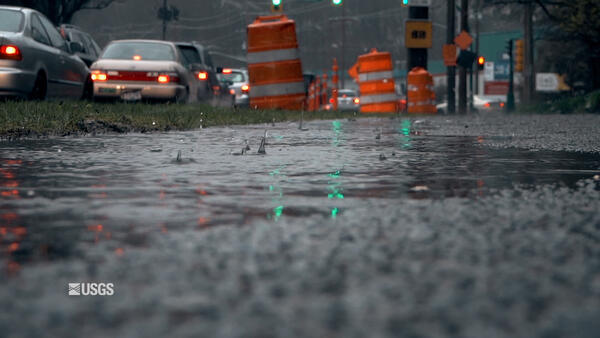
The Essential Storm Drain Water Management
Why storm drains are essential to watershed management.
Why storm drains are essential to watershed management.

USGS scientists collecting soil and worms at a site on Cape Cod, Mass.
USGS scientists collecting soil and worms at a site on Cape Cod, Mass.USGS scientists Gregory D'Agostino and Katherine Wares collecting soil and worms at a site on Cape Cod, Massachusetts, that was contaminated by PFAS from fire-fighting foam.
USGS scientists collecting soil and worms at a site on Cape Cod, Mass.
USGS scientists collecting soil and worms at a site on Cape Cod, Mass.USGS scientists Gregory D'Agostino and Katherine Wares collecting soil and worms at a site on Cape Cod, Massachusetts, that was contaminated by PFAS from fire-fighting foam.

Active surface lava limited to a small pond in Halema‘uma‘u
Active surface lava limited to a small pond in Halema‘uma‘uThis comparison of thermal images taken from the south rim of Halema‘uma‘u, at the summit of Kīlauea, show the diminishing area of active lava on the surface over the past month. Today, active lava was limited to a small pond, about 20 meters (yards) long, near the western fissure. USGS images by M. Patrick.
Active surface lava limited to a small pond in Halema‘uma‘u
Active surface lava limited to a small pond in Halema‘uma‘uThis comparison of thermal images taken from the south rim of Halema‘uma‘u, at the summit of Kīlauea, show the diminishing area of active lava on the surface over the past month. Today, active lava was limited to a small pond, about 20 meters (yards) long, near the western fissure. USGS images by M. Patrick.

Beach and groin at Seven Mile Island, New Jersey
A groin at Seven Mile Island, New Jersey traps sand and contributes to widening of the barrier beach. This illustrates how human modification and wave processes shape the beach. In May 2021, Andrew Farmer, Chelsea Stalk, and Emily Wei conducted a multibeam bathymetry survey offshore of Seven Mile Island, along the southern coast of New Jersey.
A groin at Seven Mile Island, New Jersey traps sand and contributes to widening of the barrier beach. This illustrates how human modification and wave processes shape the beach. In May 2021, Andrew Farmer, Chelsea Stalk, and Emily Wei conducted a multibeam bathymetry survey offshore of Seven Mile Island, along the southern coast of New Jersey.