U.S. flag

An official website of the United States government

All Multimedia

Access all multimedia to include images, video, audio, webcams, before-after imagery, and more. Filter and explore with filtering options to refine search. 

Filter Total Items: 24939
Resurfacing event on small lava pond in Halema`uma`u

The area of active surface lava has diminished over the past month in Halema`uma`u crater, at the summit of Kilauea. Today, active surface lava was limited to a small pond, about 20 meters (yards) long. The pond surface was normally covered with a stationary crust, but occasionally resurfaced. This video shows crustal foundering during a resurfacing event.

The area of active surface lava has diminished over the past month in Halema`uma`u crater, at the summit of Kilauea. Today, active surface lava was limited to a small pond, about 20 meters (yards) long. The pond surface was normally covered with a stationary crust, but occasionally resurfaced. This video shows crustal foundering during a resurfacing event.

A utility task vehicle parked on a beach with plants in the background, seaweed on the ground, and a cloudy sky above.
UTV in front of beach scarp

UTV (utility task vehicle) parked in front of a beach scarp used to collect data that is used in cooperation with FWC, FWS, USGS, and USFSP to understand sea turtle nesting behavior in response to beach renourishment with the goal of advising engineers on how to develop more turtle friendly nourishment desig

UTV (utility task vehicle) parked in front of a beach scarp used to collect data that is used in cooperation with FWC, FWS, USGS, and USFSP to understand sea turtle nesting behavior in response to beach renourishment with the goal of advising engineers on how to develop more turtle friendly nourishment desig

Color photograph of lava lake
Close-up view of remaining lava lake within Halema‘uma‘u, May 18, 2021

This close-up view of the of the Halema‘uma‘u lava lake at the summit of Kīlauea was captured on Tuesday, May 18. During an approximately one-hour visit to the crater rim, USGS Hawaiian Volcano Observatory scientists' only observation of active lava was the crustal foundering event captured here, which lasted approximately five minutes.

This close-up view of the of the Halema‘uma‘u lava lake at the summit of Kīlauea was captured on Tuesday, May 18. During an approximately one-hour visit to the crater rim, USGS Hawaiian Volcano Observatory scientists' only observation of active lava was the crustal foundering event captured here, which lasted approximately five minutes.

The Water Cycle Kids (JPG)
USGS Coastal Change Hazards

The USGS Coastal Change Hazards team works to identify and address the Nation’s coastal change hazards problems.  By integrating research, technical capabilities and applications, and stakeholder engagement and communications, the Coastal Change Hazards team develops robust and accessible coastal change assessments, forecasts, and tools that help improve the lives,

The USGS Coastal Change Hazards team works to identify and address the Nation’s coastal change hazards problems.  By integrating research, technical capabilities and applications, and stakeholder engagement and communications, the Coastal Change Hazards team develops robust and accessible coastal change assessments, forecasts, and tools that help improve the lives,

USGS Coastal Change Hazards (AD)

The USGS Coastal Change Hazards team works to identify and address the Nation’s coastal change hazards problems.  By integrating research, technical capabilities and applications, and stakeholder engagement and communications, the Coastal Change Hazards team develops robust and accessible coastal change assessments, forecasts, and tools that help improve the lives,

The USGS Coastal Change Hazards team works to identify and address the Nation’s coastal change hazards problems.  By integrating research, technical capabilities and applications, and stakeholder engagement and communications, the Coastal Change Hazards team develops robust and accessible coastal change assessments, forecasts, and tools that help improve the lives,

Photographs from raccoon tissue showing long tan nematodes.
Nematodes in raccoon tissue

Photographs from a raccoon (Procyon lotor) from Arizona, US.  (A) Large tan nematodes (arrowheads) are present within the subcutaneous tissue and muscle fascia in the distal right forelimb. (B) Closer view of the distal right forelimb showing the large tan nematodes (arrowheads).

Photographs from a raccoon (Procyon lotor) from Arizona, US.  (A) Large tan nematodes (arrowheads) are present within the subcutaneous tissue and muscle fascia in the distal right forelimb. (B) Closer view of the distal right forelimb showing the large tan nematodes (arrowheads).

Thermal timelapse of summit lava lake

The lava lake in Halemaʻumaʻu crater, at the summit of Kīlauea, remains active but has diminished in area and vigor over the past month. This thermal timelapse sequence shows the changes in the lake activity over the past month. In mid-April the area of active surface lava in the lake was approximately 7.5 acres (3 hectares).

The lava lake in Halemaʻumaʻu crater, at the summit of Kīlauea, remains active but has diminished in area and vigor over the past month. This thermal timelapse sequence shows the changes in the lake activity over the past month. In mid-April the area of active surface lava in the lake was approximately 7.5 acres (3 hectares).

Terry Sohl and Jordan Dornbierer with the logo for the USGS EROS podcast "Eyes on Earth"
Eyes on Earth - Delaware River Basin
Eyes on Earth Episode 50 – Delaware River Basin
Terry Sohl and Jordan Dornbierer with the logo for the USGS EROS podcast "Eyes on Earth"
Eyes on Earth - Delaware River Basin
Eyes on Earth Episode 50 – Delaware River Basin

About 15 million people rely on the Delaware River Basin for drinking water, including residents of Philadelphia, PA, Camden, NJ, and Wilmington, DE. What might happen to the water supply if climate change and population growth continue unabated? How might that impact land cover and land use patterns?

About 15 million people rely on the Delaware River Basin for drinking water, including residents of Philadelphia, PA, Camden, NJ, and Wilmington, DE. What might happen to the water supply if climate change and population growth continue unabated? How might that impact land cover and land use patterns?

Color photograph of caldera
Routine visit to Mauna Loa summit

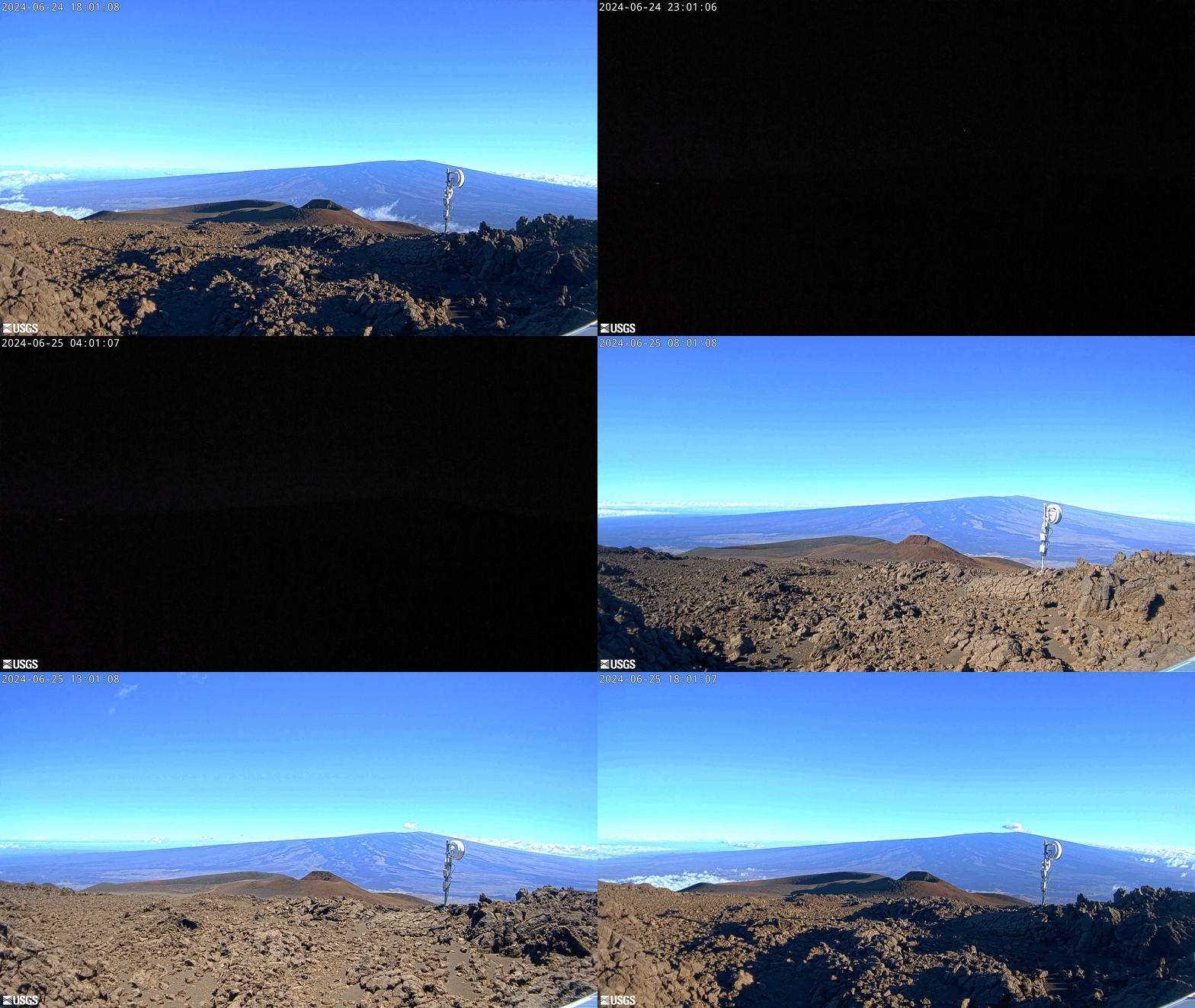
On May 15, USGS Hawaiian Volcano Observatory geologists did a routine hike to the summit of Mauna Loa and inspected summit monitoring equipment. Clear weather provided good views across the floor of Moku‘āweoweo, Mauna Loa's summit caldera, and nothing unusual was observed.

On May 15, USGS Hawaiian Volcano Observatory geologists did a routine hike to the summit of Mauna Loa and inspected summit monitoring equipment. Clear weather provided good views across the floor of Moku‘āweoweo, Mauna Loa's summit caldera, and nothing unusual was observed.

Color photograph of caldera
Routine visit to Mauna Loa summit

A USGS Hawaiian Volcano Observatory geologist inspects the thermal camera at the summit of Mauna Loa on May 15, 2021.

A USGS Hawaiian Volcano Observatory geologist inspects the thermal camera at the summit of Mauna Loa on May 15, 2021.

People on the deck of a research vessel handling a piece of scientific equipment
Deploying seismic streamer

Science crew from the USGS Pacific Coastal and Marine Science Center work on deployment of seismic streamer on deck of R/V Robert Gordon Sproul. Green cable is the hydrophone streamer and a "bird" is being attached to control depth in the water.

Science crew from the USGS Pacific Coastal and Marine Science Center work on deployment of seismic streamer on deck of R/V Robert Gordon Sproul. Green cable is the hydrophone streamer and a "bird" is being attached to control depth in the water.

A large metal arch against a bright blue sky.
Gateway Arch, St. Louis, Missouri

Can you find something around you that reminds you of a rock arch? www.usgs.gov/findafeature

Landsat 8 Collection 2 image of the Menindee Lakes in Australia

The Menindee Lakes in the Far West of New South Wales, Australia, are seen in this Landsat 8 Collection 2 image from May 14, 2021, and is shown as a natural color composite using the red, green, and blue bands (Bands 4,3,2).

The Menindee Lakes in the Far West of New South Wales, Australia, are seen in this Landsat 8 Collection 2 image from May 14, 2021, and is shown as a natural color composite using the red, green, and blue bands (Bands 4,3,2).

The lava lake in Halema‘uma‘u crater, at the summit of Kīlauea, remains active
View of the active lava lake area in Halema‘uma‘u—Kīlauea, May 14

The lava lake in Halema‘uma‘u crater, at the summit of Kīlauea, remains active, although surface incandescence (glowing red lava) has become less frequent over the last few days. In this view looking northwest, two elongated lobes oriented west (left) to east (right) with a relatively smooth shiny grey surface are visible in the center of the photo.

The lava lake in Halema‘uma‘u crater, at the summit of Kīlauea, remains active, although surface incandescence (glowing red lava) has become less frequent over the last few days. In this view looking northwest, two elongated lobes oriented west (left) to east (right) with a relatively smooth shiny grey surface are visible in the center of the photo.

More of Kīlauea's lava lake surface in Halema‘uma‘u crater has solidified in recent weeks, evident in this May 13 aerial view
Kīlauea summit overflight - May 13

More of Kīlauea's lava lake surface in Halema‘uma‘u crater has solidified in recent weeks, as is evident in this aerial view taken yesterday, May 13. However, gas emissions and small patches of active lava on the surface indicate that the eruption continues. Most recently, gas emissions were measured as 225 tonnes per day on May 12.

More of Kīlauea's lava lake surface in Halema‘uma‘u crater has solidified in recent weeks, as is evident in this aerial view taken yesterday, May 13. However, gas emissions and small patches of active lava on the surface indicate that the eruption continues. Most recently, gas emissions were measured as 225 tonnes per day on May 12.

Digital elevation model of crater and lava lake
Halema‘uma‘u DEM May 13, 2021

A helicopter overflight on May 13, 2021, at approximately 11:30 a.m. HST allowed for aerial visual and thermal imagery to be collected of the eruption within Halema‘uma‘u crater at the summit of Kīlauea Volcano. The visual images were used to create a digital elevation model (DEM) of the crater, shown here.

A helicopter overflight on May 13, 2021, at approximately 11:30 a.m. HST allowed for aerial visual and thermal imagery to be collected of the eruption within Halema‘uma‘u crater at the summit of Kīlauea Volcano. The visual images were used to create a digital elevation model (DEM) of the crater, shown here.

The eruption in Halema‘uma‘u, at the summit of Kīlauea, continues
Halema‘uma‘u lava lake, Kīlauea summit eruption—May 13, 2021

The eruption in Halema‘uma‘u, at the summit of Kīlauea, continues. Gas emissions, last measured on May 12, were 225 tonnes per day. This photo, taken on May 13, shows the bluish-tinged plume of volcanic gas being emitted from the western vent complex within Halema‘uma‘u crater. USGS image by K. Mulliken.

The eruption in Halema‘uma‘u, at the summit of Kīlauea, continues. Gas emissions, last measured on May 12, were 225 tonnes per day. This photo, taken on May 13, shows the bluish-tinged plume of volcanic gas being emitted from the western vent complex within Halema‘uma‘u crater. USGS image by K. Mulliken.

USGS Hawaiian Volcano Observatory geologists observed fluid lava on the surface of the lava lake in Halema‘uma‘u, at the summit
Halema‘uma‘u lava lake, Kīlauea summit eruption—May 13, 2021

USGS Hawaiian Volcano Observatory geologists observed fluid lava on the surface of the lava lake in Halema‘uma‘u, at the summit of Kīlauea, while monitoring the eruption on May 13. Two areas of ponded lava exhibited foundering, during which more-dense solidified crust sinks into the lava lake and is replaced by less-dense liquid lava from below.

USGS Hawaiian Volcano Observatory geologists observed fluid lava on the surface of the lava lake in Halema‘uma‘u, at the summit of Kīlauea, while monitoring the eruption on May 13. Two areas of ponded lava exhibited foundering, during which more-dense solidified crust sinks into the lava lake and is replaced by less-dense liquid lava from below.

The area of solidified crust at the surface of Halema‘uma‘u's lava lake, has been growing over the past several weeks
Halema‘uma‘u lava lake, Kīlauea summit eruption—May 13, 2021

The area of solidified crust at the surface of Halema‘uma‘u's lava lake, at the summit of Kīlauea, has been growing over the past several weeks. This may make it seem that the eruption is over but lava continues to be supplied to the lava lake from below.

The area of solidified crust at the surface of Halema‘uma‘u's lava lake, at the summit of Kīlauea, has been growing over the past several weeks. This may make it seem that the eruption is over but lava continues to be supplied to the lava lake from below.

Was this page helpful?