



In this photo taken during a helicopter overflight of Halema‘uma‘u crater on October 15, lava can be seen fountaining within the western vent cone and flowing down a short spillway into the lava lake. The main island created in the initial stages of the Dec. 2020–May 2021 eruption is in the foreground and continues to rise with the lake surface.
Images
Volcano Hazard Program images.
Filter Total Items: 6279

West vent and lava lake islands—October 15, 2021
In this photo taken during a helicopter overflight of Halema‘uma‘u crater on October 15, lava can be seen fountaining within the western vent cone and flowing down a short spillway into the lava lake. The main island created in the initial stages of the Dec. 2020–May 2021 eruption is in the foreground and continues to rise with the lake surface.

Different views of an eruption from two predictable geysers
Different views of an eruption from two predictable geysersDifferent views of an eruption from two predictable geysers. (a, c) Graphs showing water temperatures recorded by data loggers stationed near Beehive and Old Faithful Geysers, respectively. These data loggers were deployed by the Yellowstone Geology Program, configured to capture temperatures at one-minute intervals (indicated by blue dots).
Different views of an eruption from two predictable geysers
Different views of an eruption from two predictable geysersDifferent views of an eruption from two predictable geysers. (a, c) Graphs showing water temperatures recorded by data loggers stationed near Beehive and Old Faithful Geysers, respectively. These data loggers were deployed by the Yellowstone Geology Program, configured to capture temperatures at one-minute intervals (indicated by blue dots).

Scientist collects data—Kīlauea eruption overflight—Oct. 15, 2021
Scientist collects data—Kīlauea eruption overflight—Oct. 15, 2021Hawaiian Volcano Observatory scientists make observations and collect data during Kīlauea eruption overflights. The data collected is used to construct updated topographic and thermal maps of the lava lake surface and surrounding area.
Scientist collects data—Kīlauea eruption overflight—Oct. 15, 2021
Scientist collects data—Kīlauea eruption overflight—Oct. 15, 2021Hawaiian Volcano Observatory scientists make observations and collect data during Kīlauea eruption overflights. The data collected is used to construct updated topographic and thermal maps of the lava lake surface and surrounding area.

Active west vent in Halema‘uma‘u—October 15, 2021
A telephoto image of the the west vent taken on the morning of October 15, during an HVO helicopter overflight of Kīlauea summit. Low lava fountaining activity continues from the vent in the western wall of Halema‘uma‘u.
A telephoto image of the the west vent taken on the morning of October 15, during an HVO helicopter overflight of Kīlauea summit. Low lava fountaining activity continues from the vent in the western wall of Halema‘uma‘u.

Halema‘uma‘u Lave Lake—October 15, 2021
The eruption within Halema‘uma‘u continues. Lava fountaining from the western vent (center) feeds a rising lava lake. Activity has decreased over the past week and much of the eastern half of the lake surface (seen here in the foreground) has cooled and formed a solid crust.
The eruption within Halema‘uma‘u continues. Lava fountaining from the western vent (center) feeds a rising lava lake. Activity has decreased over the past week and much of the eastern half of the lake surface (seen here in the foreground) has cooled and formed a solid crust.

Kīlauea summit eruption - October 15, 2021
This overview photo of the Halema‘uma‘u lava lake was captured around noon on Friday, October 15, 2021, from the northwest rim of the crater. The western fissure (lower right) continues to erupt lava into the west side of the lava lake (right). The east side of the lake (left) is mostly stagnated and solidified on the surface.
This overview photo of the Halema‘uma‘u lava lake was captured around noon on Friday, October 15, 2021, from the northwest rim of the crater. The western fissure (lower right) continues to erupt lava into the west side of the lava lake (right). The east side of the lake (left) is mostly stagnated and solidified on the surface.

Halema‘uma‘u lava lake, Kīlauea summit eruption—October 15, 2021
Halema‘uma‘u lava lake, Kīlauea summit eruption—October 15, 2021The Kīlauea summit eruption continues within Halema‘uma‘u, in Hawai‘i Volcanoes National Park. This photo of the lava lake was taken this morning, October 15, 2021, during a Hawaiian Volcano Observatory eruption overflight. The vent in the western crater wall (center) continues to supply lava into the lava lake.
Halema‘uma‘u lava lake, Kīlauea summit eruption—October 15, 2021
Halema‘uma‘u lava lake, Kīlauea summit eruption—October 15, 2021The Kīlauea summit eruption continues within Halema‘uma‘u, in Hawai‘i Volcanoes National Park. This photo of the lava lake was taken this morning, October 15, 2021, during a Hawaiian Volcano Observatory eruption overflight. The vent in the western crater wall (center) continues to supply lava into the lava lake.

Lava fountaining at the west vent—October 14, 2021
Lava fountaining at the west vent—October 14, 2021A close-up photo of the vent in the western wall of Halema‘uma‘u, taken during the ongoing eruption at Kīlauea summit. The top of the 5–6 m (16–20 ft) tall lava fountain could be seen from the west crater rim on October 14, at 2:05 p.m. The lava fountains continue to build up a spatter cone around the vent.
Lava fountaining at the west vent—October 14, 2021
Lava fountaining at the west vent—October 14, 2021A close-up photo of the vent in the western wall of Halema‘uma‘u, taken during the ongoing eruption at Kīlauea summit. The top of the 5–6 m (16–20 ft) tall lava fountain could be seen from the west crater rim on October 14, at 2:05 p.m. The lava fountains continue to build up a spatter cone around the vent.

October 13, 2021 — Kīlauea summit eruption
A view of the western portion of the lava lake within Halema‘uma‘u, at the summit of Kīlauea. This photo, taken from the west crater rim, shows the active west vent (lower right), the main island (upper left), and the old west vent from the Dec. 2020–May 2021 eruption (lower left).
A view of the western portion of the lava lake within Halema‘uma‘u, at the summit of Kīlauea. This photo, taken from the west crater rim, shows the active west vent (lower right), the main island (upper left), and the old west vent from the Dec. 2020–May 2021 eruption (lower left).

Kīlauea summit eruption - October 12, 2021
A view of the fountaining at the west vent in Halema‘uma‘u crater, at the summit of Kīlauea. The photo was taken from the west rim, looking down upon the vent. Low fountaining and roiling within the cone supplied lava to the lake via a narrow spillway. Lava spreading out into the lake develops a zig-zag pattern in the surface crust. USGS photo by M.
A view of the fountaining at the west vent in Halema‘uma‘u crater, at the summit of Kīlauea. The photo was taken from the west rim, looking down upon the vent. Low fountaining and roiling within the cone supplied lava to the lake via a narrow spillway. Lava spreading out into the lake develops a zig-zag pattern in the surface crust. USGS photo by M.

Kīlauea summit eruption - October 12, 2021
A wide view of the ongoing eruption at Kīlauea summit, from the south rim of Halema‘uma‘u. A vent on the western crater wall (left) continues to supply lava to the active west half of the lava lake.
A wide view of the ongoing eruption at Kīlauea summit, from the south rim of Halema‘uma‘u. A vent on the western crater wall (left) continues to supply lava to the active west half of the lava lake.

Kīlauea summit eruption - October 12, 2021
Associated with an increase in fountaining activity at the main western vent in Halema‘uma‘u, a short-lived vent opened just to the north (right). Activity at this vent lasted about 10 hours with low-level fountaining about 3 meters (10 ft) high.
Associated with an increase in fountaining activity at the main western vent in Halema‘uma‘u, a short-lived vent opened just to the north (right). Activity at this vent lasted about 10 hours with low-level fountaining about 3 meters (10 ft) high.
Kīlauea summit eruption - October 12, 2021
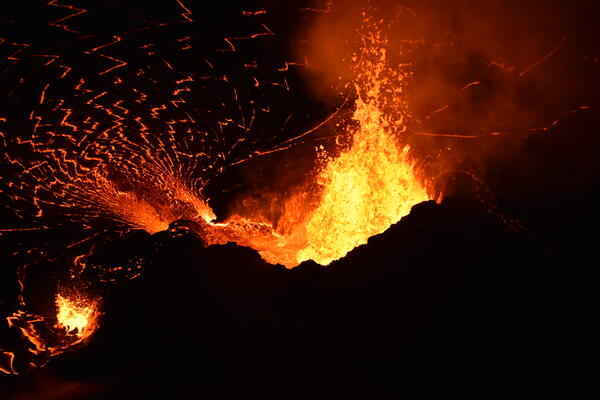
Lava fountains from the western vent within Halema‘uma‘u continue to supply lava into the lava lake through a short spillway. Consistent fountain heights of 10–15 meters (30–50 ft) were interrupted by frequent larger busts of spatter exceeding the height of the cone (30 m or 100 ft). USGS photo taken by B. Carr on October 12, 2021.
Lava fountains from the western vent within Halema‘uma‘u continue to supply lava into the lava lake through a short spillway. Consistent fountain heights of 10–15 meters (30–50 ft) were interrupted by frequent larger busts of spatter exceeding the height of the cone (30 m or 100 ft). USGS photo taken by B. Carr on October 12, 2021.

VMAP Vog Dashboard: public forecast for October 11, 2021
VMAP Vog Dashboard: public forecast for October 11, 2021VMAP Vog Dashboard: public forecast for October 11, 2021. Colors denote probability of exceeding ‘Moderate’ sulfur dioxide air quality threshold. Source: http://weather.hawaii.edu/vmap/new/
VMAP Vog Dashboard: public forecast for October 11, 2021
VMAP Vog Dashboard: public forecast for October 11, 2021VMAP Vog Dashboard: public forecast for October 11, 2021. Colors denote probability of exceeding ‘Moderate’ sulfur dioxide air quality threshold. Source: http://weather.hawaii.edu/vmap/new/

October 11, 2021 — Kīlauea
This zoomed-in view of the western fissure within Halema‘uma‘u, at the summit of Kīlauea, was captured on October 11, 2021, through the lens of a laser rangefinder. A prominent horseshoe-shaped spatter cone, measured to be standing 28 m (92 ft) above the adjacent lava lake, surrounds a roiling lava pond which also hosts taller fountains at times.
This zoomed-in view of the western fissure within Halema‘uma‘u, at the summit of Kīlauea, was captured on October 11, 2021, through the lens of a laser rangefinder. A prominent horseshoe-shaped spatter cone, measured to be standing 28 m (92 ft) above the adjacent lava lake, surrounds a roiling lava pond which also hosts taller fountains at times.

October 11, 2021 — Kīlauea
This zoomed-in view of the northwest side of the main island within the Halema‘uma‘u lava lake shows a "rootless lava flow" (silver) that formed in the early stages of the eruption on September 29, 2021.
This zoomed-in view of the northwest side of the main island within the Halema‘uma‘u lava lake shows a "rootless lava flow" (silver) that formed in the early stages of the eruption on September 29, 2021.

October 10, 2021 — Kīlauea, lava fountaining in Halema‘uma‘u
October 10, 2021 — Kīlauea, lava fountaining in Halema‘uma‘uFountaining at the western vent in Halema‘uma‘u crater, at Kīlauea volcano's summit, was approximately 15 meters (50 feet) high on the evening of October 10, 2021. Spatter from the fountaining would occasionally land on the wall of the vent cone and cool (visible on the right).
October 10, 2021 — Kīlauea, lava fountaining in Halema‘uma‘u
October 10, 2021 — Kīlauea, lava fountaining in Halema‘uma‘uFountaining at the western vent in Halema‘uma‘u crater, at Kīlauea volcano's summit, was approximately 15 meters (50 feet) high on the evening of October 10, 2021. Spatter from the fountaining would occasionally land on the wall of the vent cone and cool (visible on the right).

October 10, 2021 — Kīlauea, Halema‘uma‘u lava lake at dusk
October 10, 2021 — Kīlauea, Halema‘uma‘u lava lake at duskLava fountaining activity continues from the western vent in Halema‘uma‘u, within Kīlauea summit caldera, viewed at dusk on October 10, 2021, from the west rim of the crater. Only the western half of the lake surface is active; the eastern half is covered by a cooling, solidified crust. USGS image by B. Carr.
October 10, 2021 — Kīlauea, Halema‘uma‘u lava lake at dusk
October 10, 2021 — Kīlauea, Halema‘uma‘u lava lake at duskLava fountaining activity continues from the western vent in Halema‘uma‘u, within Kīlauea summit caldera, viewed at dusk on October 10, 2021, from the west rim of the crater. Only the western half of the lake surface is active; the eastern half is covered by a cooling, solidified crust. USGS image by B. Carr.

October 9, 2021 — Kīlauea, summit eruptive vent
HVO scientists captured this zoomed-in photo of the western fissure within Halema‘uma‘u through the lens of a laser rangefinder on October 9, 2021. The fissure has formed a horseshoe-shaped spatter cone around its source, with an opening on the east (right) side allowing lava to flow into the active lava lake.
HVO scientists captured this zoomed-in photo of the western fissure within Halema‘uma‘u through the lens of a laser rangefinder on October 9, 2021. The fissure has formed a horseshoe-shaped spatter cone around its source, with an opening on the east (right) side allowing lava to flow into the active lava lake.
October 8, 2021 — Kīlauea, Halema‘uma‘u Lava Lake Growth
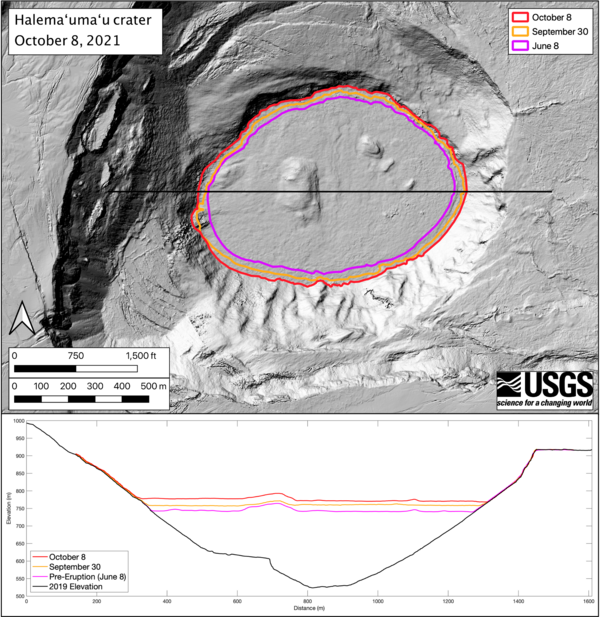
October 8, 2021 — Kīlauea, Halema‘uma‘u Lava Lake GrowthThe eruption within Halema‘uma‘u crater, at Kīlauea's summit, continues to feed a growing lava lake. Photos taken during helicopter overflights of the crater allow HVO scientists to create elevation maps of the rising lake’s surface. The surface area of the Halema‘uma‘u lava lake is now 553000 square meters, or 157 acres.
October 8, 2021 — Kīlauea, Halema‘uma‘u Lava Lake Growth
October 8, 2021 — Kīlauea, Halema‘uma‘u Lava Lake GrowthThe eruption within Halema‘uma‘u crater, at Kīlauea's summit, continues to feed a growing lava lake. Photos taken during helicopter overflights of the crater allow HVO scientists to create elevation maps of the rising lake’s surface. The surface area of the Halema‘uma‘u lava lake is now 553000 square meters, or 157 acres.
October 8, 2021 — Kīlauea, Halema‘uma‘u Lava Lake Growth
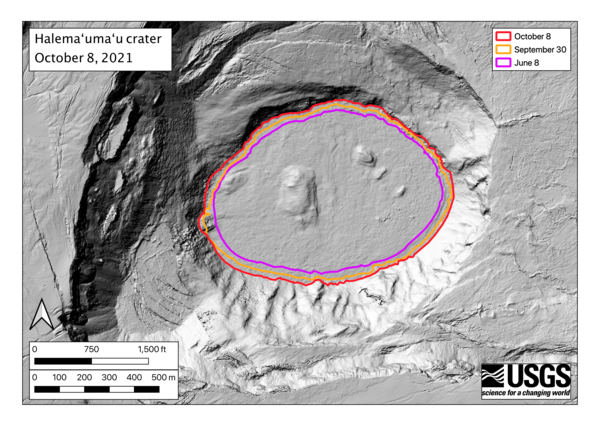
October 8, 2021 — Kīlauea, Halema‘uma‘u Lava Lake GrowthThe surface area of the Halema‘uma‘u lava lake at the summit of Kīlauea is now 553,000 square meters, or 157 acres. At its widest point, the lake is a kilometer wide (0.62 mile).
October 8, 2021 — Kīlauea, Halema‘uma‘u Lava Lake Growth
October 8, 2021 — Kīlauea, Halema‘uma‘u Lava Lake GrowthThe surface area of the Halema‘uma‘u lava lake at the summit of Kīlauea is now 553,000 square meters, or 157 acres. At its widest point, the lake is a kilometer wide (0.62 mile).