U.S. flag

An official website of the United States government

Images

Coastal and Marine Hazards and Resources Program images.

Filter Total Items: 2397
Person on back of boat in the ocean handling equipment
Mapping Nantucket Sound

USGS Marine Operations Manager Chuck Worley conducting fieldwork to study the geologic framework of Nantucket Sound.

USGS Marine Operations Manager Chuck Worley conducting fieldwork to study the geologic framework of Nantucket Sound.

Screenshot shows 5 linked topics on the Coastal Wetland Synthesis Applications geonarrative webpage.
U.S. Coastal Wetland Synthesis Applications Webpage Image

The USGS is assessing the physical condition of coastal wetlands and their response to external forces, using field observations and remote-sensing data. The U.S.

Distinguished Service Award - Carolyn Ruppel
Overview map of the Mississippi River delta

Overview map of the Mississippi River delta showing subaerial birdfoot morphology formed by distributaries.

Map of U.S. Extended Continental Shelf Regions.
Map of U.S. Extended Continental Shelf Regions

The United States has ECS in seven offshore areas: the Arctic, Atlantic (east coast), Bering Sea, Pacific (west coast), Mariana Islands, and two areas in the Gulf of America.  The U.S. ECS area is approximately one million square kilometers – an area about twice the size of California.

The United States has ECS in seven offshore areas: the Arctic, Atlantic (east coast), Bering Sea, Pacific (west coast), Mariana Islands, and two areas in the Gulf of America.  The U.S. ECS area is approximately one million square kilometers – an area about twice the size of California.

A researcher drives a personal watercraft carrying scientific equipment on a calm sunny day with an island in the background
In transit to survey the shallows of Wallops Island, Virginia

Sabrina Levinson, a USGS intern on the Coastal Sediment Availability and Flux Project (St. Petersburg Coastal and Marine Science Center), pilots a survey waverunner to the shallows of Wallops Island, Virginia.

person using equipment in vegetation next to parking lot
Collecting Shoreline and Volumetric Data

From June through December, WHCMSC scientists are collecting shoreline and volumetric data at a beach in Sandwich, Massachusetts following a 2023 U.S. Army Corps of Engineers beach nourishment. The data will be useful for various purposes. Chris Sherwood is interested in comparing how the different measuring techniques work on different types of vegetation.

From June through December, WHCMSC scientists are collecting shoreline and volumetric data at a beach in Sandwich, Massachusetts following a 2023 U.S. Army Corps of Engineers beach nourishment. The data will be useful for various purposes. Chris Sherwood is interested in comparing how the different measuring techniques work on different types of vegetation.

Map of study area showing the Sur Pockmark Field offshore of central California

Location Map showing the Sur Pockmark Field outlined in green, individual pockmarks are shown as small red dots. This study focuses on the largest section of the pockmark field, from the Lucia Chica Channel down to the San Simeon Channel. AUV surveys are outlined in white and the offshore wind commercial leases are outlined in gray.

Location Map showing the Sur Pockmark Field outlined in green, individual pockmarks are shown as small red dots. This study focuses on the largest section of the pockmark field, from the Lucia Chica Channel down to the San Simeon Channel. AUV surveys are outlined in white and the offshore wind commercial leases are outlined in gray.

Diagram showing patterns of erosion and deposition that produce seafloor pockmarks

A diagram illustrating how the patterns of erosion and deposition associated with three sediment gravity flows could produce the stacked pockmarks and lateral migration observed in AUV-collected Chirp profiles. Long, uneventful episodes of hemipelagic drape (a, d, g, j) are intermittently interrupted by sediment gravity flows that either: 1b.

A diagram illustrating how the patterns of erosion and deposition associated with three sediment gravity flows could produce the stacked pockmarks and lateral migration observed in AUV-collected Chirp profiles. Long, uneventful episodes of hemipelagic drape (a, d, g, j) are intermittently interrupted by sediment gravity flows that either: 1b.

Map showing location of Salmon River estuary, Oregon

Map showing location of Salmon River estuary, Oregon. Yellow dots represent estuaries, lagoons, and lakes with evidence of the 1700 tsunami.

View of Salmon River estuary, Oregon, from above

View of Salmon River estuary, Oregon, from above. Sediment cores were collected from marshland toward the upper left of the image.

screen showing map and list of National Wildlife Refuges
Ernest F. Hollings ACE Basin National Wildlife Refuge

Ernest F. Hollings ACE Basin National Wildlife Refuge in South Carolina shown in the pop-out of the U.S. Coastal Wetlands Synthesis Applications geonarrative.   

Close-up imageof sediment core with tidal silt, tsunami sand, and marsh peat collected from the Salmon River estuary, Oregon
Detail of sediment core with tidal silt, tsunami sand, and marsh peat collected from the Salmon River estuary, Oregon.
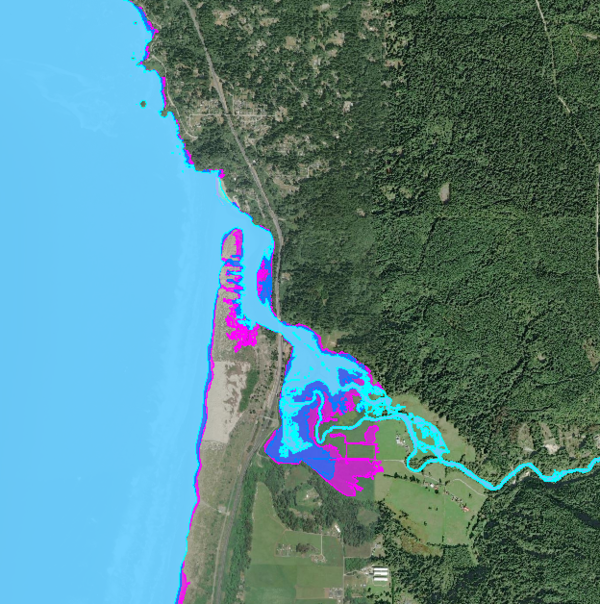
Animated GIF of Cascadia 1700 tsunami simulation at Salmon River, Oregon
Screen showing legend and map
Ernest F. Hollings ACE Basin National Wildlife Refuge

Ernest F. Hollings ACE Basin National Wildlife Refuge in South Carolina shown in the pop-out of the U.S. Coastal Wetlands Synthesis Applications geonarrative. 

Was this page helpful?