San Miguel Site Map, New Mexico Water Science Center
San Miguel Site Map, New Mexico Water Science CenterCanadian escarpment rising above the plains, northeastern San Miguel County, NMWSC


Official websites use .gov
A .gov website belongs to an official government organization in the United States.

Secure .gov websites use HTTPS
A lock () or https:// means you’ve safely connected to the .gov website. Share sensitive information only on official, secure websites.

Images below come from a wide variety of USGS science activities in the Northeast Region. Science Center staff showcase what we do, who we are, and where we work conducting science that inform decision makers and addresses societal needs.

Canadian escarpment rising above the plains, northeastern San Miguel County, NMWSC
Canadian escarpment rising above the plains, northeastern San Miguel County, NMWSC

Sunrise with a recently deployed buoy measuring meteorological data off Fire Island, NY in 2012. The data collected is part of a study of the coastal processes that mobilize and transport sediment in the region
Sunrise with a recently deployed buoy measuring meteorological data off Fire Island, NY in 2012. The data collected is part of a study of the coastal processes that mobilize and transport sediment in the region

Anti-fouling treatment is applied to a sensor on a platform about to be deployed off Fire Island, NY in 2012. The data collected is part of a study of the coastal processes that mobilize and transport sediment in the region
Anti-fouling treatment is applied to a sensor on a platform about to be deployed off Fire Island, NY in 2012. The data collected is part of a study of the coastal processes that mobilize and transport sediment in the region

USGS hydrologist Hannah Ingleston extracting cations from soil samples using an ammonium chloride method.
USGS hydrologist Hannah Ingleston extracting cations from soil samples using an ammonium chloride method.
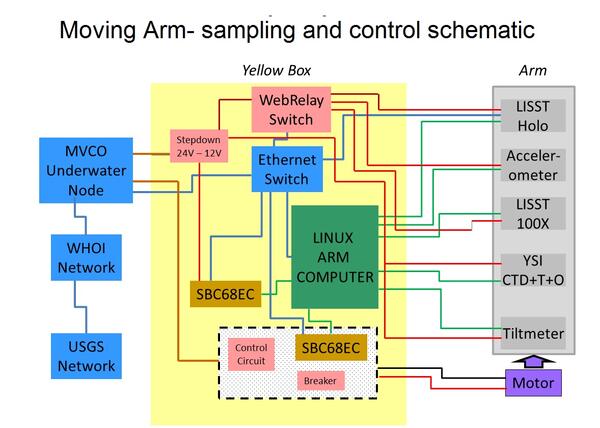
Schematic of system designed to control movement and logging of data collected by the Moving Arm Tripod at Martha's Vineyard Coastal Observatory in 2011.
Schematic of system designed to control movement and logging of data collected by the Moving Arm Tripod at Martha's Vineyard Coastal Observatory in 2011.

Map showing Holocene (modern) sediment thickness in meters overlain on bathymetry. Regional bathymetric contours are in meters. Note the shoreface-attached sand ridges west of Watch Hill.
Map showing Holocene (modern) sediment thickness in meters overlain on bathymetry. Regional bathymetric contours are in meters. Note the shoreface-attached sand ridges west of Watch Hill.

Map showing the thickness of a relatively young Pleistocene outwash lobe in meters mapped using chirp seismic-reflection profiles collected in 2011, overlain on acoustic backscatter imagery. Regional bathymetric contours are in meters.
Map showing the thickness of a relatively young Pleistocene outwash lobe in meters mapped using chirp seismic-reflection profiles collected in 2011, overlain on acoustic backscatter imagery. Regional bathymetric contours are in meters.

Deployment period storm analysis. (A) significant wave height (red line) and wind speed and direction (arrows). Shading represents storm type (blue = cold front, red = warm front, yellow = low-pressure). (B) Vertical profiles of suspended-sediment concentration. (C) Cumulative along-shore and cross-shore sediment flux.
Deployment period storm analysis. (A) significant wave height (red line) and wind speed and direction (arrows). Shading represents storm type (blue = cold front, red = warm front, yellow = low-pressure). (B) Vertical profiles of suspended-sediment concentration. (C) Cumulative along-shore and cross-shore sediment flux.

Example of a rip current experiment. Colors show bathymetry and arrows show velocity vectors after 1 h of model simulation. Similar to results in Kumar and others, 2012.
Example of a rip current experiment. Colors show bathymetry and arrows show velocity vectors after 1 h of model simulation. Similar to results in Kumar and others, 2012.

Map of Fire Island, N.Y. study area

Study area map of coastal South Carolina
Study area map of coastal South Carolina

Oceanographic equipment recovery

The use of carbon dioxide (CO2) injection for enhanced oil recovery (EOR) can prolong the productivity of many oil reservoirs and increase the U.S. hydrocarbon recoverable resource volume.
The use of carbon dioxide (CO2) injection for enhanced oil recovery (EOR) can prolong the productivity of many oil reservoirs and increase the U.S. hydrocarbon recoverable resource volume.

Worldwide distribution of observed and inferred gas hydrates in marine and permafrost-associated settings that have been the subject of drilling programs. The color coding refers to the primary sediment type in each location and therefore designates the likely type of gas hydrate reservoir at each site.
Worldwide distribution of observed and inferred gas hydrates in marine and permafrost-associated settings that have been the subject of drilling programs. The color coding refers to the primary sediment type in each location and therefore designates the likely type of gas hydrate reservoir at each site.

Bathymetry of the New England inner shelf and south shore of Martha’s Vineyard with model grids
Bathymetry of the New England inner shelf and south shore of Martha’s Vineyard with model grids

Map C. Backscatter intensity and sun-illuminated topography. Blue= "soft" seabed, Green, orange = "hard" seabed
Map C. Backscatter intensity and sun-illuminated topography. Blue= "soft" seabed, Green, orange = "hard" seabed

Stellwagen Bank project research areas in the United States and Canada
Stellwagen Bank project research areas in the United States and Canada


Numerical model grids showing downscaling from larger regional grid (far right) to more refined coastal grid (left). Colors are bathymetry (m).
Numerical model grids showing downscaling from larger regional grid (far right) to more refined coastal grid (left). Colors are bathymetry (m).

Cape Hatteras, N.C.

Map of Long Bay, S.C. study area