One of the houses destroyed during the 6.4 earthquake in Puerto Rico
One of the houses destroyed during the 6.4 earthquake in Puerto RicoOne of the houses destroyed during the 6.4 earthquake in Puerto Rico.
An official website of the United States government
Here's how you know
Official websites use .gov
A .gov website belongs to an official government organization in the United States.
Secure .gov websites use HTTPS
A lock () or https:// means you’ve safely connected to the .gov website. Share sensitive information only on official, secure websites.
Images from the Southeast Region.
One of the houses destroyed during the 6.4 earthquake in Puerto Rico.
Congressional event following the 6.4 earthquake in Puerto Rico held on Jan. 20, 2020. Dr. Jonathan Godt (USGS) and Dr. Elizabeth A. Vanacore (Red Sismica Puerto Rico) answered questions to congressmen: Yauco's major, Bill Posey, Jenniffer González Colón, Stephanie Murphy, Donna Shalala
Part of the USGS Earthquake Response Team visiting areas affected by the 6.4 earthquake. Place: Guánica Boardwalk. From left to right: Donyelle Davis, Dianne López, Jonathan Godt, Alex Grant
USGS team with Wanda Vazquez-Garced, governor of Puerto Rico. From left to right: Lindsay Davis, Wanda Vazquez, Dianne Lopez-Trujillo, Jonathan Godt, Donyelle Davis, Alex Grant
This historic brick Studebaker Building, originally built in 1925, was chosen as the location for the USGS St. Petersburg Coastal and Marine Science Center in the late 1980s.
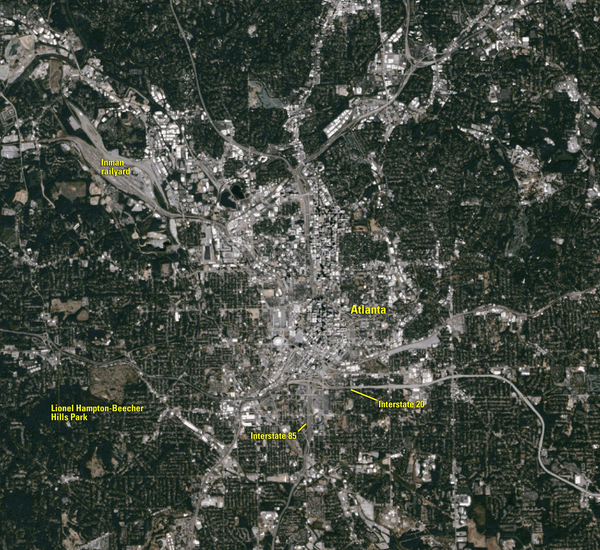
Animation comparing a natural color Landsat 8 satellite image of Atlanta, GA with satellite-based surface temperatures. Buildings and impervious surfaces trap heat, leading to higher temperatures in urban areas - a phenomenon generally referred to as the Urban Heat Island effect.
The Georgia chapter of the Minerals Yearbook Volume II - Area Reports, Domestic - contains data and information on the nonfuel mineral commodities produced in Georgia including a generalized map of principal mineral commodity producing areas. The map is included in the PDF version; both PDF and XLS versions of text and data are available.
A commercially caught wild black carp from the Mississippi River. Credit: USGS.
Stream gaging in Puerto Rico after Tropical Storm Karen: computing gage height – Manual Rosario does some math required to compute the gage height September 25.
Stream gaging in Puerto Rico after Tropical Storm Karen: finishing the visit – Manuel Rosario, with the Caribbean-Florida Water Science Center, walks to the gage house after completing a discharge measurement September 25.
Stream gaging in Puerto Rico after Tropical Storm Karen: Gage house – Manuel Rosario, with the Caribbean-Florida Water Science Center, checks the sensors in the gage house September 25.
Stream gaging in Puerto Rico after Tropical Storm Karen: recording gage height – A ding-wop, a weight attached to measuring devices, was used to measure the gage height, September 25.
Stream gaging in Puerto Rico after Tropical Storm Karen: tethered ADCP – A tethered acoustic Doppler current profiler (ADCP) is pulled through a cross section of Rio de La Plata near Toa Alta, Puerto Rico, September 25, 2019.
Stream gaging in Puerto Rico after Tropical Storm Karen: downstream control – The pool pictured is almost twice it’s normal size and depth after Tropical Storm Karen passed the island, September 25.
Stream gaging in Puerto Rico after Tropical Storm Karen: Crest Stage Gage – The distance of a cork line from a known gage height is measured September 25. The cork line was left on a crest stage gage after a high flow event.
Stream gaging in Puerto Rico after Tropical Storm Karen: computer – Gage height and precipitation data recorded by sensors and measured manually are logged into an electronic notebook, September 25.
Stream gaging in Puerto Rico after Tropical Storm Karen: staging the measurement – Manuel Rosario, with the Caribbean-Florida Water Science Center, stages an acoustic Doppler current profiler (ADCP) to measure high flow September 25.
Jim Smith working on cabling inside of Lucchetti dam in Puerto Rico, assisting the Puerto Rico Strong Motion Program with Hurricane Maria recovery efforts.
Sean Egen, hydrologic technician, installs a storm tide sensor
at River Dunes Marina in Pamlico County, NC
Sean Egen, hydrologic technician, installs a storm tide sensor
at River Dunes Marina in Pamlico County, NC
A storm-tide sensor deployed on Florida's Indian River Lagoon, at Indian River Drive in St. Lucie County, on Aug. 30, 2019 in preparation for Hurricane Dorian. NOTE: Though the story is about the Carolinas, the photo is from Florida. No photos of the Carolinas deployment were available at the time this story was published.