



Lukas Medo, a USGS hydrologic technician, installs a water-level sensor in Levy County, Florida, September 26, ahead of Hurricane Ian's landfall. Photo by Patrick Marasco, USGS.
Images
Images from the Southeast Region.
Filter Total Items: 402

Installing Storm-tide Sensors for Hurricane Ian
Lukas Medo, a USGS hydrologic technician, installs a water-level sensor in Levy County, Florida, September 26, ahead of Hurricane Ian's landfall. Photo by Patrick Marasco, USGS.

Tres científicos del USGS que instalan equipos submarinos
Tres científicos del USGS que instalan equipos submarinosTres científicos del Servicio Geológico de los Estados Unidos en equipo de buceo instalando una boya de olas y un sensor de presión a 60 pies de profundad para medir las olas y niveles de agua en Isla Verde, Puerto Rico.

USGS scientists installing underwater equipment
Three U.S. Geological Survey scientists in scuba gear work to install a wave buoy and pressure sensor 60 feet underwater to measure waves and water levels in Isla Verde, Puerto Rico.
Three U.S. Geological Survey scientists in scuba gear work to install a wave buoy and pressure sensor 60 feet underwater to measure waves and water levels in Isla Verde, Puerto Rico.

USGS scientists set-up equipment on beach
Two U.S. Geological Survey scientists set-up equipment to survey a beach in Dorado, Puerto Rico. This equipment will monitor how the beach and shoreline change through time. USGS Image.
Two U.S. Geological Survey scientists set-up equipment to survey a beach in Dorado, Puerto Rico. This equipment will monitor how the beach and shoreline change through time. USGS Image.
Dos científicos del Servicio Geológico de los Estados Unidos instalando un equipo para sondeos de una costa
Dos científicos del Servicio Geológico de los Estados Unidos instalando un equipo para sondeos de una costaDos científicos del Servicio Geológico de los Estados Unidos instalando un equipo para sondeos de una costa en Dorado, Puerto Rico. Este equipo monitoreará como la playa y la línea costera cambian a través del tiempo. Imagen de USGS.

Collection Of Sediment And Water Sampling Prior To The Possible Occurrence Of Oil Contamination From The Deepwater Horizon Oil Well At Egmont Key, Florida
Collection Of Sediment And Water Sampling Prior To The Possible Occurrence Of Oil Contamination From The Deepwater Horizon Oil Well At Egmont Key, FloridaBruce Bernard (left) and Scott McBride (right) obtain water and sediment samples at Egmont Key which is about 1 mile west of the mouth of Tampa Bay in the Gulf of America. Samples were collected June 14, 2010 prior to the possible occurrence of oil contamination from the Deepwater Horizon's oil well.
Collection Of Sediment And Water Sampling Prior To The Possible Occurrence Of Oil Contamination From The Deepwater Horizon Oil Well At Egmont Key, Florida
Collection Of Sediment And Water Sampling Prior To The Possible Occurrence Of Oil Contamination From The Deepwater Horizon Oil Well At Egmont Key, FloridaCollection Of Sediment And Water Sampling Prior To The Possible Occurrence Of Oil Contamination From The Deepwater Horizon Oil Well At Egmont Key, Florida
Collection Of Sediment And Water Sampling Prior To The Possible Occurrence Of Oil Contamination From The Deepwater Horizon Oil Well At Egmont Key, FloridaBruce Bernard (left) and Scott McBride (right) obtain water and sediment samples at Egmont Key which is about 1 mile west of the mouth of Tampa Bay in the Gulf of America. Samples were collected June 14, 2010 prior to the possible occurrence of oil contamination from the Deepwater Horizon's oil well.
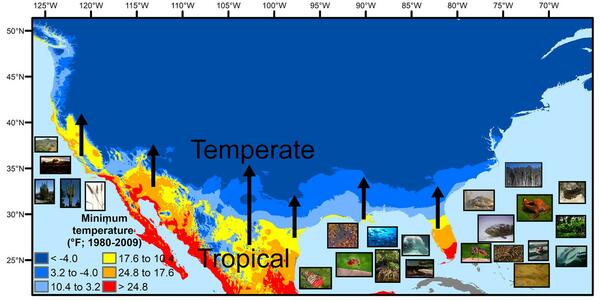
U.S. regions in the tropical-to-temperate transition
U.S. regions in the tropical-to-temperate transitionA map showing North America's tropical-to-temperate transition zone. Red, orange, and yellow depict the more tropical zones, and blues depict the more temperate zones, based on to the coldest recorded temperature for each area between 1980 and 2009.
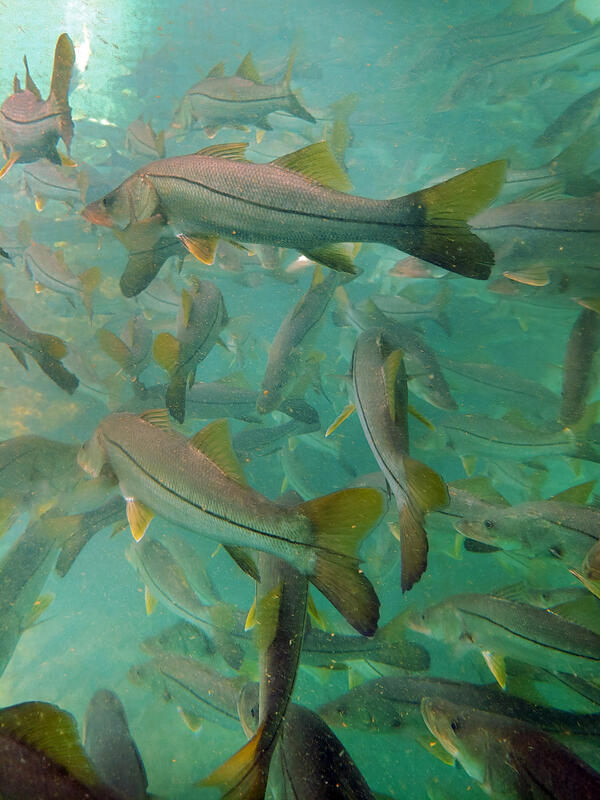
Subtropical snook gather at a warm Florida springhead in winter
Subtropical snook gather at a warm Florida springhead in winterWinter temperature extremes control the distributions of subtropical fishes. Common snook (Centropomus undecimalis), aggregate at a spring in northern Florida during winter. Snook are warm saltwater game fish, common in Florida, that have been moving further northward as extreme cold spells become less frequent and less intense.

Winter landscape at Lake Placid
Photo Contest Winner | January 2021 | USGS at Work
Winter Wonderland in Lake Placid, NY
Photo Contest Winner | January 2021 | USGS at Work
Winter Wonderland in Lake Placid, NY

Ellis River New Hampshire
Photo Contest Winner | January 2021 | Where We Work
Ellis River, New Hampshire
Photo Contest Winner | January 2021 | Where We Work
Ellis River, New Hampshire

Earth MRI Funds Critical Minerals Projects in Texas
Earth MRI Funds Critical Minerals Projects in TexasUSGS map of Earth MRI projects in Texas' Trans-Pecos region announced in September 2020.
Earth MRI Funds Critical Minerals Projects in Texas
Earth MRI Funds Critical Minerals Projects in TexasUSGS map of Earth MRI projects in Texas' Trans-Pecos region announced in September 2020.

Wild Black Carp
A black carp collected by USGS scientists from the Mississippi River. Credit: USGS.
A black carp collected by USGS scientists from the Mississippi River. Credit: USGS.

USGS Scientists Work on Four Tropical Cyclones at Once
USGS Scientists Work on Four Tropical Cyclones at OnceIn this NOAA satellite image from Sept. 15, 2020, Hurricane Sally approaches the U.S. Gulf Coast, Hurricane Paulettte creates storm waves far out in the Atlantic, and Tropical Storms Teddy and Vicky lie near the coast of Africa. Two tropical depressions are also developing; one of them is not visible in this image.
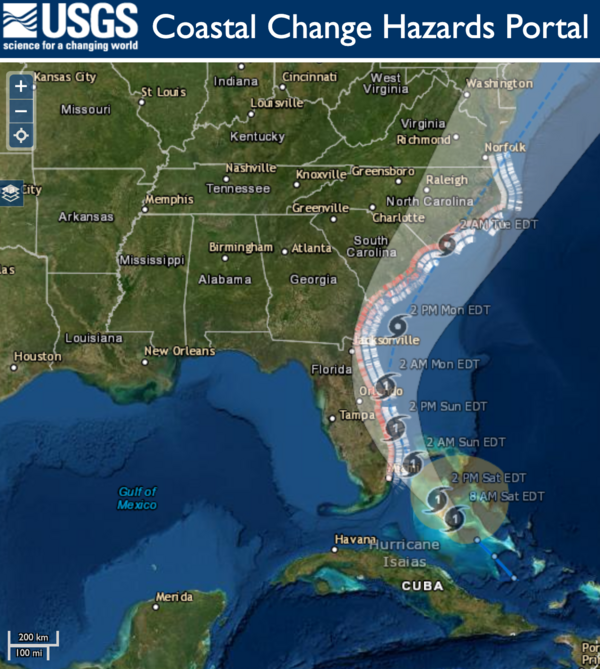
Hurricane Isaias Unlikely to Cause Widespread Atlantic Beach Erosion
Hurricane Isaias Unlikely to Cause Widespread Atlantic Beach ErosionUSGS coastal change experts predict that storm waves kicked up by the Category 1 hurricane are likely to cause some erosion at the base of the dunes along about 11 percent of coastal beaches between Florida and Virginia.

Dragonfly Mercury Project specimen collection in Glacier NP
Dragonfly Mercury Project specimen collection in Glacier NPResearchers instruct volunteers on how to collect dragonfly larvae in Glacier NP as a part of the Dragonfly Mercury Project.
Dragonfly Mercury Project specimen collection in Glacier NP
Dragonfly Mercury Project specimen collection in Glacier NPResearchers instruct volunteers on how to collect dragonfly larvae in Glacier NP as a part of the Dragonfly Mercury Project.

Finding Seafloor Faults Linked to Puerto Rico Earthquake
Finding Seafloor Faults Linked to Puerto Rico EarthquakeMap of the portion of the southwest coast of Puerto Rico affected by an earthquake sequence that began in December 2019, along with portions of the seafloor where faults involved in the earthquake sequence were suspected to exist.

Scientists find signs of undersea faults off SW Puerto Rico
Scientists find signs of undersea faults off SW Puerto RicoLocations of multichannel seismic reflection profiles (in black), collected during cruise FA2020-14. The profiles are overlain on colored and shaded multibeam bathymetry, Lidar topography (green and white) and near-shore bathymetry (darker blue), and NOAA coastal relief model (light blue and white).

A helicopter flight reveals landslides' damage in Utuado municipality
A helicopter flight reveals landslides' damage in Utuado municipalityAn aerial view of landslide damage after Hurricane Maria in Utuado municipality, Puerto Rico.
A helicopter flight reveals landslides' damage in Utuado municipality
A helicopter flight reveals landslides' damage in Utuado municipalityAn aerial view of landslide damage after Hurricane Maria in Utuado municipality, Puerto Rico.

On a hillside in Las Marias, USGS scientists examine landslide effects
On a hillside in Las Marias, USGS scientists examine landslide effectsUSGS ground failure experts examine landslides after Hurricane Maria in the municipality of Las Marias, Puerto Rico.
On a hillside in Las Marias, USGS scientists examine landslide effects
On a hillside in Las Marias, USGS scientists examine landslide effectsUSGS ground failure experts examine landslides after Hurricane Maria in the municipality of Las Marias, Puerto Rico.

Scientist launches instrument used to map seafloor off Puerto Rico
Scientist launches instrument used to map seafloor off Puerto RicoUSGS marine technician Wayne Baldwin prepares to deploy the hydrophone array during a seismic research cruise off the southwest coast of Puerto Rico on board the R/V Sultana in March 2020.

USGS marine technicians launch a hydrophone off Puerto Rico seafloor
USGS marine technicians launch a hydrophone off Puerto Rico seafloorUSGS marine technicians Alex Nichols (L) and Eric Moore (R) deploy the hydrophone array on a seismic research cruise off the southwest coast of Puerto Rico aboard the R/V Sultana in March 2020.