U.S. flag

An official website of the United States government

Yellowstone

Find U.S. Volcano
Current Updates and Notifications
Yellowstone
green NORMAL, 2026-06-01 16:55:15 UTC

The Yellowstone Plateau volcanic field developed through three volcanic cycles that span two-million years. Two of the eruptions are considered some of the world's largest volcanic events. Yellowstone's youngest eruptions have been lava flows that remain confined to the caldera of present-day Yellowstone National Park. The 77,000 year-old Pitchstone Plateau flow is the volcano's most recent lava.

Quick Facts

Location: Wyoming and Montana

Latitude: 44.615° N

Longitude: 110.6° W

Elevation: 2,805 m / 9,203 f

Volcano type: Caldera

Composition: basalt to rhyolite

Most recent eruption: 70,000 years ago (lava), current hydrothermal explosions

Threat Potential: High*

*based on the National Volcano Early Warning System

Summary

The >2450 km3 (588 mi3) Huckleberry Ridge Tuff erupted about 2.1 million years ago, creating an approximately 75 km (47 mi) wide caldera and thick volcanic deposits. A second eruption cycle concluded with the much smaller Mesa Falls Tuff around 1.3 million years ago. Activity subsequently shifted to the present Yellowstone Plateau and culminated 640,000 years ago with the eruption of the >10003km (240 mi3) Lava Creek Tuff and consequent formation of the 45 x 85 km (28 x 53 mi) caldera. Large volumes of rhyolitic lava flows (approximately 600 km3 (144 mi3) were erupted in the caldera between 180,000 and 70,000 years ago, distributed primarily along two north-south alignments of vents.

No magmatic eruptions have occurred since then, but large hydrothermal explosions have taken place during the Holocene, including from within and near Yellowstone Lake. Uplift and subsidence of the ground surface is centered on two uplifted regions (the Mallard Lake and Sour Creek resurgent domes). Large earthquakes occur just off the plateau along the nearby Teton and Hebgen Lake faults, the latter of which ruptured in 1959 (Ms = 7.5), causing considerable damage to the region. Yellowstone is presently the site of one of the world's largest hydrothermal systems including Earth's largest concentration of geysers.

News

Oops, it did it again: Another small hydrothermal explosion at Biscuit Basin

Oops, it did it again: Another small hydrothermal explosion at Biscuit Basin

The fascinating history of Imperial Geyser

The fascinating history of Imperial Geyser

Young mountains, old rocks: A geological overview of the Teton range

Young mountains, old rocks: A geological overview of the Teton range

Publications

2018 update to the U.S. Geological Survey national volcanic threat assessment 2018 update to the U.S. Geological Survey national volcanic threat assessment

When erupting, all volcanoes pose a degree of risk to people and infrastructure, however, the risks are not equivalent from one volcano to another because of differences in eruptive style and geographic location. Assessing the relative threats posed by U.S. volcanoes identifies which volcanoes warrant the greatest risk-mitigation efforts by the U.S. Geological Survey and its partners...
Authors
John W. Ewert, Angela K. Diefenbach, David W. Ramsey

Science

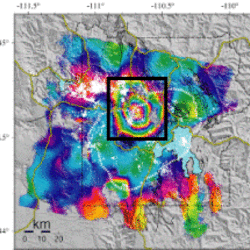
Uplift along the north rim of Yellowstone Caldera
An area on the north rim of Yellowstone caldera, to the south of Norris Geyser Basin, started to uplift slightly in July 2025. Similar deformation occurred in the same area during 1996-2004 and reveals characteristics of the subsurface.
Uplift along the north rim of Yellowstone Caldera

Uplift along the north rim of Yellowstone Caldera

An area on the north rim of Yellowstone caldera, to the south of Norris Geyser Basin, started to uplift slightly in July 2025. Similar deformation occurred in the same area during 1996-2004 and reveals characteristics of the subsurface.
Learn More
Eyes on Earth Episode 137 – Landsat Takes Yellowstone’s Temperature

Eyes on Earth Episode 137 – Landsat Takes Yellowstone’s Temperature
How do you keep track of thousands of hot spots in an area the size of Yellowstone National Park? Check out thermal satellite data like Landsat’s!
Learn More

Questions About Monitoring Yellowstone

Answers to questions about monitoring at Yellowstone.
Questions About Monitoring Yellowstone

Questions About Monitoring Yellowstone

Answers to questions about monitoring at Yellowstone.
Learn More

Multimedia

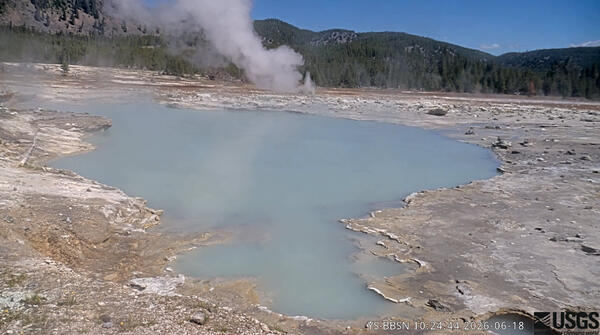
blue pool in a barren area with a treed ridge in the background under blue sky and a small steam vent in the middle ground blue pool in a barren area with a treed ridge in the background under blue sky and a small steam vent in the middle ground
Water spouting on June 18, 2026, from a new thermal pool that formed shortly after a small hydrothermal explosion at Biscuit Basin, Yellowstone National Park, on June 13, 2026
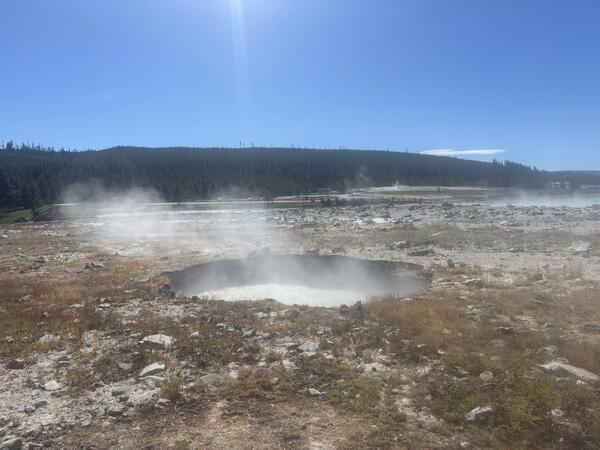
Circular pool of boiling water in a barren area strewn with rocks with a forested ridge in the distance under blue sky.
Pool of boiling water that formed via collapse a few days after the June 13, 2026, hydrothermal explosion at Biscuit Basin, Yellowstone National Park
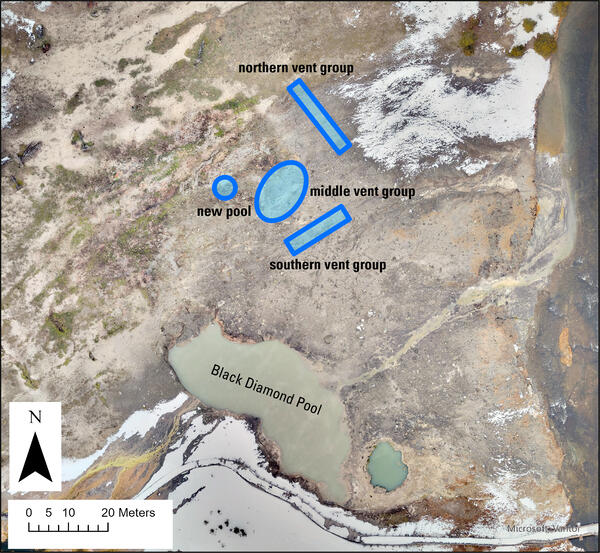
Aerial view with a muddy pool at the bottom and barren ground in the middle with blue polygons showing new vent locations
Locations of new features associated with June 13, 2026, small hydrothermal explosion at Biscuit Basin, Yellowstone National Park
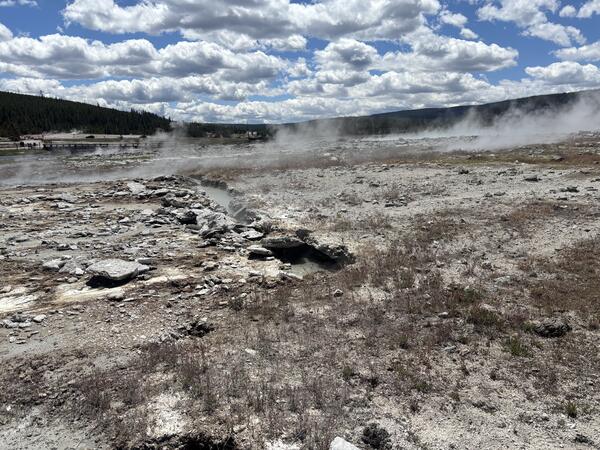
Barren, steaming ground with a water-filled crack trending away from the photographer
Northern-most water-filled fracture that formed on June 13, 2026, near Black Diamond Pool, Biscuit Basin, Yellowstone National Park
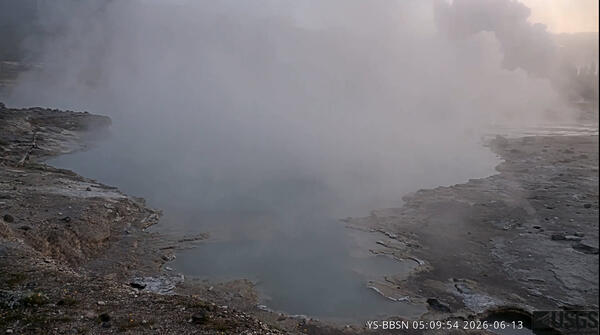
steaming blue pool in low-light dawn conditions with an explosive steam plume in the background steaming blue pool in low-light dawn conditions with an explosive steam plume in the background
Video of small hydrothermal explosion at Biscuit Basin on June 13, 2026
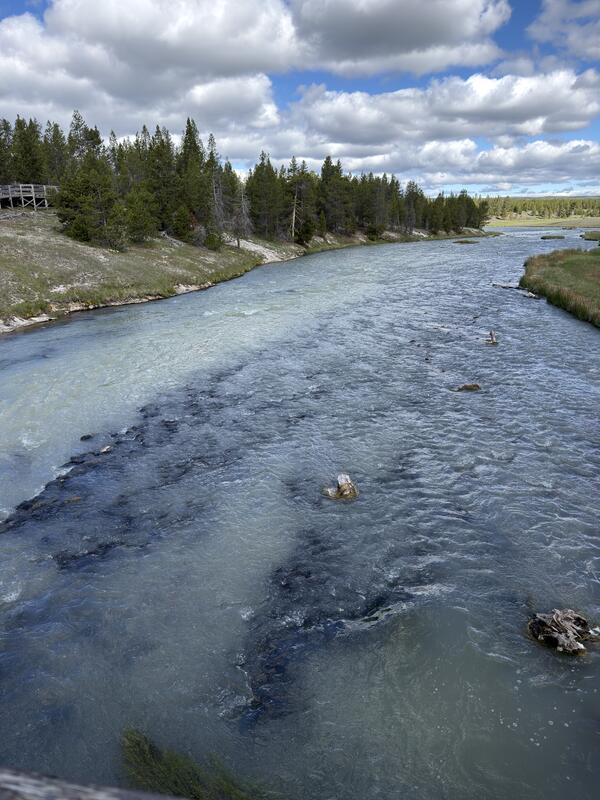
River with milky blue-green color mixing with normal dark blue, and some trees along the grassy banks under partly cloudy sky
Firehole River from Midway Geyser bridge on the morning of June 13, 2026
steaming blue pool in low-light dawn conditions with an explosive steam plume in the background
Screen capture showing onset of a small hydrothermal explosion at Biscuit Basin, Yellowstone National Park, on June 13, 2026
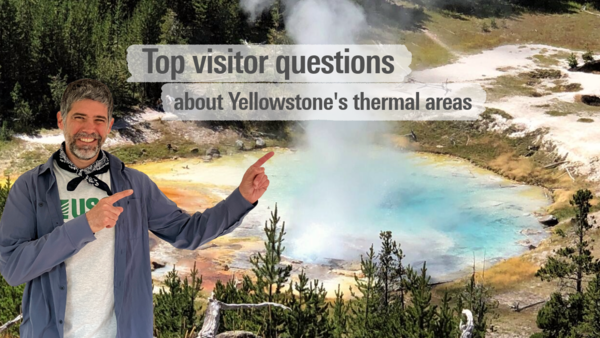
Smiling man in blue shirt pointing at rainbow-colored hot spring with text "Top Visitor Questions" Smiling man in blue shirt pointing at rainbow-colored hot spring with text "Top Visitor Questions"
Top visitor questions about Yellowstone's thermal areas (Yellowstone Monthly Update - June 2026)
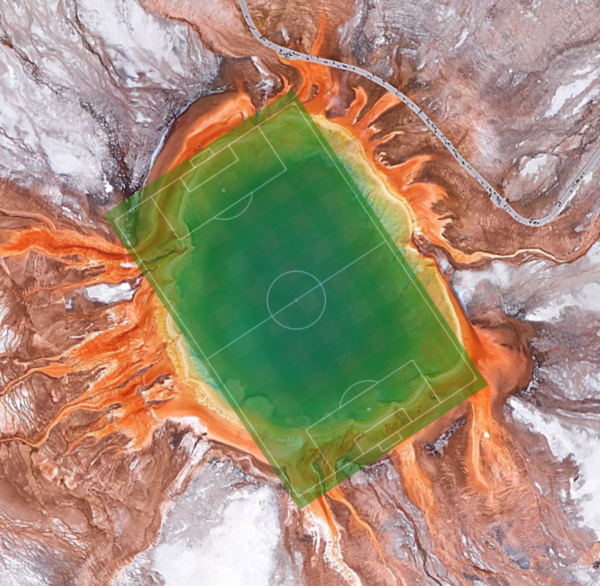
Aerial view of colorful Grand Prismatic Spring with a soccer field overlain and covering the spring's area almost exactly
Soccer field overlain on Grand Prismatic Spring
Was this page helpful?