



How much water was used in New England in 2015?
New England water use in 2015.
The USGS 2015 water-use compilation estimated that total water withdrawals in New England were 6,413 million gallons of water per day (Mgal/day).
- Surface water withdrawals totaled 5,671 Mgal/d (88 % of total)
- Groundwater withdrawals totaled 742 Mgal/d (12 % of total)
- Freshwater withdrawals were 2,375 Mgal/d (37 % of total)
- Saline water withdrawals were 4,038 Mgal/d (63 % of total)
Water Withdrawals by State
Estimates by State and percentages of total New England water withdrawals:
- Connecticut - 3,128 Mgal/day (49%)
- Massachusetts - 1,406 Mgal/day (22%)
- New Hampshire - 935 Mgal/day (15%)
- Maine - 509 Mgal/day (8%)
- Rhode Island - 344 Mgal/day (5%)
- Vermont - 91 Mgal/day (1%)
Water Withdrawals by Water Use Category
Estimates by category and percentages of total New England water withdrawals:
- Thermoelectric Power - 4,209 Mgal/day (65.6%)
- Public Supply - 1,209 Mgal/day (18.9%)
- Self-Supplied Industrial - 501 Mgal/day (7.8%)
- Irrigation - 181 Mgal/day (2.8%)
- Self-Supplied Domestic - 145 Mgal/day (2.3%)
- Aquaculture - 123 Mgal/day (1.9%)
- Mining - 34 Mgal/day (0.5%)
- Livestock - 11 Mgal/day (0.2%)
Population on Public vs Self-Supplied Water
Eighty percent of the New England population relies on publicly supplied water and 20% uses self-supplied water.
Media
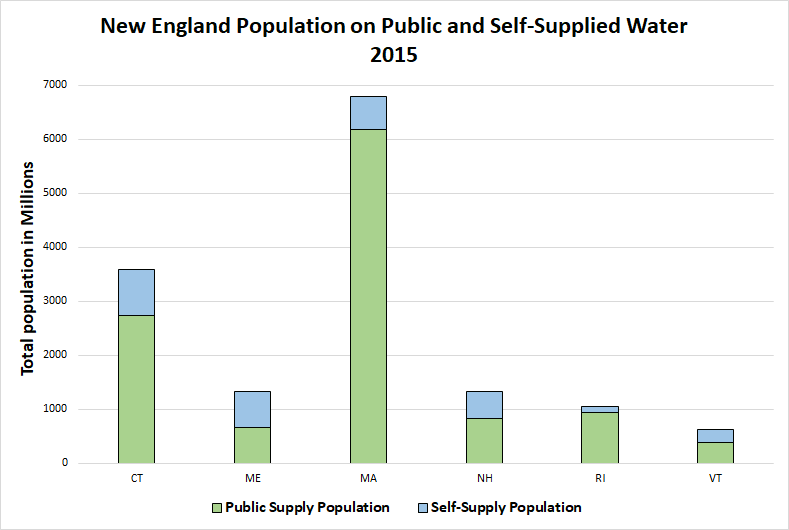
Sources/Usage: Public Domain. View Media Details
Related

New England Water Use
Water use research in the New England Water Science Center serves both regional and national interests. USGS works with our New England partners in all six states to address questions about water demand, availability, and sustainability. Additionally, the New England Water Science Center contributes to national water use research and ensures that New England is well and accurately represented in...
Related
New England Water Use
Water use research in the New England Water Science Center serves both regional and national interests. USGS works with our New England partners in all six states to address questions about water demand, availability, and sustainability. Additionally, the New England Water Science Center contributes to national water use research and ensures that New England is well and accurately represented in...